Stepping into a local garden center or nursery, you will find aisles stacked high with bright bags of commercial potting soil. For many gardeners, buying a few bags seems like the easiest route. However, experienced horticulturists across regions as diverse as Texas, New York, California, Washington, and San Francisco quickly discover that commercial mixes can be inconsistent, expensive, overly compacted, or lacking in true biological vitality.
When you blend your own custom potting soil at home, you take complete control over your plants’ environment. You decide the exact drainage, moisture retention, and nutrient density tailored to everything from delicate herb seedlings to heavy-feeding patio tomatoes.
For growers cultivating high-yielding containers on kcplants.com, this comprehensive, expert-level guide explores the essential components of elite potting soil, the science of container aeration and water retention, regional considerations, and a step-by-step masterclass on how to craft the ultimate organic soil mix.
1. The Golden Rule of Container Growing: Why Garden Soil Fails
Before exploring ingredients, we must establish a foundational horticultural truth: never put native backyard garden soil into a container.
The Compaction Crisis
Native garden soil relies on earthworms, freeze-thaw cycles, and deep subsoil networks to maintain structure. When you scoop native dirt (which is heavy with dense clay or fine silt) into a confined pot or container, gravity and watering compress those fine particles into a solid, concrete-like brick. Water can no longer drain, air pockets disappear, and plant roots suffocate.
The Potting Soil Difference
Container gardening requires an entirely different physical medium—one that is lightweight, highly porous, drains rapidly, yet holds just enough moisture and nutrition to sustain plant life. Achieving this balance requires blending three distinct functional categories of organic materials: aeration agents, moisture retainers, and nutrient bases.
2. The Best Natural Organic Ingredients for Homemade Potting Mixes
An elite organic potting soil is built by combining specific raw ingredients. Here are the finest natural materials to use:
A. The Nutrient & Biological Foundation
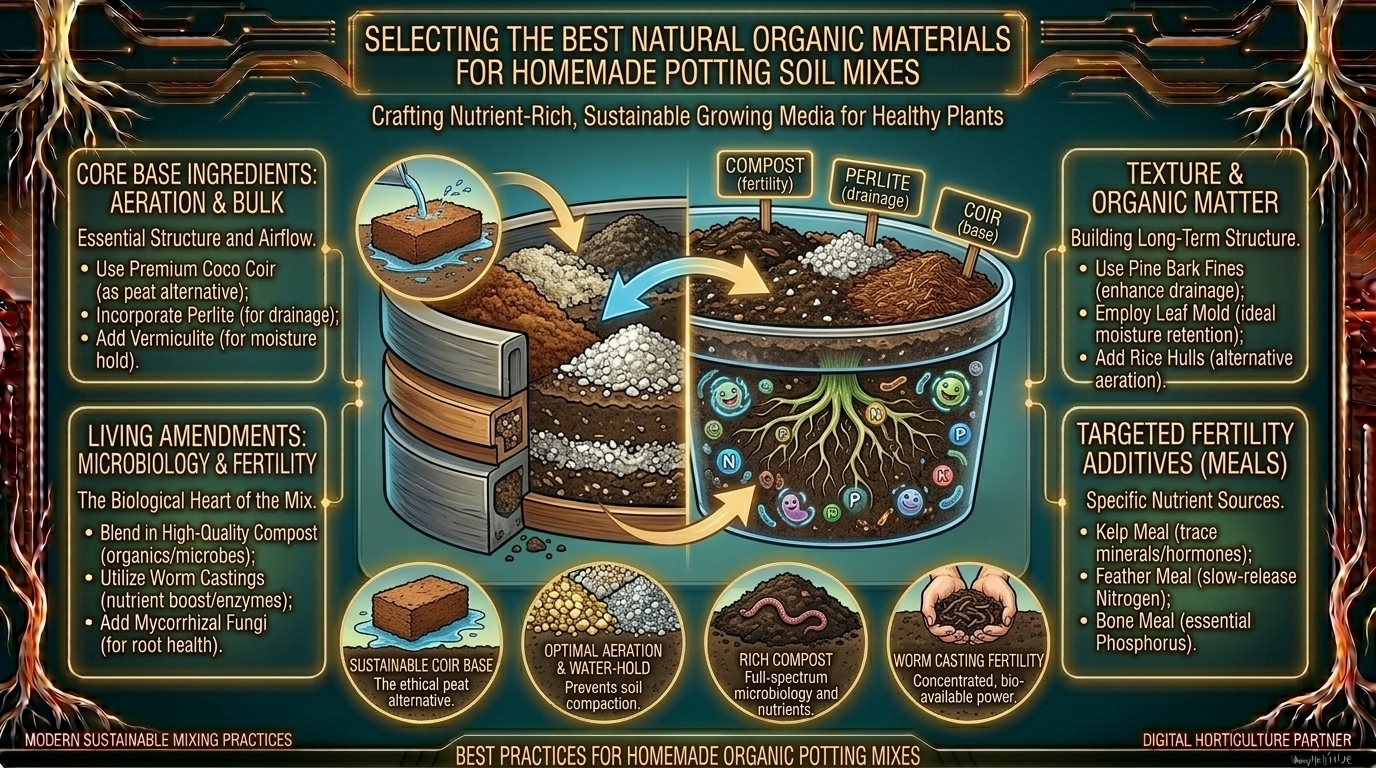
- Finished Organic Compost: The undisputed heart of any potting mix. Well-aged, screened compost delivers a massive microbial population, essential trace minerals, and a slow-release stream of nutrients. (Always ensure compost is thoroughly finished and sifted to remove coarse twigs).
- Worm Castings (Vermicompost): Often called “black magic,” worm castings are nature’s ultimate organic fertilizer. They are packed with beneficial bacteria, water-soluble plant nutrients, and humic acids that stimulate explosive root growth without burning tender seedlings.
- Aged Leaf Mold: Decomposed deciduous leaves create a spongy, rich, earthy amendment that boosts microbial diversity and holds moisture delicately without compacting.
B. The Moisture Retainers & Buffers
- Coconut Coir (Coir Dust): Milled from the fibrous husks of coconuts, coir is the gold-standard organic alternative to peat moss. It holds up to 8 to 10 times its weight in water while maintaining incredible porosity, and unlike peat, it has a neutral pH and is completely renewable.
- Sphagnum Peat Moss: A classic lightweight, acidic organic material that retains water brilliantly. While effective, it is harvested from slow-growing bogs, prompting many modern ecological gardeners to choose renewable coconut coir instead.
C. The Aeration & Drainage Agents
- Perlite: While a mined volcanic mineral rather than a carbon-based organic material, expanded white perlite is essential. It creates microscopic air tunnels throughout the mix, ensuring roots receive vital oxygen.
- Rice Hulls: An exceptional, sustainable agricultural byproduct. Organic parboiled rice hulls add lightweight drainage and aeration to potting mixes while slowly breaking down to release beneficial silica over time.
- Biochar: Pure, pyrolyzed carbon with a microscopic honeycomb structure. Biochar acts as a permanent sponge for water and nutrients, harboring beneficial mycorrhizal fungi inside containers.
3. Regional Adaptations Across the U.S.
Your local climate dictates how quickly your containers dry out and how you should formulate your potting mix ratios:
Texas & Inland California
- Climate Challenge: Scorching summer heat, intense sun, and rapid evaporation.
- Adaptation: Increase your moisture-retentive ingredients slightly—incorporate more coconut coir, compost, and vermicompost, and consider mixing in a handful of biochar to lock water into containers during blistering summer months.
New York & Washington
- Climate Challenge: High humidity, frequent spring rains, and cooler ambient temperatures.
- Adaptation: Prioritize maximum drainage to prevent container waterlogging and root rot during wet spells. Increase the ratios of perlite or rice hulls while keeping compost percentages balanced.
San Francisco & Coastal California
- Climate Challenge: Mild, foggy summers and cool microclimates.
- Adaptation: Coastal containers do not dry out as fast as inland pots. Formulate a balanced, highly breathable mix that prevents stagnant moisture from inviting fungal gnats or root diseases during damp foggy mornings.