What Are the Best Tall Statement Houseplants to Fill an Empty Corner in Your Living Room?
Every interior designer knows the golden rule of styling a room: empty corners are wasted opportunities. Whether you are curating a sunlit open-plan loft in San Francisco, an industrial high-rise apartment in New York, a spacious suburban home in Texas, or vibrant living spaces across California and Washington, an awkward, vacant room corner can make an entire space feel unfinished, cold, and echoing.
While you could fill that void with bulky furniture or expensive lamps, nothing breathes instant life, architectural elegance, and organic warmth into a room quite like a tall statement houseplant. Towering indoor trees and vertical botanical specimens serve as living sculptures, drawing the eye upward, softening harsh architectural angles, and transforming a sterile corner into a lush, organic sanctuary.
Brought to you by kcplants.com, this comprehensive, expert-led masterclass explores the absolute best tall statement houseplants for filling empty living room corners, detailing their light requirements, care routines, and styling secrets.
Part I: The Interior Design Power of Tall Houseplants
Before selecting a species, it helps to understand why vertical statement plants are transformative design tools:
- Creating Visual Height: Tall plants anchor furniture arrangements, making low ceilings feel loftier and vast open-concept spaces feel cozy and grounded.
- Acoustic Softening: Large leaves and dense woody stems help absorb ambient sound, dampening echoes in modern hardwood-floored living rooms.
- The Biophilic Connection: Bringing a mature 6-to-8-foot tree indoors bridges the gap between indoor architecture and outdoor nature, boosting psychological well-being and indoor air quality.
Part II: The Best Tall Statement Houseplants for Living Room Corners
Here are the finest, most architecturally striking tall houseplants that thrive indoors when placed in living room corners.
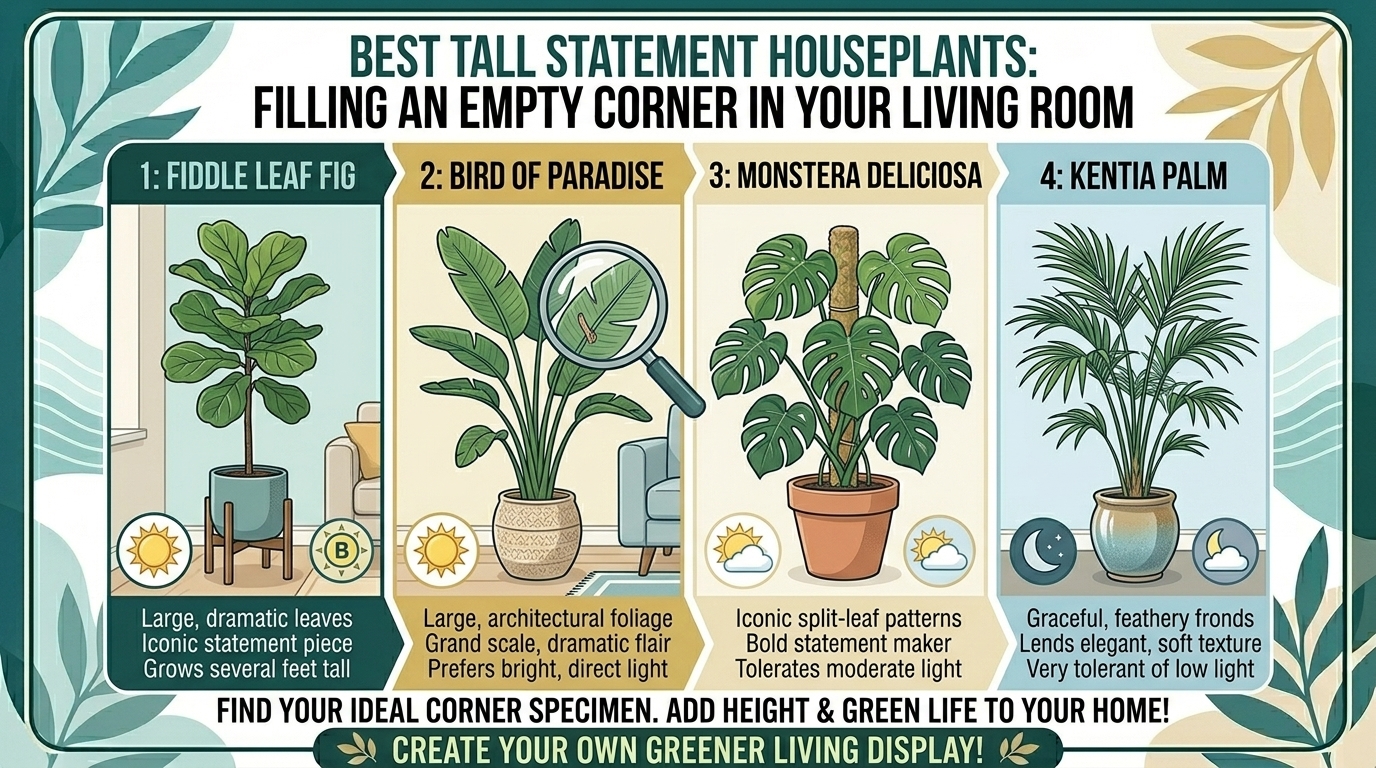
1. The Fiddle Leaf Fig (Ficus lyrata)
- Architectural Appeal: Famed for its massive, glossy, violin-shaped leaves arranged in a tight, upright spiral along a sturdy woody trunk, the Fiddle Leaf Fig is the undisputed king of modern plant styling.
- Height Potential: Reaches 6 to 10 feet indoors with proper pruning.
- Care & Placement: Thrives directly in front of a bright east-facing window or a filtered south-facing window. They despise being moved, hate cold drafts, and require a consistent soak-and-dry watering routine.
2. The Bird of Paradise (Strelitzia nicolai or Strelitzia reginae)
- Architectural Appeal: Featuring massive, paddle-shaped, banana-like emerald leaves that fan out dramatically in a sweeping, tropical arch, the White Bird of Paradise introduces instant resort-style luxury to any corner.
- Height Potential: Easily grows 6 to 8 feet (or taller) indoors.
- Care & Placement: Absolute sun worshippers. Place your Bird of Paradise in your brightest south- or west-facing living room corner. They love heavy watering and warm indoor temperatures.
3. The Madagascar Dragon Tree (Dracaena marginata)
- Architectural Appeal: With slender, woody, branching canes topped by bursts of narrow, spiky green leaves edged in deep crimson or purple, the Dragon Tree offers a sleek, mid-century modern aesthetic.
- Height Potential: Grows up to 6 feet tall with a slender footprint, making it ideal for narrow corners.
- Care & Placement: Incredibly forgiving and drought-tolerant. It adapts well to medium-light corners, though brighter light intensifies its colorful leaf margins.
4. The Corn Plant (Dracaena fragrans ‘Massangeana’)
- Architectural Appeal: Boasting thick, upright woody stalks crowned by wide, arching, glossy green leaves accented with a central chartreuse-yellow stripe, resembling sweet corn foliage.
- Height Potential: Reaches 4 to 6 feet indoors.
- Care & Placement: Highly adaptable to low-to-medium light living room corners. It prefers distilled or filtered water, as tap water fluoride can cause brown leaf tips.
5. The Rubber Tree (Ficus elastica – Burgundy or Tineke cultivars)
- Architectural Appeal: Features thick, leathery, highly polished leaves in deep glossy burgundy or striking tricolor cream-and-pink variegation. Can be trained as a single upright standard or a multi-stemmed bush.
- Height Potential: Reaches 6 to 8 feet tall.
- Care & Placement: Prefers bright, indirect light. Wipe its large leaves clean with a damp cloth every two weeks to keep them dust-free and shining.
6. The Parlor Palm or Majesty Palm (Chamaedorea elegans or Ravenea rivularis)
- Architectural Appeal: Soft, feathery, arching green fronds that cascade outward, introducing gentle movement, organic texture, and a classic botanical silhouette.
- Height Potential: Majesty palms can grow 5 to 7 feet tall.
- Care & Placement: Palms love consistent soil moisture, high humidity, and bright, indirect light. Avoid placing them in dry, dark corners where spider mites might target them.
7. The Weeping Fig (Ficus benjamina)
- Architectural Appeal: A graceful, tree-like houseplant with slender, drooping branches covered in thousands of small, shiny green leaves and a braided woody trunk.
- Height Potential: Easily reaches 6 to 8 feet indoors.
- Care & Placement: Known for being dramatic; once you find a bright corner it loves, do not move it, or it will drop leaves in protest against relocation shock.
Part III: Step-by-Step Guide to Styling and Positioning Your Corner Plant
- Assess Corner Light Levels: Corners are notorious dead zones for natural light because they sit between two solid walls. Measure the light intensity before placing a sun-loving plant like a Bird of Paradise or Fiddle Leaf Fig there. If your corner is dim, opt for low-light tolerant varieties like Dracaenas or supplement with a sleek floor-standing LED grow light.
- Choose the Right Planter Proportion: A tall plant needs a heavy, stable ceramic or fiberglass pot that is roughly 2 to 3 inches wider than its nursery container. Heavy pots prevent top-heavy trees from tipping over.
- Use Plant Stands or Caddies: For trees weighing over 50 pounds, place them on a heavy-duty plant caddy with hidden caster wheels. This makes rotating the plant for even sunlight and rolling it to the sink for watering effortless.
- Protect Your Flooring: Always place a protective waterproof saucer and cork mat beneath large heavy planters to prevent condensation rings and water stains on hardwood or carpet floors.
Part IV: Regional Considerations for Living Room Trees
Depending on where you live across our key regions, indoor environmental controls dictate your plant care:
- San Francisco & New York (Urban Apartments): Historic apartments and urban high-rises often feature blistering radiator heat in winter or chilling drafts near windows. Keep tropical statement plants away from direct blasts of forced hot air or freezing window glass.
- Texas, California, & Washington: Expansive sunrooms in Texas and California provide blazing southern light that keeps Fiddle Leaf Figs and Birds of Paradise extraordinarily happy. In Washington, darker winter months mean you may need to supplement your living room corner with a warm-spectrum grow bulb to keep your trees from dropping leaves.
Part V: Pro Tips for Maintaining Big Statement Plants
- Rotate Quarterly: Because light hits living room corners from one primary window direction, plants will naturally lean toward the light. Give your tall statement tree a quarter-turn every 3 months to maintain a straight, balanced, symmetrical trunk.
- Prune for Shape: If your Ficus or Dracaena gets too tall for your ceiling height, don’t panic. Pruning the top central growing tip encourages branching, forcing the plant to bush outward rather than upward.
10 Frequently Asked Questions (FAQ)
1. Which tall houseplant is the absolute easiest for a beginner to keep in a corner?
The Madagascar Dragon Tree (Dracaena marginata) or the Corn Plant are widely considered the most forgiving, drought-tolerant, and adaptable tall plants for indoor living room corners.
2. How much light do tall statement plants need in a corner?
It depends on the species. Tropical trees like Birds of Paradise and Fiddle Leaf Figs need bright, direct-to-indirect light (usually near a south- or east-facing window), while Dracaenas and Palms tolerate medium-light corners better.
3. Why are the lower leaves of my tall Ficus dropping off?
Lower leaf drop is often caused by insufficient light reaching the bottom of the plant, underwatering, or relocation shock if the plant was recently moved to that corner.
4. How do I water a massive 8-foot indoor tree that is too heavy to carry to the sink?
Water it thoroughly in place using a long-spout watering can, and place a deep, hidden saucer or drainage tray underneath the pot to catch runoff water (which you can vacuum up with a wet/dry vac or soak up with a sponge).
5. Can I use a floor lamp with a grow bulb if my living room corner is too dark?
Yes! Replacing a standard floor lamp bulb with a high-output, full-spectrum LED grow bulb is a fantastic way to illuminate a dark living room corner while keeping light-hungry plants healthy.
6. What is the best pot size for a tall statement plant?
Choose a decorative pot that is 2 to 4 inches larger in diameter than the nursery pot the plant currently occupies. Avoid oversizing massively, as excess soil retains too much moisture and causes root rot.
7. Do tall statement houseplants help clean indoor air?
Yes, large-leafed trees like Rubber Trees and Ficus species are brilliant at trapping particulate dust on their foliage and absorbing indoor volatile organic compounds (VOCs).
8. How do I prevent my tall plant from tipping over?
Large plants can become top-heavy. Use a heavy ceramic, terracotta, or weighted fiberglass pot, and ensure the root system is well-established. You can also add heavy decorative stones to the topsoil for added stability.
9. Why are my Bird of Paradise leaves splitting down the edges?
Leaf splitting is entirely natural! In their native tropical habitats, large paddle leaves split naturally in strong winds to prevent the wind from snapping the stem.
10. How often should I fertilize large living room trees?
Feed your statement plants once a month during their active spring and summer growing seasons using a balanced, water-soluble houseplant fertilizer. Withhold all fertilizer during fall and winter.
Conclusion
Filling an empty living room corner with a majestic, tall statement houseplant is one of the most rewarding interior design upgrades you can make. By matching the right plant species to your corner’s unique light levels, providing proper watering routines, and styling with stable, beautiful planters, you can turn an empty architectural void into a breathtaking living centerpiece. Visit kcplants.com regularly for expert plant care guides, design tips, and inspiration to help your indoor jungle thrive!