What Are the Best Techniques for Blanching Homegrown Cauliflower Heads to Keep Them Pure White
By the Horticultural Team at kcplants.com
Every ambitious vegetable gardener knows the exquisite satisfaction of stepping into the backyard garden or inspecting a flourishing raised bed to find a developing cauliflower head. Sitting nestled amidst a sprawling rosette of glaucous, blue-green leaves is a tight, pristine dome of immaculate white curds.
Yet, as every experienced grower eventually learns, leaving that delicate head exposed to the elements can turn a masterpiece of gardening into a disappointing culinary chore. Without proper intervention, relentless ultraviolet sunlight, splashing rain, wind-blown dust, and hovering pests can quickly stain those snow-white curds into a dull, yellowish-brown, or mottled grey color.
The secret to achieving that pristine, snow-white, supermarket-quality appearance without the use of harsh chemical sprays lies in a classic horticultural practice known as blanching.
At kcplants.com, we champion region-smart cultivation techniques tailored for diverse environments across the United States—from the intense, baking sun of Texas and California to the cool, crisp climate windows of New York, Washington, and urban microclimates like San Francisco. In this comprehensive guide, we unpack the precise science, timing, and step-by-step techniques required to master cauliflower blanching and harvest heads that are visually stunning and bursting with sweet, tender flavor.
1. Understanding the Science: Why Cauliflower Turns Yellow
To master the art of blanching, you must first understand why cauliflower curds change color when exposed to light.
Cauliflower (Brassica oleracea var. botrytis) is a cool-season cole crop bred specifically for its hypertrophied inflorescence—the dense cluster of undeveloped flower buds we call the curd.
The Photochemical Reaction
- Chlorophyll and Carotenoids: When young cauliflower curds are exposed to direct sunlight, they begin synthesizing small amounts of chlorophyll and carotenoid pigments. While this is a normal photosynthetic response for green plants, it ruins the iconic aesthetic and alters the mild, nutty flavor profile of white cauliflower.
- Oxidation and Weathering: Sunlight, high temperatures, and wind oxidation cause the delicate cellular walls of the exposed curds to break down slightly, resulting in a tough, fibrous texture and an unappealing yellowish or brownish discoloration.
- The Role of Blanching: Blanching is simply the act of shielding the developing curd from direct sunlight. By artificially wrapping or tying the plant’s own outer foliage over the head, you halt chlorophyll production, lock in internal moisture, and allow the curds to mature in cool, shaded darkness, preserving that prized snow-white hue.
2. Knowing the Varieties: Self-Blanching vs. Traditional Cultivars
Before you run out into the garden with twine, it is important to note that not all cauliflower varieties require the same level of intervention. Plant breeders have spent decades developing cultivars to make the gardener’s job easier.
| Cauliflower Category | Growth Habit | Blanching Requirement | Best Regional Application |
| Traditional Cultivars | Open, upright leaves exposing the center | Required | Standard garden beds across NY, WA, SF, and CA. |
| Self-Blanching Types | Upright leaves naturally curl inward | Minimal / Optional | Urban containers and windy coastal microclimates. |
| Colored Varieties | Purple (Graffiti), Orange (Cheddar) | Not Recommended | Grown specifically for their vibrant, sun-activated antioxidants. |
If you are growing traditional white cultivars like ‘Snowball’ or ‘Early Snowball’, you must manually intervene once the curd reaches a specific size. Self-blanching varieties (such as ‘Self-Blanching Snowball’) possess inner leaves that naturally arch over the head, though they still benefit from a gentle tie-up during peak summer sun exposure.
3. The Golden Rule of Timing: When to Start Blanching
Timing is the single most critical factor in successful cauliflower blanching. If you tie up the leaves too early, the tiny curd will not have enough room to expand, leading to a deformed, compressed, or rotting head. If you wait too long, sunlight will have already triggered pigmentation and surface hardening.
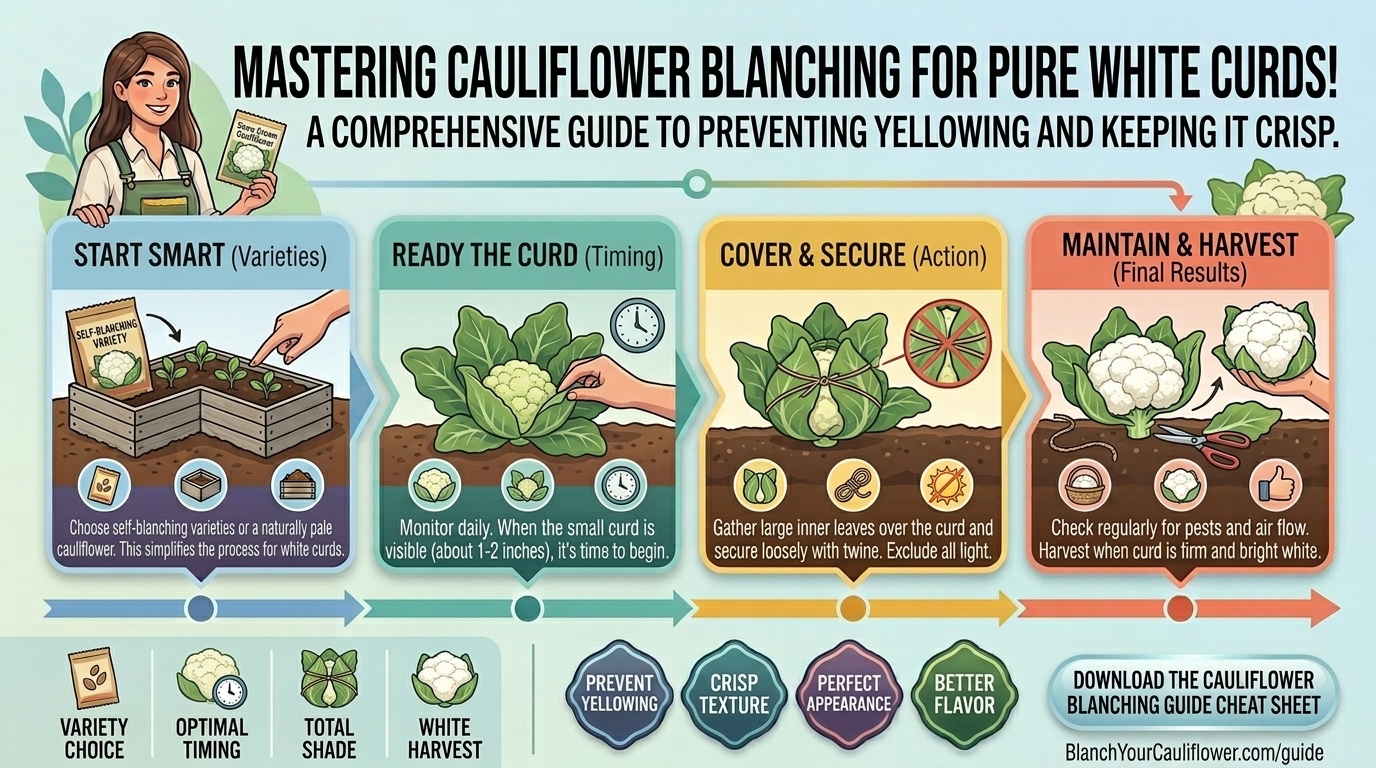
[Curd Reaches 2 to 3 Inches] ➔ [Gather Upright Outer Leaves] ➔ [Secure Gently with Twine/Rubber Band] ➔ [Harvest in 7 to 12 Days]
The Magic Measurement
- The Size Threshold: Inspect your cauliflower plants weekly. The exact moment to initiate blanching is when the central white curd reaches 2 to 3 inches in diameter—roughly the size of a teacup or a small baseball.
- Dry Weather Check: Always perform the blanching procedure on a dry day when the morning dew has completely evaporated. Tying up wet leaves traps high ambient moisture against the developing curd, inviting destructive fungal diseases, bacterial soft rot, and head discoloration.
4. The Classic Technique: Step-by-Step Manual Blanching
Mastering the traditional manual blanching method takes only a few minutes per plant, but yields professional results.
What You Will Need
- Garden twine, soft jute string, elastic garden bands, or large paper clips.
- Dry hands and a careful eye.
Step-by-Step Execution
- Select Healthy Outer Leaves: Choose 3 to 5 large, healthy, unblemished outer leaves (known as wrapper leaves) that are long enough to stretch across the top of the central curd.
- Gather Gently: Gently pull the leaves upward and inward toward the center, bringing them together like the petals of a blooming flower over the white curd. Take care not to snap or crack the main stems at the base of the plant.
- Secure the Canopy: Wrap your twine, rubber band, or clip around the upper third of the gathered leaves to hold them firmly in place. Leave enough breathing room at the top so air can circulate, preventing heat buildup.
- Mark Your Calendar: Depending on seasonal temperatures, the blanching process takes anywhere from 7 to 14 days. Check underneath the leaves around day 10 to gauge the progress of the whitening process.
5. Alternative and Modern Blanching Hacks
While traditional twine tying is the gold standard, modern gardeners have adapted clever alternatives for unique growing spaces and large-scale home plots:
- The Rubber Band Method: Instead of messing with tangled twine or cutting string in the dirt, keep a stash of heavy-duty, thick rubber bands in your pocket. Slip a band over the gathered leaves in one fluid motion. Tip: Replace rubber bands annually, as outdoor UV light degrades cheap rubber quickly.
- The Paper Clip / Clothes-Pin Method: For quick adjustments, use large stainless steel or plastic paper clips to pin opposing leaves together across the top of the curd.
- The Outer Leaf Snap (Traditional Farm Method): Some experienced growers gently snap or break the midribs of the largest outer leaves halfway down, folding them directly over the curd like a protective roof without pulling the entire plant structure together. This works exceptionally well in dry climates.
6. Regional Adaptations Across the United States
Growing conditions across the United States require subtle tweaks to your blanching strategy to account for local weather anomalies:
Texas & Inland California
- The Challenge: Sudden, intense heat waves and blazing afternoon sun can cause cauliflower to “button” (form tiny, premature heads) or bolt to seed, while trapped heat under tight ties can cause rapid interior rotting.
- The Strategy: Opt for loose tying methods. Ensure maximum air circulation by leaving the top of the leaf canopy slightly open, and provide partial afternoon shade cloth if temperatures spike above 85°F.
New York & Washington State
- The Challenge: High relative humidity, autumn morning dews, and frequent rain showers that create a breeding ground for fungal molds inside wrapped leaves.
- The Strategy: Only blanch during dry spells. Inspect wrapped heads every 4 to 5 days during wet autumn weeks to ensure moisture isn’t pooling on top of the delicate white curds.
San Francisco & Coastal Microclimates
- The Challenge: Cool marine fog, damp winds, and limited direct UV light.
- The Strategy: San Francisco’s persistent fog acts as a natural partial filter, meaning cauliflower heads develop less yellowing naturally. However, when the sun breaks through, traditional blanching ensures uniform, restaurant-quality color. Use breathable jute twine rather than plastic clips to manage cool marine moisture effectively.
7. Common Pitfalls and Troubleshooting
Even with careful planning, gardeners occasionally run into trouble during the blanching phase. Watch out for these common issues:
- Trapped Moisture and Head Rot: If you tie up your cauliflower while the leaves are wet from rain or dew, or if you tie them too tightly without ventilation, bacteria can multiply rapidly, turning your pristine white curd into a brown, foul-smelling mush. Always tie when dry and leave the apex slightly open.
- Pest Infestations: Aphids and cabbage loopers love to hide inside the cool, dark microclimate created by a newly blanched cauliflower canopy. Before tying your leaves, inspect the curd closely and dust with organic Bacillus thuringiensis (Bt) if caterpillars are present.
- Forgetting to Harvest on Time: Once blanched, cauliflower matures quickly. Leaving a fully blanched head in the garden too long causes the tight curds to “rice”—loosening up, separating, and preparing to flower, which ruins the texture and flavor.
8. When and How to Harvest Your Blanched Cauliflower
Knowing the exact moment to harvest is just as important as knowing when to blanch.
- Test Firmness: Gently slip your hand under the wrapper leaves and press your thumb against the curd. It should feel firm, compact, and dense, with tight individual segments. If it feels spongy or loose, it has passed its prime.
- Check the Diameter: A mature, high-quality home-grown cauliflower head typically measures between 6 to 8 inches across.
- The Cut: Use a sharp, clean harvest knife to slice through the main stalk just below the lowest set of wrapper leaves, leaving a few protective leaves attached to cushion the head during transport to the kitchen.
9. Frequently Asked Questions (FAQ)
1. Do all varieties of cauliflower require blanching?
No. Only traditional white cauliflower varieties require manual blanching to maintain their snow-white color. Self-blanching varieties have inner leaves that naturally curl over the head, and vibrant colored varieties (like purple or orange types) do not require blanching at all.
2. What happens if I forget to blanch my cauliflower?
If left unblanched, your cauliflower will still be completely edible and nutritious, but direct sunlight will turn the curds a yellowish, brownish, or greyish color, and the surface texture may become slightly tougher and more strongly flavored.
3. When is the exact right time to tie up the leaves for blanching?
You should tie up the leaves when the central white curd reaches 2 to 3 inches in diameter (about the size of a teacup). Tying too early stunts head growth, while tying too late leaves sun-staining on the curds.
4. What is the best material to use for tying cauliflower leaves?
Soft garden twine, jute string, or thick rubber bands work best. Avoid thin wire or sharp strings that can slice into the plant stems when the leaves shift or expand in the wind.
5. Can I use rubber bands to blanch my cauliflower?
Yes! Heavy-duty rubber bands are a favorite shortcut among experienced home gardeners because they are fast to slip over the gathered leaves and hold the canopy securely in place.
6. How long does the blanching process take before harvest?
The blanching process typically takes 7 to 14 days, depending on ambient air temperatures and sunlight intensity. Check under the leaves around day 10 to evaluate the color.
7. Why did my blanched cauliflower turn brown and rot inside the leaves?
This is usually caused by trapped moisture. If you tie the leaves up while they are wet from rain or dew, or if the bundle is tied too tightly without airflow, bacteria and fungi cause the curd to rot. Always blanch on dry days.
8. Can I blanch cauliflower during a heat wave?
It is risky. During extreme heat waves, sealing the leaves traps hot air around the curd, which can cause the head to cook or rot. If temperatures spike above 85°F, use a loose tying method and consider adding temporary shade cloth over the entire plant.
9. How do I know when the cauliflower is ready to be harvested?
Gently press your thumb against the curd beneath the leaves. It should feel firm, compact, and measure roughly 6 to 8 inches in diameter. If the curds are starting to separate or “rice,” harvest immediately.
10. Do colored cauliflowers like purple or orange need to be blanched?
No. Purple, orange, and green (Romanesco) cauliflower varieties are specifically bred to develop their vibrant colors in direct sunlight. Blanching them actually prevents them from developing their rich antioxidant profiles and brilliant hues.
10. Conclusion
Mastering the technique of blanching homegrown cauliflower bridges the gap between casual gardening and professional-grade vegetable production. By understanding the science of sunlight exposure, timing your intervention when curds reach two to three inches, and utilizing breathable materials to secure the wrapper leaves, you protect your harvest from discoloration and unpalatable texture.