What Are the Easiest Air-Purifying Indoor Houseplants for Complete Beginners to Keep Alive?
Bringing living greenery into your home is one of the most rewarding lifestyle upgrades you can make. Whether you are styling a sunlit urban apartment in San Francisco, a cozy high-rise loft in New York, a spacious contemporary home in Texas, or vibrant residential spaces across California and Washington, houseplants add immediate warmth, style, and tranquility to your daily life.
Beyond their undeniable aesthetic appeal, many popular houseplants boast an incredible superpower: they act as natural bio-filters. Documented extensively by NASA clean air studies, certain resilient botanical species actively absorb common indoor air pollutants—such as formaldehyde, benzene, trichloroethylene, and carbon monoxide—while releasing fresh oxygen.
However, if you are a complete beginner who has accidentally killed a succulent or two in the past, the thought of maintaining finicky tropical foliage can feel intimidating. You do not need a botanical degree or a greenhouse to enjoy cleaner indoor air. Brought to you by kcplants.com, this comprehensive, expert-led masterclass explores the absolute easiest, practically indestructible air-purifying indoor houseplants designed for absolute beginners to keep alive.
Part I: Why Indoor Air Quality Matters
Before introducing our top beginner-friendly plant picks, let’s explore why improving your indoor air with plants is essential:
- The Indoor Pollution Trap: Modern homes and urban apartments are built with energy-efficient tight seals. While great for heating and cooling, this traps synthetic volatile organic compounds (VOCs) off-gassed by carpets, paints, cleaning products, furniture, and plastics inside your living space.
- Natural Bio-Filtration: Houseplants absorb airborne toxins through microscopic leaf pores (stomata) and route them down to their root zones, where beneficial soil microbes break them down into harmless organic compounds.
- Boosted Mood and Focus: Interacting with living plants reduces mental fatigue, lowers indoor stress levels, and elevates home humidity, making your living environment infinitely healthier.
Part II: The 6 Easiest Air-Purifying Houseplants for Beginners
Here are the bulletproof champions of the indoor plant world—species that forgive missed waterings, tolerate low light, and scrub your air clean with minimal effort.
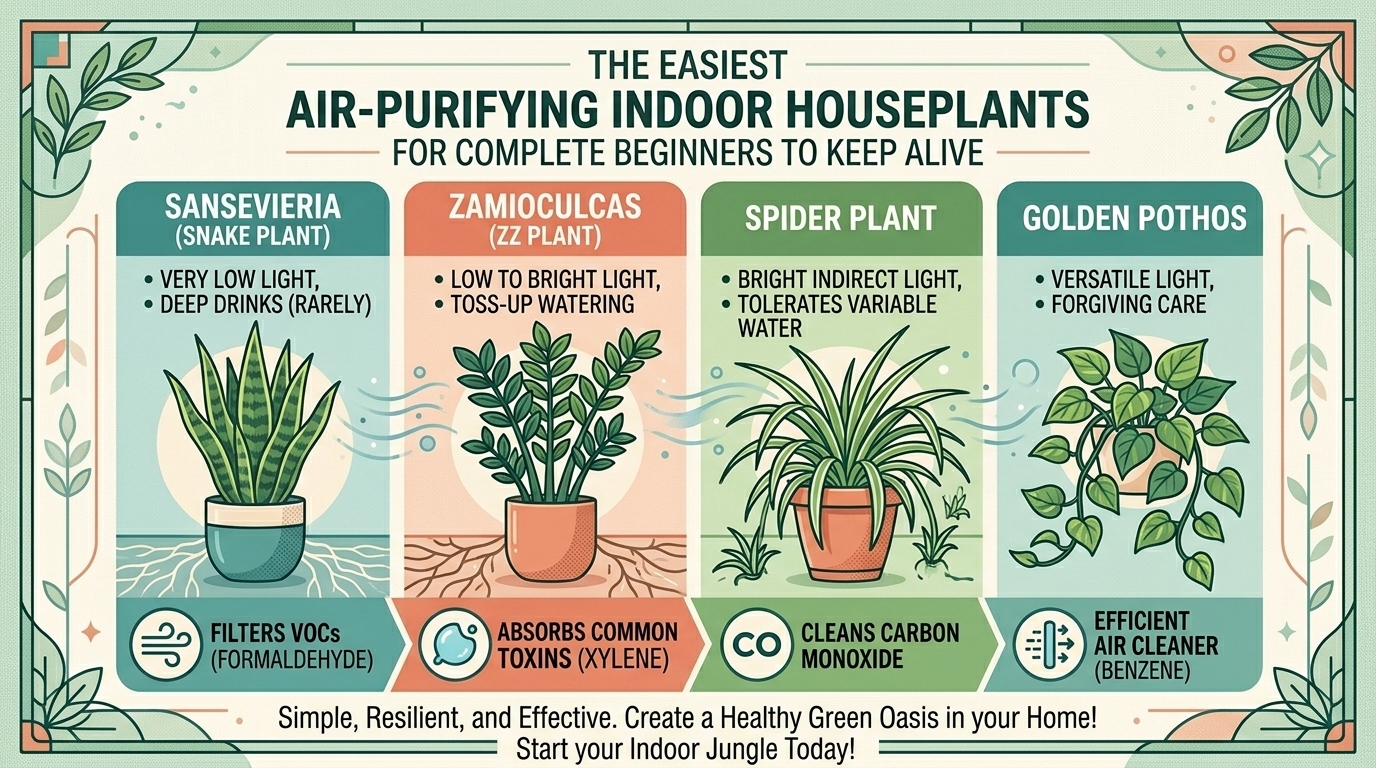
1. The Snake Plant (Sansevieria or Dracaena trifasciata)
- Air-Purifying Superpowers: Famed for removing formaldehyde, benzene, and xylene from indoor air. Unlike most plants, Snake Plants perform crassulacean acid metabolism (CAM) photosynthesis, meaning they absorb carbon dioxide and release fresh oxygen at night, making them the ultimate bedroom companion.
- Why It’s Bulletproof: It survives months of neglect, thrives in pitch-black corners or blazing sun, and only requires watering every 3 to 4 weeks.
- Care Rule: The number one way to kill a Snake Plant is overwatering. Let the soil dry out 100% between drinks.
2. The ZZ Plant (Zamioculcas zamiifolia)
- Air-Purifying Superpowers: Excellent at removing indoor VOCs while introducing glossy, waxy emerald foliage that looks permanently polished.
- Why It’s Bulletproof: ZZ plants store water in thick, potato-like underground rhizomes. They can withstand weeks of drought, low light, and erratic care without dropping a single leaf.
- Care Rule: Water thoroughly only when the soil is completely bone-dry from top to bottom.
3. The Cast Iron Plant (Aspidistra elatior)
- Air-Purifying Superpowers: A classic Victorian parlor plant that quietly filters airborne toxins while enduring harsh indoor conditions.
- Why It’s Bulletproof: True to its name, this plant is nearly indestructible. It tolerates deep shade, erratic watering, dust, and temperature swings that would kill other tropicals.
- Care Rule: Keep it out of direct scorching sun, which can bleach its dark green leaves, and water when the top two inches of soil feel dry.
4. The Golden Pothos (Epipremnum aureum)
- Air-Purifying Superpowers: Consistently ranked among the top plants for scrubbing formaldehyde and carbon monoxide from indoor spaces.
- Why It’s Bulletproof: Pothos vines grow rapidly in almost any lighting condition. If you forget to water it, the leaves will droop dramatically as a gentle reminder, then bounce right back within hours of a drink.
- Care Rule: Trim trailing vines with clean shears whenever they get too long to encourage bushier, fuller growth.
5. The Peace Lily (Spathiphyllum)
- Air-Purifying Superpowers: A powerhouse cleaner capable of neutralizing benzene, formaldehyde, trichloroethylene, and airborne mold spores.
- Why It’s Bulletproof: While dramatic when thirsty, Peace Lilies recover with astonishing speed. They tolerate lower light levels exceptionally well.
- Care Rule: Keep out of harsh direct sun, and water when the leaves begin a slight, dramatic sag.
6. The Spider Plant (Chlorophytum comosum)
- Air-Purifying Superpowers: Highly efficient at removing carbon monoxide, xylene, and formaldehyde. It also produces adorable little “spiderettes” (baby plant pups) that you can easily snip off and propagate.
- Why It’s Bulletproof: Fast-growing, non-toxic to pets, and incredibly resilient against occasional neglect.
- Care Rule: Use filtered or distilled water if possible, as fluoride in tap water can sometimes cause brown tips on its grassy leaves.
Part III: Step-by-Step Guide to Keeping Your Beginner Plants Alive
Even the toughest air-purifying plants will thrive when given a few basic fundamentals:
Step 1: Match Light Levels Properly
- Even though beginner plants are forgiving, verify your room’s natural light. Place Snake Plants and ZZ plants in medium-to-low light, and Pothos or Peace Lilies near bright, indirect light sources (such as an east-facing window).
Step 2: Master the Soil Dryness Test
- Never water plants on a rigid calendar schedule. Always push your index finger 2 inches into the soil. If it feels dry, water; if it feels damp, wait. Overwatering is the single greatest cause of houseplant mortality.
Step 3: Choose Pots with Drainage Holes
- Always plant your greens in nursery pots or ceramic planters featuring functional bottom drainage holes. This allows excess water to escape freely, preventing fatal root rot.
Part IV: Regional Considerations for Indoor Plant Care
Depending on your geographical location across our key regions, indoor microclimates require minor adjustments:
- San Francisco & New York: Urban apartments often feature dry winter heating or chilly drafts. Keep your beginner plants away from direct radiator blasts and cold window glass during winter months.
- Texas, California, & Washington: Expansive windows in Texas and California provide brilliant sun that keeps plants growing rapidly, requiring slightly more frequent summer watering. In Washington, monitor indoor humidity levels and water a bit less frequently during dark winter months.
Part V: Pro Tips for Beginner Plant Success
- Wipe Your Leaves Clean: Dust acts like a physical sunscreen, blocking light from reaching plant pores. Wipe down large leaves with a damp cloth every few weeks.
- Don’t Over-Fertilize: Beginners often think more plant food equals better health. In reality, beginner plants need very little fertilizer—feed them once a month in spring and summer only at half-strength.
10 Frequently Asked Questions (FAQ)
1. Which indoor houseplant is truly the hardest to kill for a complete beginner?
The Snake Plant and the ZZ Plant tie for first place. Both store water in their roots or leaves, tolerate low light, and survive weeks of total neglect.
2. Do indoor houseplants really clean indoor air effectively?
Yes! NASA clean air studies and modern botanical research confirm that common houseplants absorb indoor VOCs through their leaves and neutralize them at their root zones.
3. How often should I water my beginner houseplants?
As a general rule, most beginner plants (like Snake Plants and ZZ plants) need watering every 3 to 4 weeks, while Pothos and Peace Lilies prefer watering every 7 to 10 days, depending on soil dryness.
4. Why are the tips of my spider plant turning brown?
Brown tips are usually caused by dry indoor air, underwatering, or sensitivity to fluoride and chlorine found in municipal tap water (try using filtered water).
5. Are air-purifying plants safe for cats and dogs?
Not all of them! Spider Plants and Boston Ferns are completely pet-safe. However, Snake Plants, ZZ Plants, and Peace Lilies are toxic if ingested by pets, so keep them on high shelves or out of reach.
6. Do I need special grow lights for beginner houseplants?
Usually no! Standard indoor household lighting or natural ambient light from a nearby window is more than enough for resilient beginner varieties like Snake Plants and Pothos.
7. What is the most common mistake beginners make with houseplants?
Overwatering. Giving plants too much water too frequently suffocates the roots, cuts off oxygen, and triggers fatal root rot. Always check soil dryness first.
8. Should I mist my indoor houseplants every day?
Most beginner plants (like Snake Plants, ZZ plants, and Pothos) actually prefer dry indoor air and do not require daily misting. Tropical ferns or calatheas are the exception, but they aren’t beginner plants.
9. Can I keep my houseplants in a room with zero windows?
While plants cannot survive in pitch-black windowless rooms indefinitely, Snake Plants and ZZ Plants can tolerate low-light windowless offices if you leave overhead fluorescent or LED lights on during work hours.
10. When should I repot my beginner houseplant?
Repot your plant only when roots are visibly emerging from the bottom drainage holes or circling the surface, typically every 2 to 3 years during spring.
Conclusion
Starting your indoor gardening journey doesn’t have to be stressful. By selecting bulletproof, air-purifying champions like the Snake Plant, ZZ Plant, Golden Pothos, and Peace Lily, you can easily clean your indoor air and introduce vibrant living greenery into your home. Visit kcplants.com regularly for expert beginner guides, plant care tips, and inspiration to help your indoor oasis thrive!