What Are the Top Natural Ways to Prevent Your Garden Soil from Washing Away During Storms?
- Author: KC Plants Editorial Team
- Published For Gardeners In: Texas, New York, California, Washington, and San Francisco
- Estimated Read Time: 25-30 Minutes (Comprehensive Soil Conservation Masterclass)
Introduction: The Silent Threat Beneath the Rain
Every experienced gardener knows the raw power of a sudden, violent downpour. Whether it is an unexpected flash storm rolling across the plains of Texas, an atmospheric river slamming into Washington or Northern California, an urban cloudburst in New York, or sudden runoff cascading down San Francisco’s legendary hills, heavy rain can turn a pristine garden bed into a muddy disaster overnight.
When storm waters rush across unprotected earth, they carry away your garden’s most precious asset: topsoil.
Topsoil is the result of centuries of natural weathering and biological activity. It contains the concentrated organic matter, nutrients, and beneficial microbial life necessary for plant health. Losing even a fraction of an inch of topsoil to erosion strips your garden of its fertility, exposes plant root systems, clogs local drainage systems, and leaves behind compacted, sterile dirt.
Relying on chemical sealants, artificial plastic geotextiles, or concrete retaining walls is not only expensive; it disrupts the natural ecosystem of your yard. Fortunately, nature provides powerful, elegant solutions.
This exhaustive, masterclass-level guide explores the top natural, eco-friendly methods to lock your garden soil in place, absorb heavy storm water, and transform your landscape into a resilient sanctuary.
Chapter 1: The Physics of Soil Erosion and Storm Runoff
To stop soil from washing away, you must first understand the destructive mechanics of a rainstorm.
1. The Kinetic Impact of Raindrops
Erosion begins long before water starts flowing across the ground. A single falling raindrop acts like a tiny explosive projectile. When millions of heavy raindrops strike bare, unprotected soil at high velocity, they shatter soil aggregates (the tiny crumbs that hold soil together).
- Surface Crusting: This impact blasts fine soil particles apart, which then settle into a dense, impermeable crust that blocks water infiltration and triggers surface pooling and runoff.
2. Overland Flow and Sheet Erosion
Once water can no longer soak into crusted or saturated soil, it begins to pool and flow downhill under the influence of gravity.
- Sheet Erosion: Water sweeps across flat surfaces in a thin layer, skimming off the richest, lightest organic particles.
- Rill and Gully Erosion: As water converges into channels, it gains velocity and carves deep, destructive trenches (“rills” or “gullies”) straight through your garden beds.
Chapter 2: The Top Natural Soil Conservation Techniques
To combat rain erosion naturally, you must slow water down, spread it out, and let it sink into the earth. Here are the most effective natural techniques used by professional landscape ecologists.
[Storm Water Management Hierarchy]
  ├── 1. Armor the Surface (Heavy Organic Mulches & Cover Crops)
  ├── 2. Slow the Velocity (Contour Planting & Terracing)
  ├── 3. Reinforce Subsurface Strength (Deep-Rooted Perennials & Native Grasses)
  └── 4. Channel Safely (Bioswales & Rain Gardens)
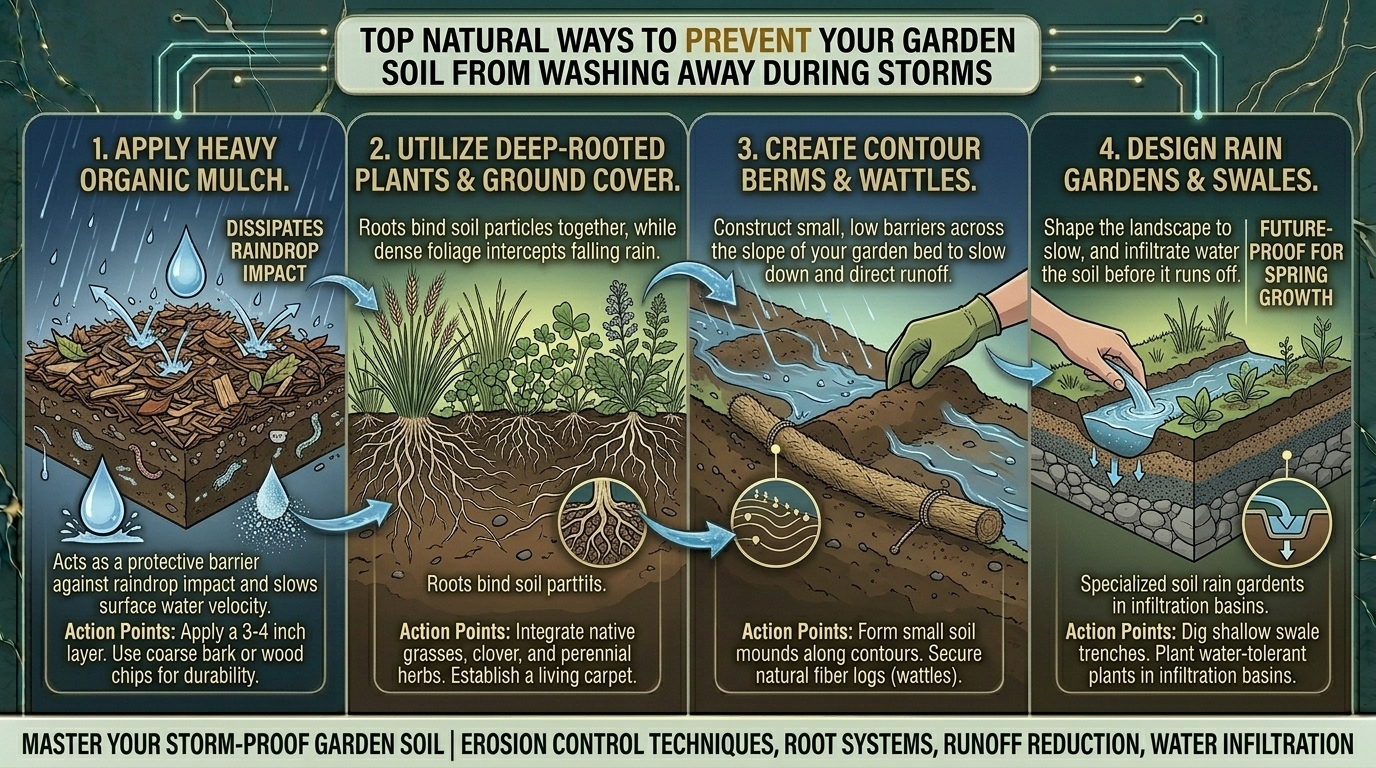
1. Heavy Organic Mulching (Armoring the Soil Surface)
The single fastest and easiest defense against raindrop impact is a robust layer of organic mulch.
- How It Works: Mulch acts as a physical shock absorber. Raindrops shatter against the mulch rather than the soil, preventing surface crusting.
- Materials to Use: Coarse arborists’ wood chips, shredded bark, straw, or leaf mold. Avoid fine, powdery mulches that float away in heavy streams; use chunky materials that lock together to form a permeable carpet.
2. Planting Living Armor: Cover Crops and Dense Groundcovers
Bare soil is an eroding soil. Nature abhors a vacuum, and living plants provide the ultimate defense network.
- Dense Root Webs: Fibrous root systems act like natural rebar, binding soil particles together in a tight underground matrix.
- Foliage Canopies: Multi-layered plant canopies intercept heavy rain, reducing droplet velocity before it ever touches the ground. Use low-growing creeping perennials, clover, or dense groundcovers in ornamental beds, and winter cover crops in vegetable beds.
3. Terracing Slopes to Break Momentum
If your garden is located on a slope, gravity is your primary enemy. Water accelerates as it runs downhill, exponentially increasing its erosive force.
- The Terracing Principle: Break a long slope into a series of flat, step-like planting beds supported by natural stone, logs, or living borders.
- Water Trapping: Terraces force water to pause, pool gently, and infiltrate the soil rather than rushing straight to the bottom of your yard.
4. Contour Planting and Berms
- Contour Gardening: Instead of planting rows up and down a slope (which creates ready-made channels for runoff), plant along the contour lines running horizontally across the slope. Each plant row acts as a natural dam.
- Berms and Swales: Construct a low, mounded ridge of soil (berm) paired with a shallow, concave trench (swale) running across the slope to intercept, slow down, and redirect runoff safely into designated infiltration zones.
5. Installing Rain Gardens and Bioswales
- Rain Gardens: A depression engineered in a low-lying spot in your yard, filled with moisture-tolerant, deep-rooted native plants. Instead of letting storm runoff wash away topsoil, the rain garden catches, filters, and infiltrates the water naturally.
- Bioswales: Gently sloped, vegetated drainage ditches lined with river rock and planted with water-loving grasses and shrubs that filter pollutants while slowing storm flow.
Chapter 3: Regional Realities: Texas, New York, California, Washington, and San Francisco
Soil erosion challenges vary drastically depending on regional weather patterns, topography, and soil composition.
1. Texas (Managing Sudden Flash Floods and Heavy Clay Runoff)
- The Challenge: Texas weather is defined by dramatic extremes—extended dry spells that bake clay soils hard as concrete, followed by torrential, tropical downpours or severe thunderstorms. Because baked clay sheds water instantly, flash floods frequently wash away topsoil and mulch.
- Erosion Control Strategy: Focus on breaking up surface crusting with expanded shale and compost to maximize infiltration before storms hit. Use heavy shredded hardwood mulch that mats together and resists floating away during intense Texas gully-washers.
2. New York (Combating Urban Runoff and Freeze-Thaw Spring Rains)
- The Challenge: New York landscapes often feature urban compaction, sloping suburban lawns, and aggressive spring rainstorms colliding with melting winter snowpacks. This combination can easily saturate shallow topsoils, triggering sudden mudslides on sloped residential properties.
- Erosion Control Strategy: Install deep-rooted perennial shrubs and ornamental grasses along property slopes. Utilize dense layers of leaf mold and composted wood chips to absorb heavy spring rains and protect vulnerable planting beds.
3. California (Preventing Mudslides During Atmospheric Rivers)
- The Challenge: California’s Mediterranean climate features dry summers followed by intense winter storms. Hillside properties (especially in Southern California or interior regions) face severe wildfire risks followed by winter rains, creating dangerous mudslide and debris-flow conditions due to lack of vegetation.
- Erosion Control Strategy: Plant deep-rooted native chaparral shrubs, ceanothus, and native bunchgrasses whose root systems anchor unstable hillsides. Use jute netting or coir logs on newly graded slopes to hold soil in place until vegetation establishes.
4. Washington (Surviving Prolonged Pacific Northwest Downpours)
- The Challenge: Western Washington experiences months of persistent, soaking autumn and winter rainfall. While individual storms may not always be flash floods, continuous saturation weakens soil structure, leading to slumping hills and topsoil washout in sloped garden beds.
- Erosion Control Strategy: Implement French drains, rock-lined swales, and raised beds to manage excess moisture. Cover all bare soil surfaces with heavy layers of arborists’ wood chips to prevent constant raindrop impact from washing nutrients away.
5. San Francisco (Controlling Urban Runoff on Steep Slopes)
- The Challenge: San Francisco’s iconic hills create severe topographic challenges. Rainwater rushing down steep urban gardens picks up incredible velocity, threatening backyard patios, retaining walls, and delicate flower beds.
- Erosion Control Strategy: Terracing is essential for San Francisco backyards. Combine terraced garden beds with interlocking retaining logs, deep-rooted drought-tolerant perennials, and dry creek beds to channel storm water safely around your property.
Chapter 4: Step-by-Step Action Plan to Stormproof Your Garden
Follow this practical blueprint to safeguard your garden beds before the next big storm hits.
Step 1: Conduct a Vulnerability Walk
Walk your yard during or immediately after a moderate rainstorm. Look for where water pools, where puddles rush fastest, where mud is splashing against siding or pathways, and where rills are beginning to form in your soil.
Step 2: Armor Exposed Soil Immediately
Do not leave bare dirt exposed. Cover every square inch of empty garden bed with at least 3 to 4 inches of coarse organic mulch or plant rapid-germinating cover crops.
Step 3: Install Physical Barriers on Slopes
For any slope steeper than 10 degrees, install natural physical barriers:
- Lay coir logs (coconut fiber logs) or jute netting horizontally across the slope, anchoring them with wooden stakes.
- Build low log terraces or rock borders using native stones to catch cascading water.
Step 4: Direct Downspouts Wisely
Ensure your roof gutters and downspouts do not discharge torrents of water directly onto bare garden beds. Extend downspouts using flexible piping or direct them into rain barrels, dry wells, or rock-lined bioswales.
Chapter 5: 10 Frequently Asked Questions (FAQs)
1. What is the fastest temporary fix for soil washing away during a storm?
Coarse organic mulch and burlap or jute netting. Spreading a thick 4-inch layer of chunky wood chips or staking down biodegradable jute mesh over vulnerable soil instantly absorbs raindrop impact and prevents surface washing while you plan permanent landscaping.
2. Can I use rubber mulch to stop soil erosion?
While rubber mulch is heavy and won’t wash away easily, it is not recommended for natural garden beds. Rubber leaches toxic chemicals (like zinc and heavy metals) into the soil, harms beneficial microbes, and does nothing to improve soil health or plant vitality.
3. How do plant roots prevent soil erosion?
Plant roots act like a living biological anchor. Fine hair roots bind soil particles together into stable aggregates, while deep taproots and sprawling root networks stabilize the subsoil, preventing earth from slipping on slopes.
4. What are the best plants for holding soil on a steep slope?
Deep-rooted native perennials, ornamental bunchgrasses (like switchgrass or fescue), creeping groundcovers (like creeping thyme or periwinkle), and deep-rooting shrubs are exceptionally effective at locking hillside soils in place.
5. What is a bioswale, and how does it stop erosion?
A bioswale is a shallow, wide, gently sloped ditch lined with rocks and planted with dense vegetation. It is designed to capture storm runoff, slow its velocity, filter out sediment and pollutants, and allow water to soak safely into the ground.
6. Why does heavy clay soil wash away so easily during heavy storms?
When dry clay soils are hit by intense rain, their surface crusts over instantly. Because water cannot infiltrate the baked clay, it accumulates rapidly on the surface and rushes downhill in sheets, carrying the loose top layer of soil with it.
7. How do I stop water from an uphill neighbor’s yard from eroding my garden?
Install an interceptor swale or French drain along your upper property line. This captures incoming runoff before it enters your yard and reroutes it safely around your planting beds via underground piping or a rock-lined channel.
8. Are retaining walls necessary for sloping backyards?
Not always. While masonry or concrete retaining walls work for severe slopes, natural terracing using logs, large boulders, or living bio-swales is often more affordable, aesthetically pleasing, and supportive of local soil ecology.
9. How thick should my mulch layer be to prevent erosion?
Apply a layer of 3 to 4 inches of coarse organic mulch. Anything thinner may wash away in a heavy downpour; anything thicker than 4 inches can suffocate plant roots and restrict necessary gas exchange.
10. Does tilling garden soil increase or decrease erosion risk?
Tilling drastically increases erosion risk. Turning the soil destroys natural soil aggregation, breaks up fungal hyphae networks, and leaves the earth powdery, loose, and highly vulnerable to being washed away by the next rainstorm. Practice no-till gardening to keep soil structure intact.
Conclusion: Build a Resilient Landscape from the Ground Up
Protecting your garden soil from storm erosion is essential for maintaining a thriving, beautiful landscape. By replacing artificial chemical solutions with natural armor—such as heavy organic mulches, deep-rooted native plants, terraced slopes, and bioswales—you turn storm water from a destructive threat into a life-giving resource.