As autumn arrives across the United States—painting the neighborhoods of New York, the Pacific Northwest hills of Washington, the urban landscapes of San Francisco, the diverse microclimates of California, and the wide-open spaces of Texas in brilliant shades of amber, gold, and red—millions of homeowners are met with an annual ritual: raking up massive piles of fallen leaves.
For generations, the standard suburban response has been to bag those leaves up in plastic and haul them to the curb for municipal waste collection.
In the world of modern, regenerative organic gardening, throwing away fallen leaves is recognized as a massive missed opportunity. Fallen leaves—often referred to by veteran horticulturists as “liquid gold in dry form”—are one of the most powerful, free, and nutrient-dense organic amendments available.
When shredded properly and incorporated into your garden beds, autumn leaves do more than just clean up your lawn; they fundamentally transform your soil structure for the long term.
This comprehensive, expert-backed guide breaks down the biological science of leaf mold, how shredded leaves improve soil aeration, moisture retention, and microbial life, and how you can harness this seasonal bounty to build an elite garden ecosystem.
1. What Happens in Nature? (The Forest Floor Blueprint)
To understand why fallen leaves are so beneficial, look at how nature manages soil in a healthy, mature deciduous forest.
Every autumn, trees drop millions of leaves onto the forest floor. There is no one out there bagging them, burning them, or hauling them away. Instead, a natural biological succession takes place:
- Fallen leaves form a protective thermal blanket over the earth.
- Fungi, bacteria, earthworms, and wood-boring insects move in to digest the organic carbon.
- Over the winter and spring, those leaves break down into a dark, crumbly, sweet-smelling humus that feeds the trees and keeps the soil soft, spongy, and bursting with life.
When you rake up and shred autumn leaves to use in your home garden, you are simply replicating this brilliant natural forest cycle right in your own backyard.
2. How Shredded Leaves Improve Long-Term Soil Structure
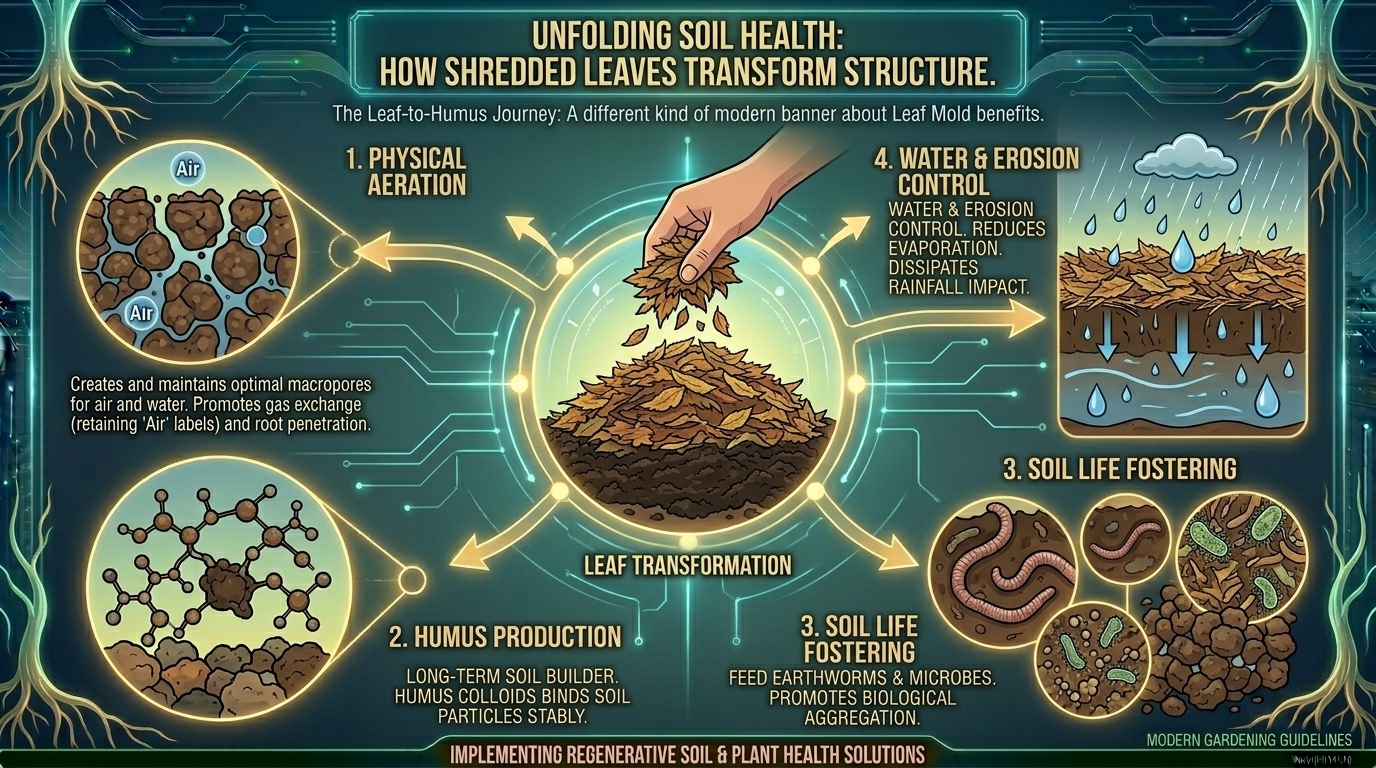
Soil structure refers to how individual mineral particles (sand, silt, clay) and organic matter bind together to form stable clumps or aggregates. Poor soil structure leads to compaction, root suffocation, and drought stress. Shredded leaves improve this structure in several distinct ways:
A. Introducing Slow-Release Carbon and Humus
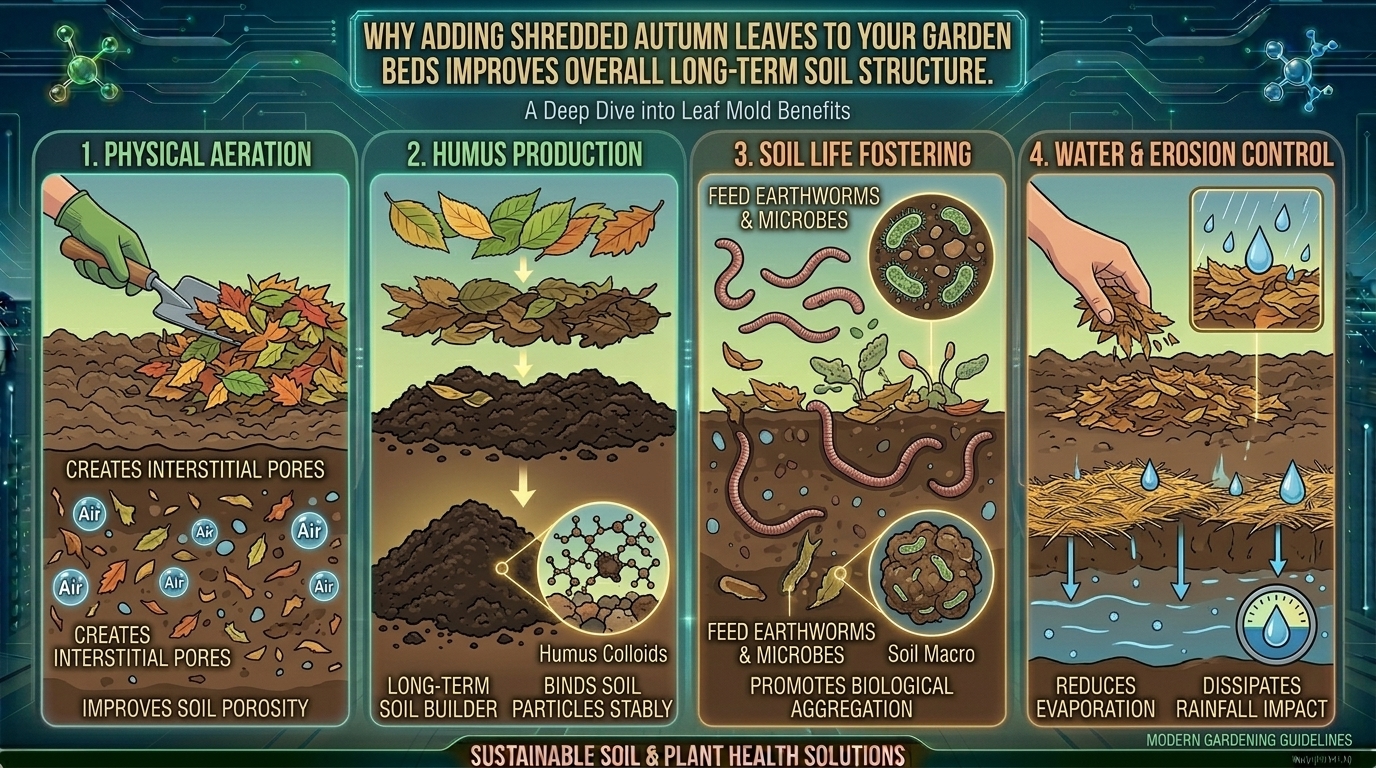
Leaves are packed with lignin and carbon. As soil microbes slowly break down shredded leaves, they convert that carbon into stable humus—the dark, sticky organic glue that binds loose mineral particles together.
- In heavy clay soils, humus creates microscopic spaces between flat clay plates, keeping the soil loose and preventing it from baking into concrete.
- In loose sandy soils, humus acts like a sponge, filling the massive empty air gaps and holding onto water and nutrients that would otherwise leach away.
B. Fueling the Soil Food Web (Microbes and Fungi)
Carbon is the primary energy source for soil microorganisms. By adding shredded leaves to your garden beds, you are feeding the baseline of the Soil Food Web. Saprophytic fungi and beneficial bacteria multiply exponentially, weaving a vast underground network of microscopic threads (mycelium) that physically knit your soil together into a resilient, crumbly matrix.
C. Creating Permanent Macro-Pores via Earthworm Activity
Earthworms adore decaying leaf litter. When you spread shredded leaves across your garden beds, native earthworms migrate to the surface to feed on the organic material. As they tunnel up and down, they leave behind stable biological burrows that allow air, water, and plant roots to penetrate deep into the subsoil.
3. Whole Leaves vs. Shredded Leaves: Why the Detail Matters
One of the most critical rules of leaf composting and mulching is this: Never put whole, unbroken leaves directly into your garden beds as a thick blanket.
- The Problem with Whole Leaves: When wet whole leaves fall flat against each other, they lock together like wet sheets of paper, forming an airtight, waterproof mat. This suffocates the soil underneath, prevents rainwater from soaking in, and creates an anaerobic swamp that breeds fungi and rots plant stems.
- The Magic of Shredding: Running your autumn leaves through a lawnmower with a collection bag, a dedicated leaf shredder, or a string trimmer inside a large plastic trash can chops them into fine, thumbnail-sized pieces.
- Why Shredding Works: Shredded leaves allow air and water to pass through freely, dramatically increase the surface area for microbes to work on, and decompose in a fraction of the time.
4. Two Ways to Use Autumn Leaves in Your Garden
Depending on your gardening style, you can deploy shredded leaves in two major ways:
Method A: As a Protective Surface Mulch (Sheet Mulching)
Spread a 3-to-4-inch layer of shredded leaves across your garden beds in late autumn after harvesting your summer crops.
- Benefits: It protects your soil from the destructive impact of winter rains, stops erosion, moderates soil temperature freezes, and slowly breaks down into rich topsoil by the time spring planting arrives.
Method B: Making “Leaf Mold” (Pure Fungal Gold)
Leaf mold is simply shredded leaves that have decomposed entirely on their own with the help of fungi. It requires almost zero effort:
- Stuff shredded leaves into black plastic trash bags, poking 10 to 15 small holes in the bag for air circulation.
- Splash a gallon of water inside the bag to dampen the leaves, tie the top loosely, and store the bags in an out-of-the-way corner of your yard.
- Leave them alone for 6 to 12 months. When you open the bags, you will find rich, sweet-smelling, dark brown leaf mold that can be mixed directly into potting soils and garden beds.
5. Frequently Asked Questions (FAQ)
1. Will adding oak leaves to my garden make my soil too acidic?
While oak leaves contain tannins and are slightly acidic when fresh, once they decompose into leaf mold or compost, their pH neutralizes significantly. Unless you apply massive quantities of fresh oak leaves to a very small area, they will not drastically or permanently alter your soil’s overall pH.
2. Can I put green, un-fallen autumn leaves into my garden beds?
Ideally, autumn leaves should be dry and naturally fallen. Green leaves pulled directly off trees contain higher levels of active moisture and nitrogen that can mat together quickly and rot before breaking down properly.
3. Do shredded leaves attract pests to my home garden?
Shredded leaves applied correctly do not attract pests. However, avoid piling thick mulches of leaves directly against the trunks of fruit trees or woody perennials in winter, as mice or voles can sometimes nest in the dry cover. Keep a 2-inch breathing clearance around plant stems.
4. How long does it take for shredded leaves to turn into soil?
In an active garden bed or compost pile with plenty of moisture and earthworms, shredded leaves typically break down into rich humus within 3 to 6 months. Unshredded whole leaves can take two years or longer.
5. Can I mix shredded leaves directly into heavy clay soil?
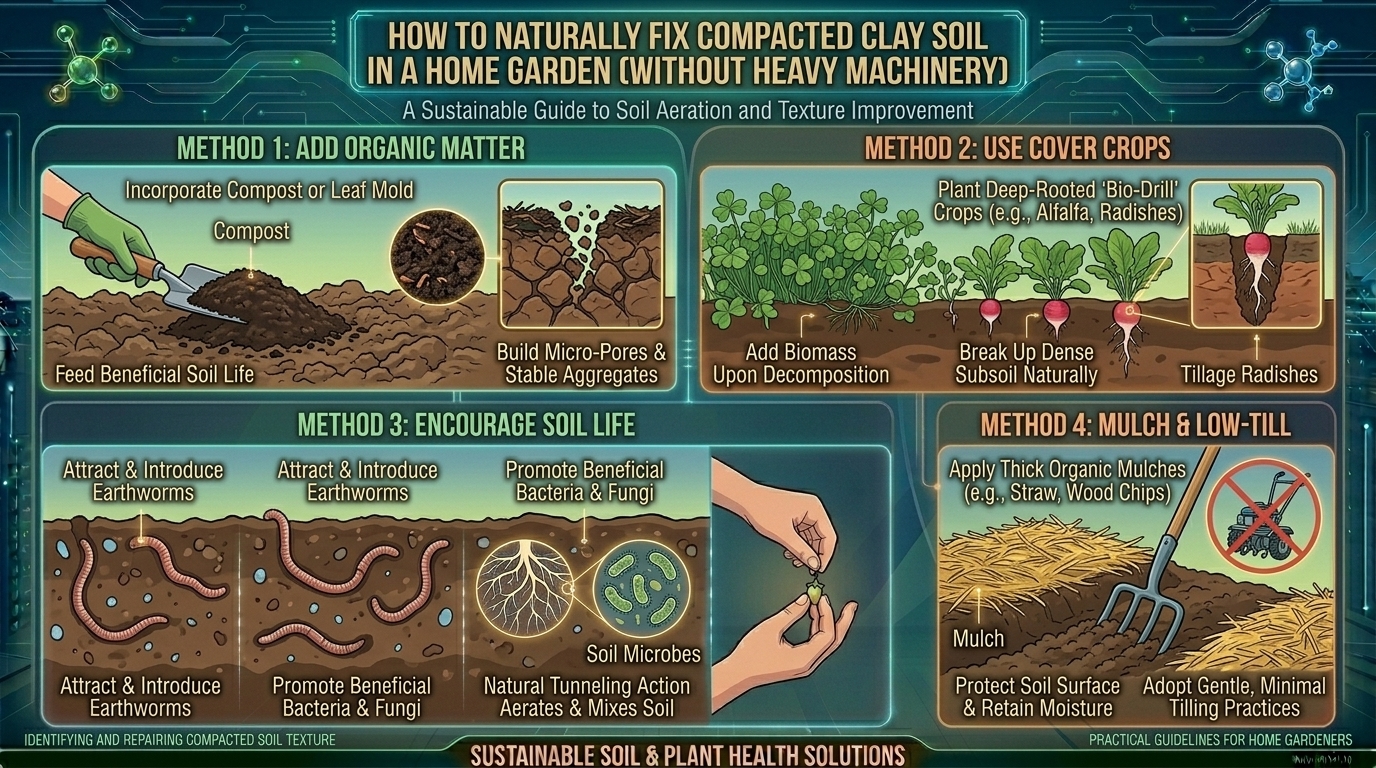
Yes! Mixing shredded leaves directly into the top 6 inches of heavy clay soil provides a massive injection of carbon that separates tightly bound clay particles, instantly improving aeration and long-term drainage.
6. Are there any tree leaves I should avoid using in my garden?
Avoid using leaves from trees known to produce strong natural growth inhibitors (allelopathic compounds) in massive concentrations, such as Black Walnut trees (which produce juglone). While small amounts of walnut leaves decompose safely in a hot compost pile, avoid using pure walnut leaf mold around sensitive plants like tomatoes and potatoes.
7. Do I need to add nitrogen when composting autumn leaves?
Leaves are high-carbon (“browns”) with a high C:N ratio. While they will eventually break down on their own, mixing in a handful of high-nitrogen organic amendments (like blood meal, fresh grass clippings, or a splash of liquid fish emulsion) speeds up the microbial decomposition process.
8. Can I use shredded leaves in container pots?
While whole leaves do not belong in small pots, well-rotted leaf mold is an exceptional, lightweight organic amendment that mimics forest humus and can make up 10% to 20% of a custom container potting soil mix.
9. Will autumn leaves blow away if I shred them?
Finely shredded leaves are much heavier than whole dry leaves and settle together nicely. However, if you live in a very windy region (such as parts of Texas or open Washington plains), lightly watering your leaf mulch after spreading it will help tack the pieces together.
10. Is leaf mold better than traditional compost?
Leaf mold and traditional compost serve different primary purposes. Traditional compost is richer in macro-nutrients (nitrogen, phosphorus, potassium), while leaf mold is unmatched for creating stable, spongy soil structure, water retention, and supporting beneficial fungal networks.
Conclusion
Raking and bagging autumn leaves is an outdated chore that robs your home garden of one of nature’s most potent soil-building resources. By investing a little time into shredding your fallen leaves and applying them as a protective winter mulch or curing them into rich fungal leaf mold, you permanently improve your soil structure, boost earthworm populations, and enhance long-term fertility without spending a dime on synthetic fertilizers.