Why Changing the Top Layer of Potting Soil Helps Eliminate Persistent Fungus Gnat Larvae Infestations
There is few indoor gardening experiences as universally maddening as watering a beloved houseplant, only to have a small cloud of tiny, erratic black flies erupt from the pot and hover annoyingly around your living room. While adult fungus gnats (Sciaridae family) are harmless insects that do not bite humans or damage mature foliage, their presence signals an active, underground infestation taking place within your potting soil.
The real culprits behind the nuisance—and the true danger to your plants—are the microscopic, transparent larvae writhing beneath the soil surface. These voracious immature gnats feed on organic matter, decaying root hairs, and delicate mycorrhizal fungi. In heavy infestations, they can severely stunt young seedlings, weaken established houseplants, and create entry wounds for secondary root rot pathogens.
While countless treatments line garden center shelves—from sticky yellow cards to chemical drenches—one of the most mechanically effective, immediate, and chemical-free cultural controls is deceptively simple: replacing the top layer of potting soil.
Whether you are managing moisture-heavy indoor jungles in Washington, battling high indoor humidity in Texas, maintaining urban apartment collections in New York, optimizing indoor light across California, or caring for prized houseplants in San Francisco, understanding how to disrupt the gnat life cycle through top-layer soil removal is a game-changing skill.
This comprehensive masterclass explores the biology of fungus gnats, why adult females target the topsoil, step-by-step soil replacement protocols, and long-term preventative strategies to keep your indoor garden completely gnat-free.
The Biology of Fungus Gnats: Understanding the Vulnerable Window
To understand why changing the top layer of potting soil works so effectively, you must understand the fungus gnat life cycle and behavior.
- The 4-Stage Life Cycle: Fungus gnats pass through four distinct stages: egg, larva (maggot-like), pupa, and adult. The entire cycle takes roughly 3 to 4 weeks depending on indoor temperatures.
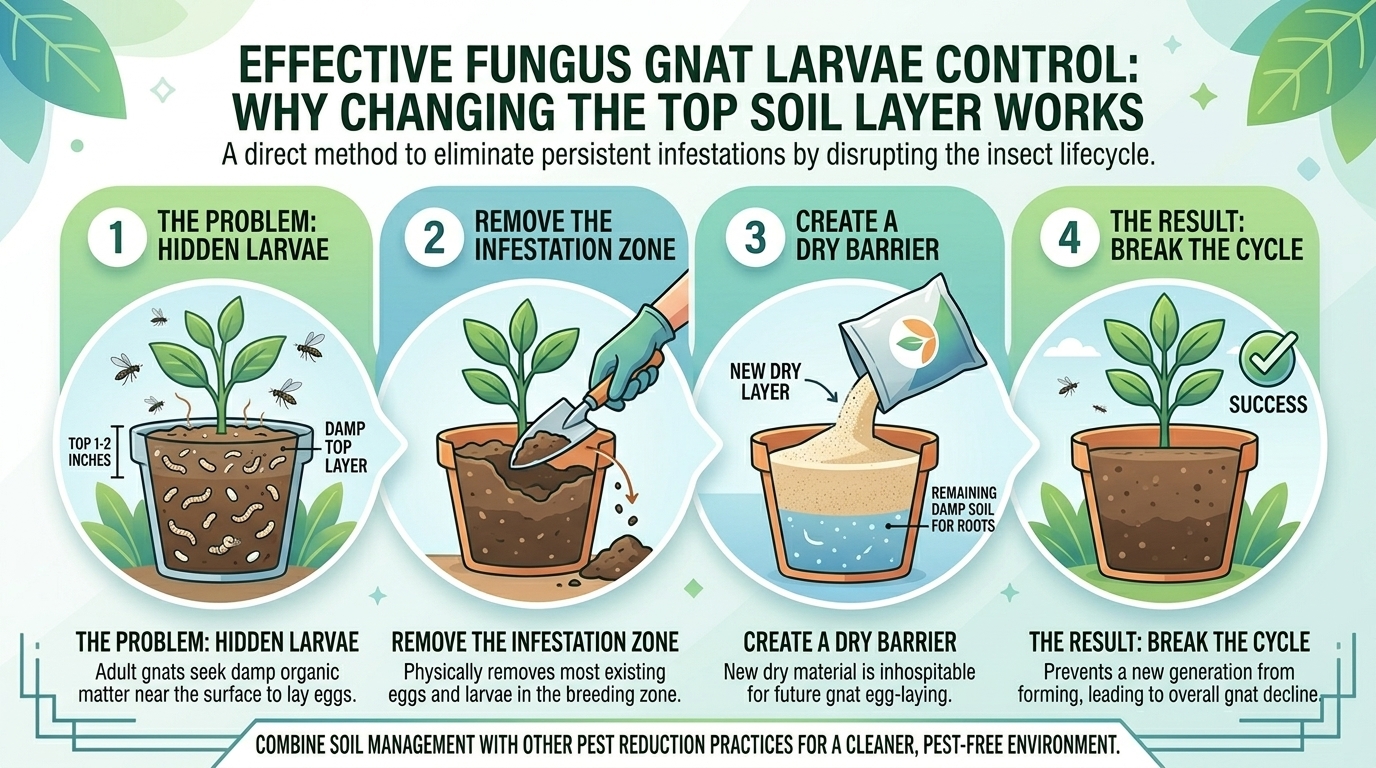
- The Fatal Flaw—Shallow Depositing: Adult female fungus gnats have very short lifespans (about one week) and lack strong mouthparts; their sole mission is to mate and lay eggs. Crucially, female gnats overwhelmingly prefer to deposit their tiny eggs in the top 1 to 2 inches of moist, organic-rich potting soil. They rarely burrow deep into the root ball.
- The Starvation and Desiccation Trap: The newly hatched larvae feed exclusively in this upper organic zone. By physically removing this top layer of soil, you strip away hundreds of unhatched eggs and active larvae in a single sweep, breaking the breeding cycle instantly.
Complete Tools and Materials Checklist
Executing a clean, mess-free top-soil replacement requires basic household tools and proper top-dressing materials.
| Category | Item | Recommended Specification | Purpose |
| Excavation Tool | Old Kitchen Spoon or Trowel | Small metal or plastic garden spoon | Gently scrapes away topsoil without severing roots |
| Disposal | Sealed Plastic Bags or Ziploc | Zip-seal garbage bags | Contains removed infested soil so pests don’t escape |
| Top-Dressing | Horticultural Sand or Pea Gravel | Coarse, washed sand or fine gravel | Creates an abrasive, dry barrier that deters egg-laying |
| Top-Dressing | Expanded Leams / Pumice | Lightweight inorganic grit | Enhances surface evaporation and stops moisture traps |
| Trapping | Yellow Sticky Cards | Commercial sticky insect traps | Captures surviving adult flying gnats |
Step-by-Step Guide: How to Replace the Top Layer of Soil
Replacing the topsoil is a surgical procedure that must be executed carefully to avoid damaging shallow plant roots while completely eliminating the gnat nursery.
Phase 1: Preparation and Drying
- Let the Soil Dry Out: Before scraping, allow your houseplant’s potting soil to dry out significantly for a few days. Fungus gnat larvae require constant moisture to survive; dry soil makes excavation cleaner and kills remaining surface larvae.
- Isolate the Plant: Move the infested houseplant away from neighboring plants temporarily to prevent adult gnats from migrating during the procedure.
Phase 2: Scraping Away the Infested Zone
- Scrape the Top 1 to 2 Inches: Using your spoon or trowel, carefully scrape away the top 1 to 2 inches of potting soil. Work your way gently around the main stem, pausing if you encounter major structural roots.
- Inspect for Larvae: As you peel back the layers, you may notice tiny, translucent, worm-like larvae with shiny black heads wriggling in the soil. This confirms your diagnosis.
- Bag and Seal Immediately: Dump the excavated, gnat-infested soil directly into a plastic garbage bag, seal it tightly, and discard it in your outdoor trash bin to prevent re-infestation.
Phase 3: Applying an Inorganic Barrier
Once the infested organic soil is removed, do not replace it with fresh organic potting mix (otherwise, adult gnats will immediately lay new eggs in it). Instead, install an inorganic top-dressing.
- The Sand or Gravel Layer: Fill the vacated top 1 to 2 inches with coarse horticultural sand, fine pea gravel, or pumice.
- Why This Works: Inorganic materials contain zero organic matter for larvae to eat, dry out rapidly between waterings, and present an abrasive physical barrier that female gnats cannot penetrate to lay eggs.
Regional Considerations for Fungus Gnat Management
Environmental factors across different regions heavily influence indoor moisture levels and gnat activity:
- Texas: Heavy reliance on air conditioning inside sealed Texas homes can create stagnant indoor microclimates. Ensure your indoor plants receive adequate airflow from ceiling fans to dry topsoils quickly.
- New York and the Northeast: During cold Northeastern winters, homes are heated by dry radiators, but lower indoor light levels slow down plant transpiration, keeping soil damp longer. Adjust watering frequency downward during winter months.
- California: Abundant natural sunlight helps indoor soils dry out rapidly across California homes, but over-watering indoor tropicals during warm spells can spark sudden gnat booms.
- Washington and the Pacific Northwest: High ambient humidity in the Pacific Northwest slows down soil evaporation. Using coarse, fast-draining potting mixes amended with perlite is essential to prevent chronic gnat issues.
- San Francisco: Cool maritime air and indoor fog can keep potting soil damp for extended periods in San Francisco apartments. Combining topsoil removal with inorganic sand top-dressing provides the ultimate moisture control.
Complementary Organic Methods to Ensure Total Eradication
While scraping away the top layer of soil eliminates the vast majority of eggs and larvae, combining it with these complementary organic treatments guarantees complete eradication:
- Yellow Sticky Traps: Place bright yellow sticky cards upright in your potted plants. Adult gnats are naturally attracted to the yellow color and will fly into the adhesive, stopping them from mating and laying new eggs.
- Mosquito Dunks (Bacillus thuringiensis israelensis – Bti): Crumble a piece of a Bti-based mosquito dunk into your watering can, let it steep for 24 hours, and water your plants with it. Bti produces natural biological toxins that selectively target and destroy gnat and mosquito larvae without harming plants, pets, or humans.
- Bottom-Watering: Transition from top-watering to bottom-watering. Place your potted plant in a tray of water for 20 minutes, allowing roots to drink upward through drainage holes while keeping the top 2 inches of soil bone dry.
Troubleshooting Common Fungus Gnat Issues
- Issue: I changed the topsoil, but adult gnats are still flying around the plant.
- Solution: The adult gnats you see currently flying were already mature and flying when you changed the soil; they live for about a week. Hang a yellow sticky card to catch these remaining adults while they finish their life cycle.
- Issue: The inorganic sand layer I added is holding too much moisture and turning green with algae.
- Solution: You likely used fine playground sand or beach sand, which packs down densely like concrete. Remove it immediately and replace it with coarse horticultural grit, poultry grit, or pumice to allow maximum airflow.
- Issue: Fungus gnats keep returning to all my houseplants simultaneously.
- Solution: Your potting mix may be infested straight out of the bag, or you are over-watering your entire collection. Let all your plants dry out thoroughly between waterings and treat all pots with Bti water.
Frequently Asked Questions (FAQ)
1. Why do fungus gnat larvae live specifically in the top layer of soil?
Female fungus gnats prefer to lay eggs in the top 1 to 2 inches because it is moist, rich in decomposing organic matter, and easily accessible. Larvae feed primarily in this upper zone where oxygen and organic debris are abundant.
2. Can fungus gnat larvae kill my houseplants?
Mature, healthy houseplants can easily tolerate a mild gnat infestation. However, heavy infestations of larvae can devour delicate root hairs and seedlings, stunting growth and creating entry wounds for root rot.
3. Should I replace all the soil in the pot or just the top layer?
You only need to replace the top 1 to 2 inches of soil. Excavating the entire root ball is unnecessary, stressful for the plant, and usually misses the point since eggs and larvae are concentrated at the surface.
4. What is the best material to use as a top-dressing after scraping the soil?
Coarse horticultural sand, fine pea gravel, pumice, or expanded clay pebbles make ideal inorganic top-dressings because they dry out quickly and prevent female gnats from laying new eggs.
5. Will replacing the topsoil kill all the gnats instantly?
It removes nearly 95% of unhatched eggs and active larvae instantly. However, any adult gnats currently flying around will need to be caught using yellow sticky cards.
6. Can I use regular playground sand from a hardware store?
No. Playground sand or fine sandbox sand packs down too tightly, cutting off oxygen to plant roots and trapping moisture. Always use coarse horticultural sand or grit.
7. How does bottom-watering help prevent fungus gnats?
Bottom-watering delivers moisture directly to the roots from the bottom drainage holes, leaving the top 2 to 3 inches of soil completely dry. Because dry topsoil cannot support gnat eggs or larvae, the breeding cycle stops.
8. What are Mosquito Dunks and are they safe for indoor plants?
Mosquito Dunks contain Bacillus thuringiensis israelensis (Bti), a natural bacterium that kills gnat and mosquito larvae when ingested. It is 100% safe for humans, pets, and plants.
9. Why does my potting soil attract fungus gnats in the first place?
Potting soils containing high amounts of peat moss, compost, and decomposing organic matter retain moisture, which naturally attracts breeding fungus gnats if kept consistently wet.
10. Where can I find more expert houseplant care guides and organic pest control tips?
For comprehensive horticultural advice, regional gardening strategies, and expert plant health resources tailored to your indoor garden, visit kcplants.com.
Conclusion
Persistent fungus gnat infestations can test the patience of even the most dedicated houseplant enthusiast, but eliminating them does not require harsh chemical insecticides or toxic aerosol sprays. By physically scraping away the top layer of infested organic potting soil and replacing it with a dry, inorganic barrier of coarse sand or pumice, you instantly dismantle the gnat nursery and break their life cycle. Whether you are managing urban apartment jungles in San Francisco or sprawling houseplant collections in Texas, this simple cultural technique ensures a clean, gnat-free indoor garden.