Why Direct Hot Afternoon Sun Through Glass Windows Can Burn the Delicate Leaves of Houseplants
Welcome back to kcplants.com! If you are an urban jungle curator or plant collector located anywhere from the sun-drenched windowsills of Texas to the coastal flats of San Francisco, the high-rises of New York, or the charming homes of Washington and California, you have likely experienced a heartbreaking moment: walking into your living room to find your favorite tropical houseplant sporting crisp, brown, paper-thin patches on its leaves.
You might assume your plant was simply getting “too much sun.” But more often than not, the culprit isn’t just sunlight—it is direct, unfiltered afternoon sunlight magnified and intensified through glass windows.
While outdoor tropical plants bask under the open sky in their native rainforest understories or arid habitats, indoor plants living behind glass experience a completely different optical environment. Understanding how window glass alters solar radiation is the secret to preventing leaf scorch and keeping your indoor foliage vibrant and healthy.
This comprehensive guide explores the physics of window sunburn, the biological impact on tropical foliage, and how to protect your collection across diverse regional climates.
1. The Physics of Window Burn: How Glass Magnifies Sunlight
To understand why indoor sunburn happens so rapidly, we have to look at what happens when sunbeams hit window glass.
The Greenhouse Effect Indoors
When sunlight passes through a windowpane, several optical phenomena occur:
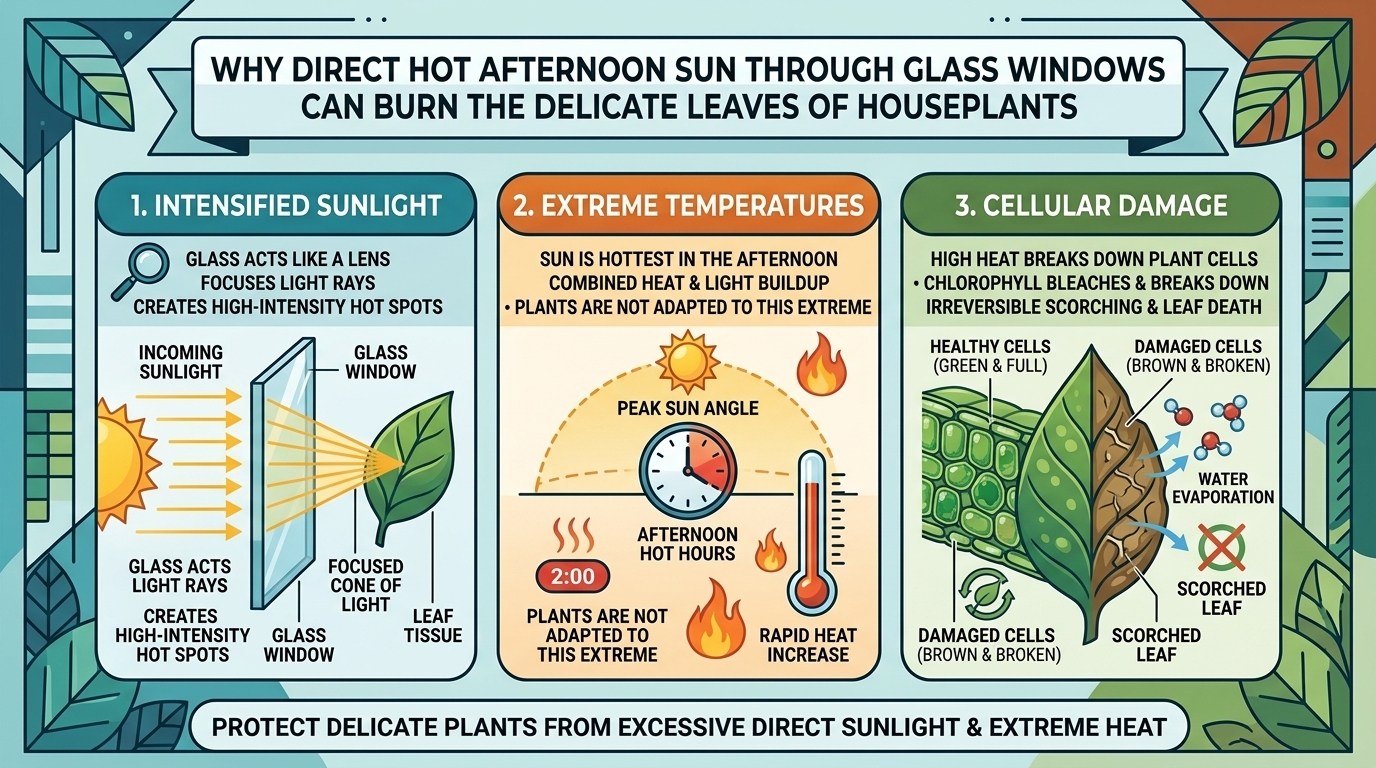
- Light Concentration: Standard window glass acts as a partial lens, concentrating light rays and intensifying thermal energy.
- UV Filtering vs. Heat Trapping: Modern window glass (especially double-paned, energy-efficient, or Low-E glass found in modern apartments in New York or San Francisco) filters out a significant portion of ultraviolet (UV) radiation, but it traps infrared heat.
- The Magnifying Glass Effect: If your window glass has microscopic imperfections, ripples, or water spots, or if you live in older buildings with wavy antique glass (common in historic homes across Washington), the glass can focus light into intense focal points—much like holding a magnifying glass over a leaf on a sunny afternoon.
Why Afternoon Sun is the Deadliest
Morning sun is gentle, low-angle light. Temperatures are cool, and the atmosphere has filtered the light through a thicker layer of air.
By contrast, afternoon sun (roughly 1:00 PM to 5:00 PM) is the most intense, scorching part of the day. The sun is high overhead, radiation levels peak, and indoor temperatures near south- and west-facing windows skyrocket. When intense afternoon heat hits glass, the ambient temperature in that micro-zone can soar by 15°F to 20°F higher than the rest of the room, cooking delicate plant tissues.
2. Regional Climates and Window Hazards
Your geographic location dictates how dangerous your windowsills are during peak afternoon hours.
Texas (The High-Intensity Zone)
- The Challenge: Texas summers bring blistering, relentless sunshine and extreme outdoor heat. West-facing windows in Texas act like ovens during afternoon hours, turning indoor sills into thermal traps.
- The Solution: Use sheer curtains or pull plants back at least 3 to 5 feet from west-facing windows during peak summer months.
New York & Washington (The Seasonal Trap)
- The Challenge: Winters here are cold and dark, so plant owners often shove every plant right up against south- or west-facing glass to catch every scrap of light. However, when spring arrives and the sun angle shifts higher, those exact same windows suddenly blast plants with scorching afternoon rays.
- The Solution: Monitor your windows seasonally. Relocate sun-sensitive tropicals away from glass as the days lengthen in late spring.
San Francisco & California (Coastal Microclimates)
- The Challenge: While San Francisco is famous for fog and cool coastal air, when the sun does break through a marine layer, the high coastal elevation and clear air pack a surprisingly intense UV and thermal punch.
- The Solution: Pay attention to sudden clear-sky days and provide filtered light using bamboo blinds or sheer linen curtains.
3. Anatomy of Leaf Scorch: What Happens to the Plant?
When a delicate tropical houseplant is subjected to hot afternoon sun through glass, cellular damage occurs rapidly.
1. Chlorophyll Bleaching
The intense light energy overwhelms the plant’s chloroplasts (the cellular machinery responsible for photosynthesis). The green pigment chlorophyll breaks down faster than the plant can rebuild it, turning the leaf pale, yellow, or bleached white.
2. Cellular Collapse (Necrosis)
As infrared heat bakes the leaf, moisture inside the plant cells evaporates faster than the roots can supply it. The cells literally dry up, collapse, and die. This results in crisp, brown, paper-thin patches or black burnt tips, typically appearing on the side of the leaf facing the window.
3. Sun-Stressed vs. Sun-Burnt
- Sun-Stressed (Acclimated): Some plants (like succulents or colorful Ctenanthe) develop gorgeous reddish or purple blushing when exposed to bright light safely. This is a natural, protective sunscreen pigment (anthocyanin).
- Sun-Burnt (Damaged): Actual sunburn is abrupt physical damage. It does not look pretty; it looks like dead, scorched tissue.
4. Which Plants Are Most Vulnerable?
Not all houseplants react to window heat the same way. Their vulnerability depends on their native evolutionary habitat.
- High Risk (Rainforest Understory Plants): Calatheas, Monsteras (juvenile), Ferns, Alocasias, Peace Lilies, and Prayer Plants evolve under thick jungle canopies where they only receive dappled, filtered light. Direct afternoon sun through glass will scorch their delicate leaves within hours.
- Medium Risk (Bright Indirect Lovers): Fiddle Leaf Figs, Pothos, Philodendrons, and Snake Plants can handle bright morning light, but harsh afternoon sun will burn their foliage, leaving unsightly dark brown patches.
- Low Risk (Desert Dwellers): Cacti, Agaves, and thick-leafed Succulents love intense sun. However, even desert cacti can suffer sunburn if abruptly moved from a dim indoor corner straight into a blistering south-facing window without gradual acclimation.
5. Practical Tips to Prevent and Manage Window Sunburn
- Use Sheer Curtains: Hanging white linen or sheer cotton curtains diffuses harsh direct rays, scattering the light so your plants get all the brightness they need without the thermal shock.
- The “Hand Test”: Place your hand between the windowpane and your plant during peak afternoon hours. If your skin feels uncomfortably hot, it is too hot for your tropical plant. Move the plant back.
- Acclimate Gradually: If you want to move a plant to a brighter window, do it over the course of 2 to 3 weeks, moving it a foot closer every few days so its cellular structure adapts safely.
- Rotate Your Pots: Rotating your plants 90 degrees every week ensures even light distribution and prevents one side of the plant from taking the brunt of harsh window angles.
- Prune Severely Damaged Leaves: Sun-burnt leaves will never heal or turn green again. Once a leaf is scorched, use sterilized scissors to snip it off (or trim away the dead edge) so the plant can redirect its energy into healthy new growth.
6. Frequently Asked Questions (FAQ)
1. Can a plant get sunburned on a cloudy or overcast day?
While severe thermal burns are rare on overcast days, glass windows can still transmit enough high-intensity light to cause mild stress, especially if the clouds suddenly break during the afternoon. However, the most destructive burns happen on clear, hot summer afternoons.
2. Can I reverse a sunburned leaf on my houseplant?
No. Once plant leaf tissue is scorched and turns brown or crisp, it is dead and cannot regenerate green color. You can safely prune off heavily damaged leaves for aesthetic reasons, leaving minor burns alone if the rest of the leaf is still photosynthesizing.
3. Why are only the leaves facing the window burning?
Houseplant leaves act like solar panels. The side facing the window receives direct, concentrated rays, while the back side is shaded by the plant’s own canopy. This creates one-sided scorching, which is why regular pot rotation is so important.
4. Do double-paned or energy-efficient windows protect plants from burning?
Modern double-paned or Low-E coated windows actually block a high percentage of UV rays, but they still trap infrared thermal heat. In fact, because they insulate homes so well, they can trap heat near the glass, creating a miniature hotbox for plants pressed against the pane.
5. Are grow lights safer than window sunlight?
Yes! Quality full-spectrum LED grow lights emit balanced, cool operating light specifically tuned for plant biology without the extreme thermal spikes and concentrated magnifying-glass effects associated with harsh window glass.
6. Why did my Monstera get burnt even though it’s a tropical plant?
In the wild, tropical monsteras climb massive rainforest trees, passing through shaded lower trunks before reaching the canopy. Young indoor monsteras are unaccustomed to harsh, unfiltered artificial window heat, making their large leaves prone to rapid scorching.
7. How far away from a south-facing window should I place sensitive plants?
For delicate shade-lovers like Calatheas or Ferns, keep them at least 4 to 6 feet away from south-facing or west-facing windows, or place them behind a sheer curtain to protect them from direct afternoon beams.
8. Does misting a sunburned plant help cool it down?
Never mist plants sitting in direct hot sun. Water droplets resting on leaves act as miniature magnifying glasses, intensifying the sun’s rays and instantly causing severe circular burn spots on the foliage.
9. Can indoor heating vents compound the damage of window sun?
Absolutely. If a window ledge is located directly above a floor heating vent in winter or an AC unit in summer, the combination of thermal air currents and direct glass heat creates an extreme microclimate that dehydrates and destroys leaves.
10. How can I tell the difference between sunburn and root rot?
Sunburn causes crisp, bleached, or brown patches on upper exposed leaves due to light and heat trauma. Root rot causes overall limpness, yellowing of lower leaves, and mushy stems caused by overwatered, suffocated roots.
Conclusion
Direct hot afternoon sun passing through glass windows is one of the most common hidden hazards for indoor houseplant collections. By understanding how window glass concentrates thermal heat and light, and by taking proactive steps like using sheer curtains, adjusting plant placement, and acclimate-testing your sills, you can safeguard your indoor jungle.