Welcome back to kcplants.com, your premier digital guide for sustainable, eco-friendly garden management and smart landscape design. Whether you are maximizing a compact rooftop container layout in San Francisco or New York, cultivating a thriving backyard vegetable patch beneath the intense sun of Texas and California, or managing cool-season crops through the damp, mist-laden valleys of Washington, one constant challenge unites all growers: protecting your plants from hungry insect pests.
When most gardeners think about defending their vegetables, flowers, and fruit crops, their minds immediately jump to physical row covers, organic insecticidal soaps, or botanical sprays. Yet, one of the most powerful, elegant, and historically proven pest-management strategies requires no spraying at all. It relies entirely on botanical warfare through scent.
By strategically interplanting intensely aromatic herbs like rosemary and mint around your garden beds, you create an invisible sensory camouflage field. This comprehensive guide explores the fascinating science of plant volatile organic compounds (VOCs), how aromatic herbs disrupt insect navigation, and how to design an effective scent-confused garden ecosystem.
Part 1: How Insects Find Your Plants (The Science of Olfactory Cues)
To understand why strong-smelling herbs work, you first need to understand how herbivorous insects hunt. Unlike humans, who rely heavily on visual cues to locate food, many destructive garden pests—such as aphids, whiteflies, carrot rust flies, cabbage moths, and flea beetles—are primarily chemically driven navigators.
1. The Power of Host Odor Plumes
Plants constantly release microscopic, airborne chemical compounds into the atmosphere. To a hungry pest floating on a gentle breeze or crawling through the soil, a single vulnerable tomato, brassica, or bean plant acts like an open bakery window releasing the scent of fresh pastries. Pests use their highly sensitive antennae, which are packed with specialized olfactory receptors, to track these specific odor plumes upwind straight to their meal.
2. Monocultures vs. Olfactory Overload
In nature, wild plants rarely grow in neat, isolated single-species rows. They grow in chaotic, densely mixed polycultures. Modern industrial agriculture and traditional home garden layouts often make the mistake of planting long, uninterrupted rows of a single crop (a monoculture). This creates a massive, concentrated beacon of scent that is exceptionally easy for pests to detect from hundreds of yards away.
Part 2: How Aromatic Herbs Disrupt Insect Navigation
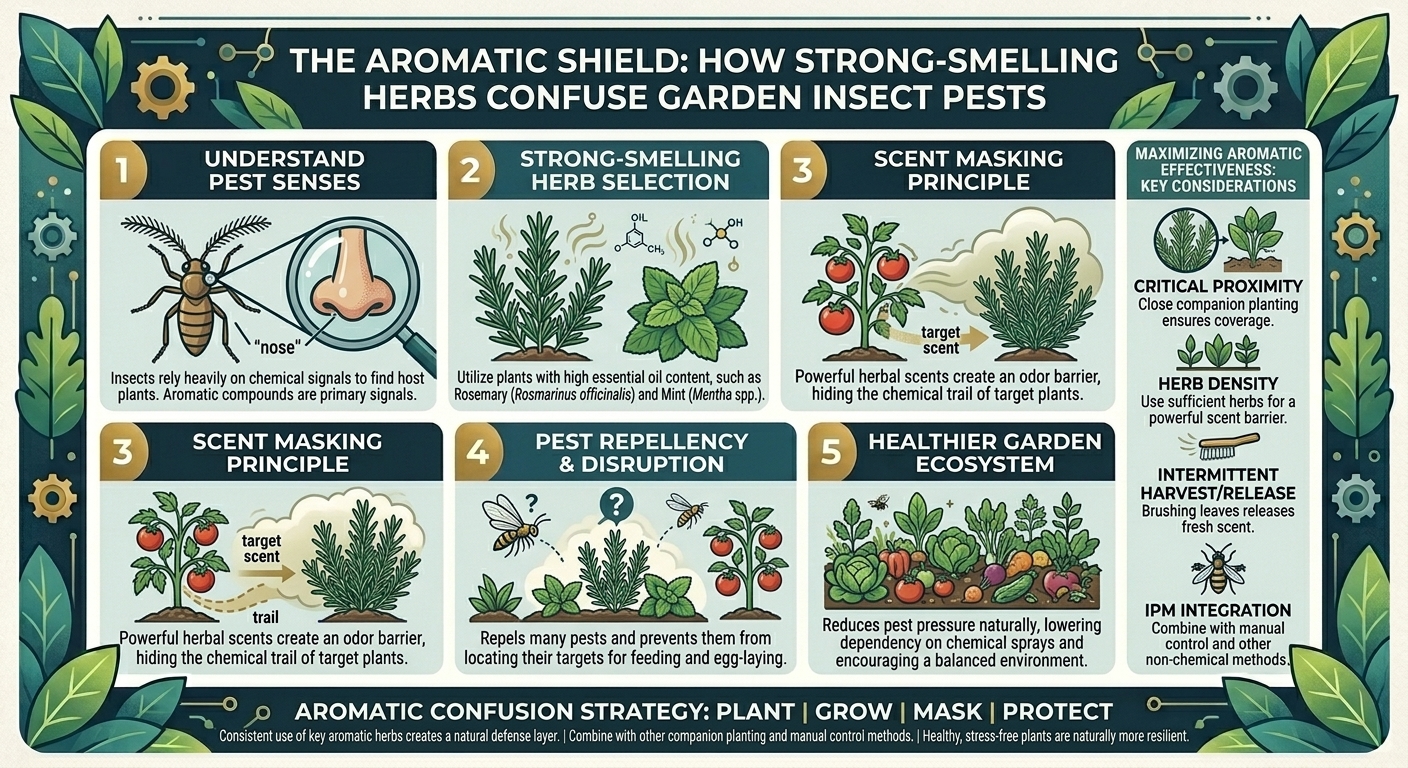
When you interplant pungent, essential-oil-rich herbs like rosemary, mint, thyme, and oregano into your vegetable layout, you fundamentally alter the garden’s sensory landscape through two primary mechanisms: scent-masking and repulsion.
1. Volatile Organic Compounds (VOCs)
Aromatic herbs are packed with powerful secondary metabolites—chemical compounds like camphor, eucalyptol, menthol, limonene, and pinene. These herbs continuously synthesize and release these volatile organic compounds (VOCs) into the surrounding air.
2. The “Invisibility Cloak” Effect (Olfactory Overload)
When wandering insect pests encounter a dense cloud of mixed VOCs rolling off a rosemary bush or a patch of mint, their sensitive antennae become overwhelmed.
- The Confusion: The intense, overlapping herbal aromas obscure and drown out the subtle odor plumes of your delicate vegetable crops.
- The Result: The pest’s chemical compass fails. Unable to isolate the distinct scent of a host plant, the insect becomes disoriented, loses interest, and flies or crawls away to search for an easier target.
Part 3: Spotlight on Powerful Aromatic Herb Champions
Not all herbs are created equal when it comes to scent-based pest deterrence. Here are the top botanical powerhouses to integrate into your garden design:
1. Rosemary (Salvia rosmarinus)
- The Aroma Profile: Heavy, woody, camphor-rich, and pine-like.
- Primary Pests Deterred: Carrot rust flies, cabbage loopers, bean beetles, and flea beetles.
- How It Works: Rosemary’s strong terpene profile acts as an intense olfactory barrier. When planted near carrots or brassicas, its sharp scent completely scrambles the host-seeking algorithms of flying pests.
2. Mint (Mentha species – Peppermint, Spearmint)
- The Aroma Profile: Sharp, cooling, high-menthol, and intensely pungent.
- Primary Pests Deterred: Aphids, flea beetles, cabbage moths, squash bugs, and ants.
- Crucial Growing Tip: Mint is a notoriously aggressive spreader that will take over a garden bed if planted directly in the soil. Always plant mint in large pots sunk into the ground, or keep container mint positioned near vulnerable perimeter zones (like squash and tomato beds) to harness its scent safely.
3. Thyme and Oregano
- The Aroma Profile: Spicy, warm, and rich in thymol and carvacrol.
- Primary Pests Deterred: Cabbage worms, whiteflies, and spider mites.
- Bonus Benefit: Low-growing thyme acts as a living ground cover that helps retain soil moisture while confusing crawling insects with its aromatic foliage.
Part 4: Step-by-Step Guide to Designing a Scent-Masked Garden
To maximize the confusion factor and protect your high-value crops, avoid planting all your herbs in one isolated corner of the yard. Instead, use an integrated design approach:
Step 1: Break Up Monocultures (Interplanting)
Never plant an entire raised bed with just one crop. Instead of a solid block of kale or tomatoes, weave aromatic herb starts directly into the rows. Space rosemary or thyme plants every 2 to 3 feet between your vegetable clusters.
Step 2: Establish an Outer Perimeter Shield
Plant a dense defensive ring of mixed aromatic herbs around the outer boundary of your garden beds or raised boxes. This acts as an initial olfactory frontline, greeting wandering pests with a wall of intense VOCs before they even reach your interior crops.
Step 3: Trigger the Volatiles (Friction and Maintenance)
Herb plants release more volatile organic compounds when their leaves are gently brushed, jostled, or warmed by the afternoon sun. Plant your fragrant herbs along narrow garden pathways where you, your pets, or passing breezes will frequently brush against them, releasing fresh waves of scent into the air.
Part 5: Frequently Asked Questions (FAQ)
1. Do scented herbs actually kill garden pests on contact?
No. Aromatic herbs do not act as chemical insecticides that instantly kill pests. Instead, they act as deterrents, maskers, and confusers, making it difficult for pests to find, recognize, or settle down on your valuable crops.
2. Can rosemary and mint repel every single insect in the garden?
No. While they are exceptionally effective against many common vegetable pests (like carrot flies, cabbage moths, and aphids), highly specialized pests with strong visual cues or high tolerance levels may still occasionally breach the barrier. A holistic pest management plan is always recommended.
3. How do I stop mint from taking over my entire garden?
Mint spreads aggressively via underground runners (stolons). To enjoy its pest-confusing benefits without losing your garden beds, always plant mint in large pots, containers, or bottomless barrier buckets sunk flush with the soil line.
4. Will planting rosemary near my vegetables stunt their growth?
Rosemary prefers dry, lean, well-draining soil and can become quite large and woody over time. Ensure you pair it with vegetables that share similar watering preferences (such as peppers, eggplant, and tomatoes), and prune it regularly so it doesn’t shade out smaller companion crops.
5. Do dried herbs work just as well as living plants for scent confusion?
Living, actively growing herbs produce a continuous, dynamic stream of volatile organic compounds driven by photosynthesis and warmth. Dried herbs lose most of their volatile oils quickly and will not provide active scent-masking in an outdoor garden setting.
6. Can I use aromatic herbs in container gardens on an apartment balcony?
Absolutely! Container gardening is one of the best places to utilize scent masking. Planting pots of rosemary, mint, basil, and thyme directly alongside your container tomatoes and lettuce on a sunny balcony in San Francisco or New York creates an enclosed micro-ecosystem that deters wandering pests.
7. Do these herbs also attract beneficial predatory insects?
Yes! When aromatic herbs are allowed to flower, their blossoms are absolute magnets for beneficial predatory insects—such as hoverflies, parasitic wasps, and lacewings—whose larvae actively hunt down garden pests like aphids and thrips.
8. Does the intensity of the herb’s scent affect how well it works?
Yes. Herbs grown in full sun and slightly stressed (not over-watered or over-fertilized) produce much higher concentrations of essential oils and VOCs, making them significantly more effective at masking scents than lush, water-logged plants grown in heavy shade.
9. Are there any vegetables that hate being planted near rosemary or mint?
Generally, most vegetables tolerate aromatic herbs well, but mint can occasionally compete aggressively for water and root space if planted too close to delicate, shallow-rooted crops. Keep mint contained in its own pots placed strategically among your beds.
10. How often should I prune my aromatic herbs to maintain scent output?
Pruning or harvesting your herbs regularly encourages fresh, vigorous growth. Every time you snip sprigs of rosemary or mint for your kitchen cooking, you stimulate the plant to release fresh volatile oils that boost your garden’s scent barrier.
Conclusion
Harnessing the power of aromatic herbs is one of the most rewarding ways to work in harmony with nature. By moving away from solid monoculture plantings and weaving fragrant champions like rosemary and mint throughout your garden ecosystem, you can successfully confuse wandering insect pests, protect your tender crops, and enjoy a flourishing, aromatic harvest from coast to coast.