Why Soil Aeration Is Critical for Delivering Oxygen to the Roots of Heavy-Feeding Garden Plants
When gardeners invest time and money into planting high-performance, heavy-feeding crops—such as indeterminate slicing tomatoes, sweet corn, sprawling squash, heavy-fruiting peppers, and vigorous brassicas—they typically focus on what goes above the ground. We obsess over balanced fertilizers, regular watering schedules, trellis systems, and pest management.
However, the true engine room of any high-yielding garden plant is hidden entirely out of sight: the root zone.
While most beginner gardeners know that plants need water and sunlight, many overlook a third vital requirement: oxygen. Plant roots are living, breathing biological organs that consume oxygen and release carbon dioxide through cellular respiration. When soil becomes heavily compacted, waterlogged, or dense, oxygen gets squeezed out. For heavy-feeding plants that demand intense metabolic energy to fuel rapid growth and heavy fruit sets, a lack of soil aeration spells disaster.
Whether you are managing heavy, impermeable clay in Texas, optimizing urban container setups in San Francisco, balancing suburban garden plots in New York, or navigating moisture-rich soils across Washington State and California, this comprehensive guide explores the vital science of soil aeration, why heavy feeders demand it, and how to maintain a breathable, oxygen-rich root zone.
1. The Hidden Physiology: Why Roots Need Oxygen
To understand why soil aeration is non-negotiable, you must look at how plant roots function beneath the surface.
Root Respiration and Nutrient Uptake
Photosynthesis occurs in the leaves during the day, where plants capture sunlight to create sugars. But how do roots utilize those sugars? They burn them through cellular respiration—a process that requires a constant supply of oxygen drawn directly from the air pockets within the soil matrix.
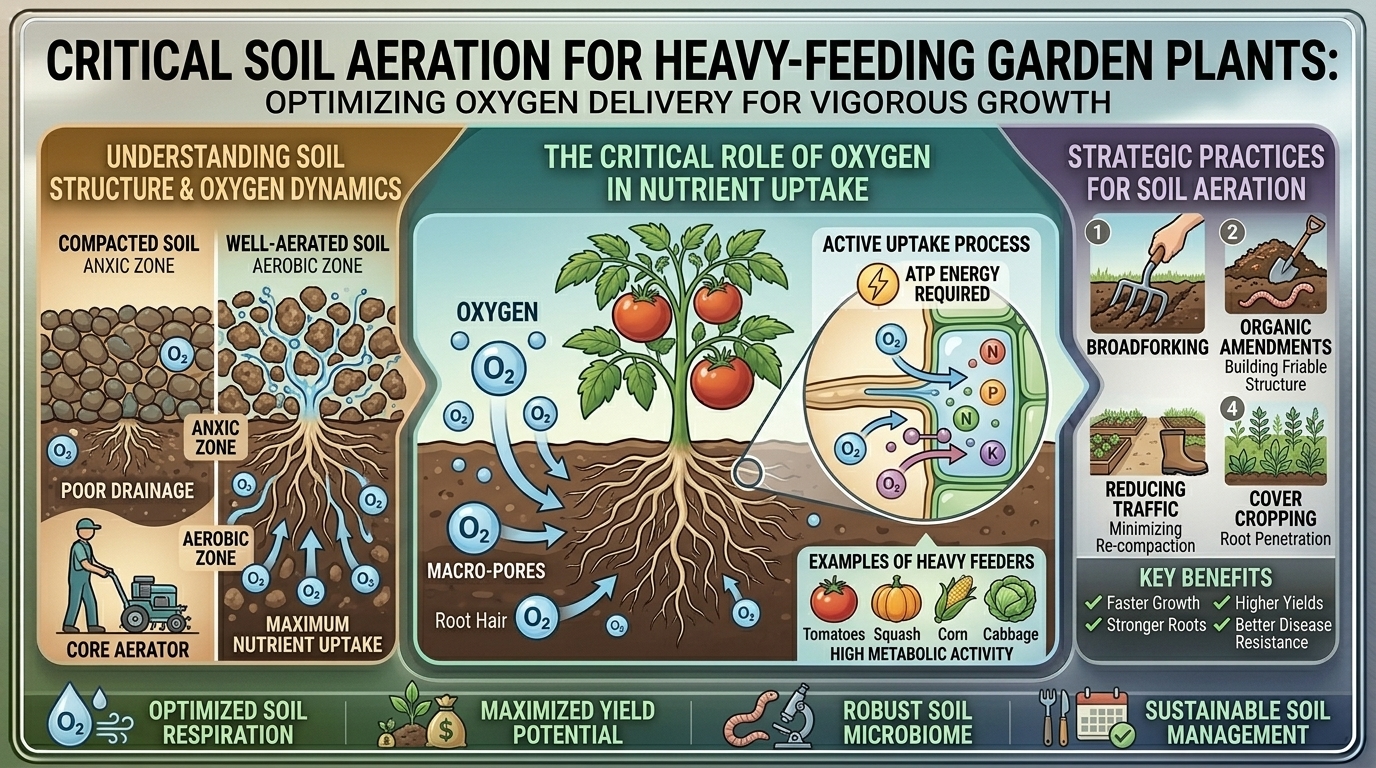
- Active Transport: To pull mineral nutrients (like nitrogen, phosphorus, potassium, and calcium) out of the soil and push them up into the stem and leaves, root cells require chemical energy (ATP). That energy is generated through oxygen-dependent respiration.
- The Suffocation Domino Effect: When soil lacks oxygen, root respiration plummets. Without energy, active transport shuts down. Even if your soil is packed with expensive fertilizers, an oxygen-deprived plant cannot absorb those nutrients, leading to stunted growth, nutrient deficiencies, and wilting.
2. The Dangers of Soil Compaction and Anaerobic Conditions
When soil structure degrades, pore spaces—the tiny pockets of air and water trapped between soil particles—collapse. This triggers a destructive chain reaction.
[ Soil Compaction Trigger ]
       │
       ├──> 1. Pore Spaces Collapse (Air Pockets Eliminated)
       │
       ├──> 2. Oxygen Diffusion Stops (Anaerobic Environment Forms)
       │
       ├──> 3. Root Suffocation & Pathogen Surge (Root Rot / Pythium)
       │
       └──> 4. Nutrient Lockout & Plant Collapse
The Birth of Anaerobic Zones
In un-aerated, waterlogged, or heavily compacted earth, oxygen is depleted faster than it can diffuse from the atmosphere. This creates an anaerobic (oxygen-free) environment.
- Toxic Byproducts: Anaerobic bacteria thrive in these suffocating conditions, producing toxic compounds like hydrogen sulfide and organic acids that burn and destroy delicate root hairs.
- Root Rot and Fungal Pathogens: Destructive water molds and fungi (such as Pythium and Phytophthora) thrive exclusively in oxygen-starved, wet soils. They attack suffocated roots, causing rapid root rot and plant collapse.
3. Why Heavy-Feeding Plants Have Massive Oxygen Demands
Not all plants have the same root respiration requirements. Slow-growing succulents or native desert shrubs require very little soil oxygen exchange. Heavy-feeding garden plants, however, are botanical marathon runners.
The Metabolic Load of Fruiting Crops
- Massive Root Biomass: Heavy feeders like indeterminate tomatoes and winter squash build extensive, deep root systems that require continuous oxygen to sustain their underground footprint.
- Rapid Nutrient Cycling: Producing pounds of juicy fruit requires relentless metabolic activity. If root zones suffocate even for a few days during a heat wave or heavy rainstorm, the plant immediately drops blossoms, halts fruit expansion, and shows severe stress symptoms.
4. Top Techniques to Boost Soil Aeration Without Tilling
Traditional agricultural advice often recommended rototilling compacted soil to restore air space. However, modern regenerative horticulture proves that tilling destroys soil structure and fungal networks. Here is how to aerate safely:
1. Broadforking (Non-Invasive Fracturing)
A broadfork is a heavy-duty manual tool equipped with sturdy steel tines.
- The Technique: Step onto the crossbar and use your body weight to drive the tines straight down into the soil, then gently rock the handles backward. This fractures and lifts dense soil layers vertically, creating micro-fissures that allow air and water to penetrate without inverting or destroying the soil layers.
2. Incorporating Coarse Porosity Amendments
When building raised beds or potting mixes, never rely on fine dirt alone.
- Aggregates: Mix in coarse materials such as horticultural perlite, pumice, expanded shale, or organic orchid bark. These rigid, irregular particles create permanent air channels in the soil matrix that cannot be easily crushed by foot traffic or heavy rain.
3. Fostering Deep-Rooting Cover Crops and Earthworms
Nature builds the ultimate aeration system for free.
- Biological Tillage: Planting taproot cover crops like daikon radish in autumn creates deep vertical channels as the roots decompose over winter. Simultaneously, feeding your soil with organic compost encourages earthworms, whose burrows act as permanent biological aeration tunnels.
5. Regional Aeration Challenges Across U.S. Climates
Regional soil types and weather conditions dictate how easily your garden beds lose or maintain soil oxygen:
Texas
- Climate Challenge: Heavy “Blackland Prairie” clay and gumbo soils pack tightly into rock-hard bricks when dry, sealing off all air pockets.
- Aeration Strategy: Incorporate expanded shale and organic compost into raised beds to break up clay cohesion. Use broadforks after spring rains to introduce air into deep sub-surface layers before summer heat arrives.
California & San Francisco
- Climate Challenge: Dry Mediterranean summers bake garden soils into dense crusts, while urban container gardeners face severe media compaction over single growing seasons.
- Aeration Strategy: Use high ratios of coarse pumice in container potting mixes. In-ground garden beds require thick organic mulches to prevent surface crusting and protect soil macro-porosity from baking sun.
New York
- Climate Challenge: Suburban and urban clay-loam soils are frequently compacted by foot traffic and heavy spring thunderstorms that saturate the topsoil.
- Aeration Strategy: Avoid walking directly inside garden beds. Use dedicated pathways and annual top-dressings of compost and coarse organic matter to maintain structural porosity.
Washington State
- Climate Challenge: Extended cool, damp autumns and springs keep regional soils waterlogged, pushing oxygen levels to critical lows.
- Aeration Strategy: Raise garden beds significantly above ground level and incorporate high amounts of coarse bark and perlite to ensure rapid drainage and continuous air exchange during wet months.
6. Frequently Asked Questions (FAQ)
1. Does regular watering suffocate plant roots?
Watering itself does not suffocate roots, provided the water drains through the soil quickly. As gravity pulls water down, it pulls fresh air (oxygen) behind it into the pore spaces. Suffocation only occurs when water stays trapped in the soil, completely blocking air exchange for extended periods.
2. Can I aerate my potted houseplants with a fork?
Yes! Gently poking holes into the top 2 inches of indoor potted plant soil using a chopstick or small garden fork helps break up surface crusting and restores air permeability. Just take care not to puncture major root systems.
3. Why is tilling considered bad for soil aeration long-term?
While tilling introduces temporary air pockets, it shatters delicate mycorrhizal fungal networks, oxidizes and burns off vital organic matter, and brings buried weed seeds to the surface. Furthermore, the first heavy rain will cause tilled soil to slump and compact even tighter than before.
4. How do earthworms naturally aerate garden soil?
Earthworms tunnel continuously through the earth, eating organic matter and casting out nutrient-rich worm poop (castings). Their burrows act as permanent biological ventilation shafts that deliver oxygen deep into the root zone and improve water drainage.
5. What are the signs that my plants are suffering from a lack of soil oxygen?
Symptoms of oxygen starvation include sudden yellowing of lower leaves, wilting despite moist soil, stunted growth, premature blossom drop, and a sour, stagnant smell rising from the damp earth around the plant base.
6. Does adding organic compost improve soil aeration?
Yes. Organic compost contains spongy humus particles that clump mineral soil into stable aggregates (“crumbs”). These crumbs create a honeycomb-like matrix of macro-pores and micro-pores that balance water retention with ideal oxygen diffusion.
7. Are raised beds better for soil aeration than in-ground beds?
Generally, yes. Raised beds sit higher off the ground, allowing excess water to drain away via gravity much faster than compacted native in-ground soil, naturally maintaining higher oxygen levels in the root zone.
8. Can I use liquid oxygen or hydrogen peroxide to aerate soil?
Diluted hydrogen peroxide (3%) mixed with water can provide a temporary emergency burst of oxygen to waterlogged, root-rotted container plants by releasing an extra oxygen atom as it breaks down. However, it is a short-term band-aid and should not replace proper soil structure management.
9. How deep do plant roots actually need oxygen?
While the majority of active nutrient-absorbing feeder roots and biological activity occur in the top 6 to 12 inches of soil, heavy-feeding crops like tomatoes can send roots several feet deep, requiring aeration throughout the upper root profile.
10. How often should I check or improve my garden soil’s aeration?
Evaluating and improving soil structure should be an ongoing seasonal habit. Top-dressing your beds with 1 to 2 inches of compost and organic matter every spring and autumn ensures your soil maintains permanent, resilient porosity year after year.
Conclusion
Delivering oxygen to the roots of heavy-feeding garden plants is just as important as supplying water and sunlight. When you maintain a porous, well-aerated soil structure through non-invasive techniques like broadforking, incorporating coarse aggregates, and feeding your soil food web with organic matter, you prevent root suffocation, eliminate toxic anaerobic conditions, and unlock maximum nutrient uptake.