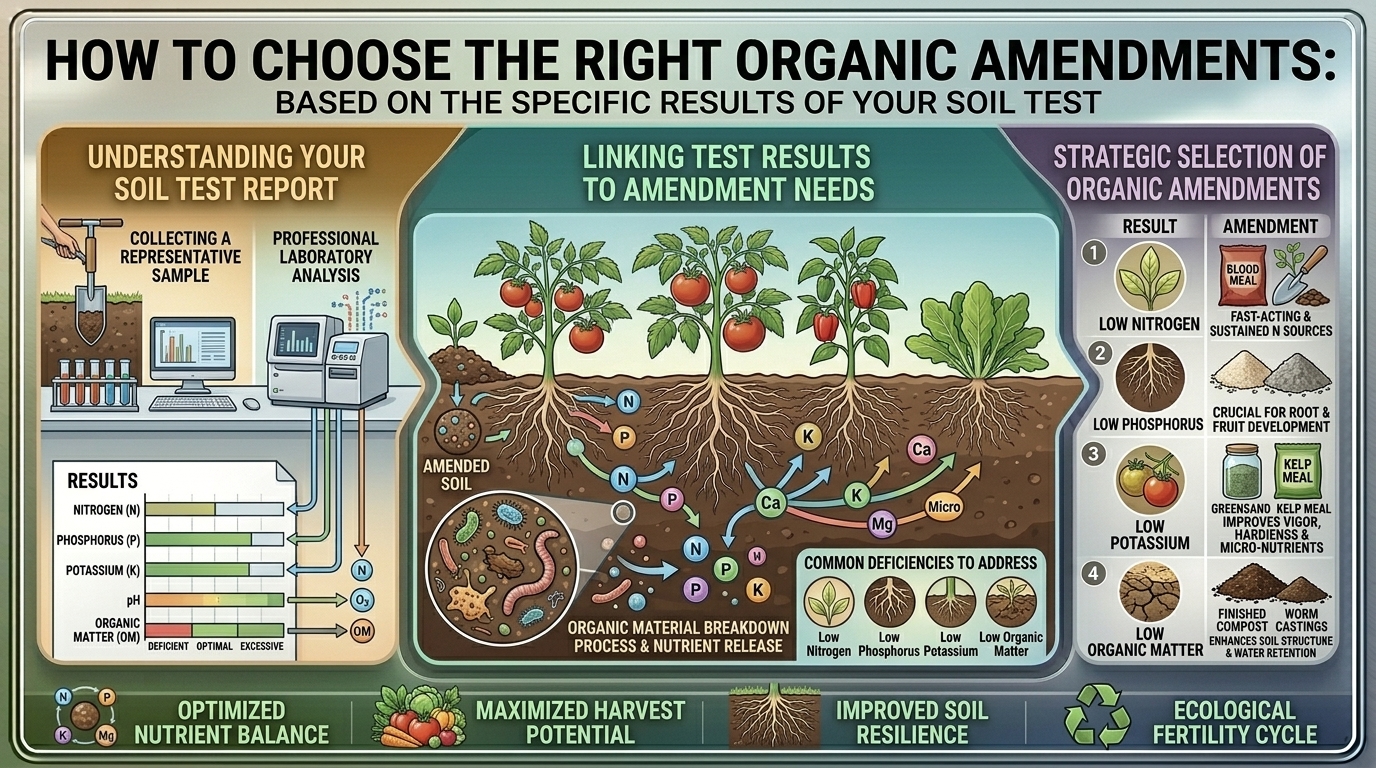
How to Choose the Right Organic Amendments Based on the Specific Results of Your Soil Test
Gardeners frequently treat soil management like a guessing game. When plants look pale, grow slowly, or produce disappointing yields, the default reaction is often a frantic trip to the garden center to purchase a generic all-purpose fertilizer. Sometimes it helps; frequently, it wastes money, pollutes local watersheds, and creates chemical imbalances that stress plants even further.
The secret to a thriving, hyper-productive backyard garden is simple: Never guess—test.
Running a professional or DIY soil test provides a scientific window into your earth’s chemical makeup, revealing exact pH levels, macronutrient availability, and organic matter percentages. However, reading a lab report filled with acronyms and parts-per-million (ppm) figures can feel like deciphering an alien language. How do you translate raw soil test numbers into precise, organic amendment strategies?
Whether you are managing baking alkaline clay in Texas, balancing urban rooftop and courtyard containers in San Francisco, revitalizing suburban plots in New York, or adapting to nutrient-leached soils across Washington State and California, this comprehensive guide explores how to interpret soil test results and select the exact organic amendments your garden needs.
1. Decoding Your Soil Test: The Core Metrics
Before you can choose amendments, you must understand what a standard comprehensive soil test measures.
[ Soil Test Analysis Framework ]
       │
       ├──> 1. Soil pH (Acidic vs. Alkaline Balance)
       │
       ├──> 2. Macronutrients (N-P-K Levels)
       │
       ├──> 3. Cation Exchange Capacity (CEC - Nutrient Holding Power)
       │
       └──> 4. Organic Matter Percentage (Biological Activity Index)
1. Soil pH (The Master Controller)
Soil pH measures the hydrogen ion concentration on a scale from 0 to 14, where 7.0 is neutral.
- Why It Matters: Even if your soil is packed with nutrients, a locked-out pH makes them chemically unavailable to plant roots. Most vegetables thrive in a slightly acidic sweet spot of 6.0 to 6.8, while acid-loving crops like blueberries demand 4.5 to 5.5.
2. Macronutrients ($N$-$P$-$K$)
- Nitrogen ($N$): Drives leafy vegetative growth. (Note: Nitrogen tests fluctuate rapidly and are often measured by predicted organic matter).
- Phosphorus ($P$): Powers root development, flower blooming, and fruit set.
- Potassium ($K$): Regulates water pressure, disease resistance, and overall plant cellular health.
3. Organic Matter (% OM)
The golden benchmark for a healthy garden soil is 5% to 8% organic matter. If your test shows OM below 3%, your soil lacks the biological sponge necessary to retain water and buffer nutrient swings.
2. Matching Amendments to Test Results: A Step-by-Step Guide
Once your test results arrive, match the specific deficiencies to the appropriate 100% natural organic amendments.
Scenario A: Your Soil pH Is Too High (Alkaline Soil, pH > 7.2)
- The Problem: Common across western states, Texas, and arid regions. High pH locks up iron, manganese, and phosphorus, causing yellowing leaves (chlorosis).
- Organic Amendments:
- Elemental Sulfur (Agricultural Sulfur): Soil bacteria slowly oxidize sulfur into sulfuric acid, gradually lowering pH.
- Sphagnum Peat Moss or Coconut Coir: Naturally acidic organic matter that lowers pH while boosting organic content.
- Pine Needle Mulch & Cottonseed Meal: Excellent organic top-dressings that introduce mild acidity as they decompose.
Scenario B: Your Soil pH Is Too Low (Acidic Soil, pH < 5.8)
- The Problem: Common in high-rainfall regions like the Pacific Northwest and the Northeast. Highly acidic soils aluminum-toxicity and stunt microbial activity.
- Organic Amendments:
- Agricultural Limestone (Calitic or Dolomitic Lime): Neutralizes acidity while supplying vital calcium and magnesium.
- Wood Ash: An alkaline kitchen-waste amendment rich in potassium and calcium carbonate (use sparingly to avoid sharp pH spikes).
Scenario C: Phosphorus ($P$) Deficiency Detected
- The Problem: Plants show purplish stems, slow root growth, and poor blossom set.
- Organic Amendments:
- Bone Meal: A classic organic amendment rich in slow-release phosphorus and calcium.
- Soft Rock Phosphate: A mined mineral powder that provides long-term, sustained phosphorus release, especially effective in acidic to neutral soils.
- Worm Castings: Biological powerhouse rich in bio-available phosphorus and microbial life.
Scenario D: Potassium ($K$) Deficiency Detected
- The Problem: Weak stems, poor drought tolerance, and marginal leaf scorching.
- Organic Amendments:
- Kelp Meal (Seaweed Extract): The premier organic source of soluble potassium, trace minerals, and natural plant growth hormones.
- Greensand: Mined marine potash deposit that breaks down very slowly to build long-term potassium reserves.
- Sul-Po-Mag (Potassium Magnesium Sulfate): An OMRI-listed natural mineral crystal supplying instant potassium and magnesium.
3. Regional Realities: Interpreting Soil Tests Across the U.S.
Regional geology and climate dictate what standard soil tests reveal:
California & San Francisco
- Test Trends: Typically alkaline pH (7.2 to 8.0), low organic matter due to dry heat, but high native mineral reserves.
- Amendment Strategy: Focus heavily on adding compost and peat to lower pH and boost organic matter, supplemented with iron sulfate or elemental sulfur in inland valleys.
Texas
- Test Trends: Heavy clay soils with high alkaline pH, often locking up phosphorus and iron, accompanied by widely variable organic percentages.
- Amendment Strategy: Use elemental sulfur, expanded shale for aeration, and heavy applications of organic compost to soften heavy clay structures.
New York
- Test Trends: Loamy to slightly acidic soils that have been intensively gardened for decades, frequently running low on phosphorus and trace minerals.
- Amendment Strategy: Apply bone meal and rock dust annually to replenish mined macronutrients and trace minerals before spring planting.
Washington State
- Test Trends: Naturally acidic soils (pH 5.0 to 6.0) due to high conifer coverage and heavy rainfall, which rapidly leaches soluble potassium and nitrogen.
- Amendment Strategy: Apply agricultural limestone to balance acidity for general vegetable beds, alongside kelp meal to restore leached potassium.
4. Frequently Asked Questions (FAQ)
1. How often should I test my garden soil?
You should test your backyard garden soil every 2 to 3 years. If you are managing new, highly variable raised beds or trying to rescue severely depleted earth, annual testing helps you track how your organic amendments are shifting your soil chemistry.
2. Can I use a cheap DIY soil test kit from the hardware store?
Inexpensive color-comparison paper strip kits offer a rough ballpark estimate of pH and general $N$-$P$-$K$ levels. However, for precise accuracy, sending a core sample to a professional agricultural extension laboratory provides exact parts-per-million (ppm) data and tailored amendment recommendations.
3. What is Cation Exchange Capacity (CEC), and why does it matter?
CEC measures your soil’s chemical capacity to hold onto positively charged nutrient ions (like calcium, magnesium, and potassium) and exchange them with plant roots. Sandy soils have low CEC (nutrients wash away easily); clay and high-organic-matter soils have high CEC (nutrients are held securely).
4. Can I over-amend my soil based on a test result?
Yes! Adding excessive amounts of a single mineral amendment (like raw bone meal or lime) can create nutrient antagonisms, locking out other vital elements like zinc or iron. Always follow laboratory application rates precisely.
5. Why does my soil test show high phosphorus, but my plants look deficient?
This is a classic “nutrient lockout” scenario. Even if phosphorus is physically present in the soil, if your soil pH is too high or too low, or if the soil is too cold and waterlogged, plant roots cannot absorb it. Fix the pH before adding more fertilizer.
6. Do organic amendments work instantly like synthetic fertilizers?
No. Organic amendments rely on soil microbes, moisture, and biological weathering to break down and release nutrients. They work gradually over weeks and months, building long-term soil fertility rather than forcing quick, artificial growth spurts.
7. Should I test my soil in spring or autumn?
Autumn is the ideal time to test your soil. Testing in fall gives you months over the winter to apply slow-acting organic amendments (like limestone, rock dust, or sulfur) so they can weather and integrate fully before spring planting begins.
8. How do I take a proper soil core sample?
Avoid grabbing dirt from just one spot. Take 6 to 8 core samples from across your entire garden bed at a depth of 6 inches, mix them together in a clean plastic bucket, and take a representative 1-cup sample from that thoroughly blended mix to test.
9. Can I use fresh manure based on soil test results?
Never use raw, uncomposted animal manure based on soil tests. Fresh manure is dangerously high in salts and ammonia, can burn plant roots, and may harbor harmful human pathogens. Always use fully aged, composted manure.
10. What is the single best amendment for almost all soil test deficiencies?
Finished organic compost is the ultimate universal corrective amendment. It introduces balanced trace minerals, buffers extreme pH levels, boosts Cation Exchange Capacity, and injects billions of beneficial microbes that unlock locked nutrients.
Conclusion
Interpreting a soil test and selecting precise organic amendments transforms gardening from a frustrating guessing game into an exact, highly rewarding science. By matching your soil’s specific pH and nutrient deficiencies to targeted natural inputs like kelp meal, bone meal, elemental sulfur, or agricultural limestone, you build a resilient, balanced subterranean ecosystem.