Why Thinning Out Crowded Carrot Seedlings Is Necessary to Produce Straight, Unblemished Roots
Introduction: The Secret to Market-Quality Carrots
Every home gardener and urban grower dreams of pulling a vibrant, perfectly straight, crisp carrot out of the soil. Yet, many beginner and intermediate gardeners face a frustrating reality at harvest time: tangled, forked, hairy, and stunted roots that look more like bizarre creatures than the produce aisle staples we expect.
The primary culprit behind misshapen carrots isn’t poor soil fertility or incorrect watering—it is overcrowding.
Carrots (Daucus carota subsp. sativus) grow entirely underground, meaning their spatial requirements are entirely dictated by subterranean competition. When carrot seeds germinate, they often emerge in dense clusters due to their tiny size. Left unattended, these seedlings battle fiercely for light, moisture, and root space.
This comprehensive guide explores the science, biology, and practical steps of thinning carrot seedlings. Whether you are gardening under the intense sun of Texas, managing the short seasonal windows in New York, adapting to microclimates in California and San Francisco, or navigating the cooler, damp soils of Washington, mastering the art of thinning is your gateway to a bountiful, picture-perfect harvest.
The Botanical Science: Why Carrots Fork and Deform
To understand why thinning is non-negotiable, you must first understand how a carrot grows.
A carrot is a taproot—a primary root that grows straight down into the earth, acting as a storage organ for the plant’s sugars and nutrients. For this taproot to develop smoothly, it needs an unobstructed path of loose, pliable soil.
1. Subterranean Competition
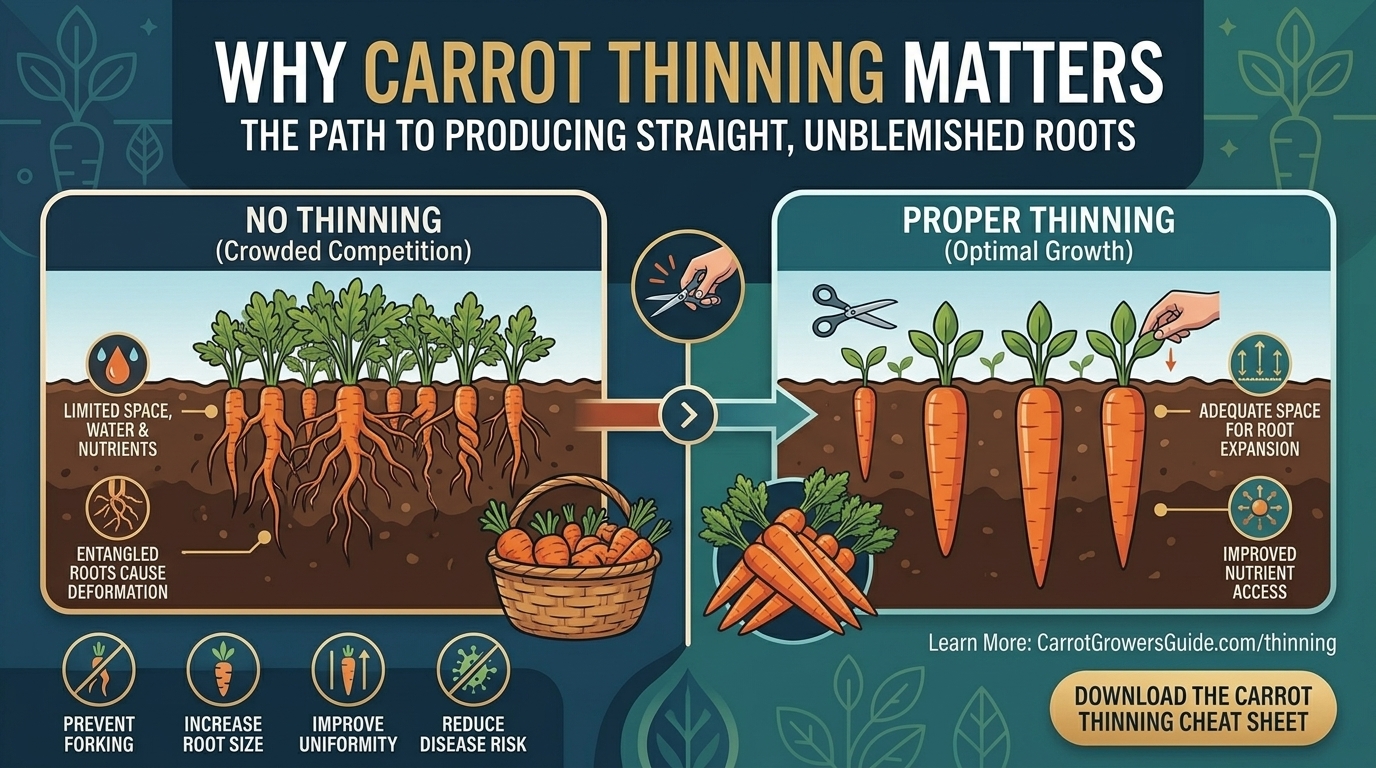
When carrot seeds are sown too close together, their emerging roots immediately cross paths. As the taproots expand to store energy, they physically collide with neighboring roots. This physical barrier forces the primary growing tip to divert, split, or stunt, resulting in:
- Forking: Multiple roots forming from a single plant because the main tip was damaged or blocked.
- Twisting and Interlacing: Roots wrapping around each other, creating a knotted, unusable mess at harvest.
2. Nutritional and Moisture Stresses
Crowding leads to fierce competition above and below ground. Plants that are too close together deplete nitrogen, phosphorus, potassium, and moisture in a concentrated micro-zone. Stressed plants signal the root to stop vertical expansion, leading to woody, thin, or prematurely bolted carrots.
3. Reduced Photosynthesis and Airflow
Above ground, a dense canopy of carrot greens creates a humid, light-deprived environment. Lower leaves struggle to capture sunlight, reducing overall plant vigor. Furthermore, poor airflow increases susceptibility to fungal diseases such as powdery mildew or cavity spot.
Regional Growing Considerations for kcplants.com Growers
Growing carrots successfully varies drastically depending on your regional climate and soil composition. Tailoring your thinning strategy to your local environment ensures maximum yields.
Texas: Managing Heat and Heavy Soils
- The Challenge: Texas soils often feature heavy clay or compacted earth, which naturally resists root expansion. High heat can also cause carrots to bolt prematurely.
- The Solution: Thinning is vital in Texas to ensure each plant maximizes moisture retention. Because water evaporates quickly in the Lone Star State, giving plants extra room prevents severe drought stress, which hardens roots and makes them woody.
New York: Navigating Short Seasons and Variable Soils
- The Challenge: New York growers face distinct spring frost dates and heavy, moisture-retaining loams in upstate regions compared to urban container gardening in the city.
- The Solution: Timely thinning ensures that plants make the most of the short frost-free growing window. Adequate spacing allows the soil to warm up faster around individual roots, accelerating growth rates.
California & San Francisco: Microclimates and Year-Round Growing
- The Challenge: California boasts diverse microclimates. San Francisco, in particular, features cool, foggy summers and mild winters, which slow down overall growth rates compared to the Central Valley.
- The Solution: In cooler coastal zones like San Francisco, carrot growth is more gradual. Thinning must be done carefully to avoid shocking the remaining plants, as cooler soils take longer to recover from root disturbance.
Washington: Embracing Moisture and Cool, Damp Springs
- The Challenge: The Pacific Northwest offers plenty of moisture, but damp, cool conditions can foster fungal issues in overcrowded beds.
- The Solution: Generous spacing (closer to 3 inches apart) is essential in Washington to maximize airflow through the dense green canopy, mitigating the risk of root rot and leaf blights.
Step-by-Step Guide to Thinning Carrot Seedlings
Thinning can feel emotionally difficult for gardeners—pulling up healthy green sprouts feels counterintuitive. However, it is an act of tough love that guarantees a successful harvest.
Phase 1: The Initial Sowing Strategy
While this article focuses on thinning, the process actually begins at planting:
- Mix with Sand: Because carrot seeds are tiny, mix them with dry sand or coffee grounds before scattering to distribute them more evenly.
- Shallow Planting: Sow seeds no deeper than one-quarter inch. Deeply buried seeds struggle to break the surface, leading to uneven germination.
Phase 2: The First Thinning (The 2-Inch Milestone)
- Timing: When your carrot seedlings reach about 2 inches in height (typically 3 to 4 weeks after germination).
- Action: Inspect the row and pinch or snip seedlings so that they stand approximately 1 inch apart. Do not pull them out aggressively, as pulling can disturb the delicate root systems of the neighbors you want to keep. Instead, use clean kitchen shears or small scissors to clip the stems at the soil line.
- Goal: Eliminate immediate overcrowding and let the strongest seedlings establish dominance.
Phase 3: The Second Thinning (The 4-Inch Milestone)
- Timing: 3 to 4 weeks after the first thinning, when the carrot tops are roughly 4 to 6 inches tall and the roots are beginning to thicken near the surface.
- Action: Thin the plants again, increasing the distance between individual carrots to 2 to 3 inches apart (depending on the variety; larger storage varieties need 3 inches, while smaller or round varieties can handle 2 inches).
- Technique: Gently wiggle the soil if necessary, or continue snipping at the base to avoid disturbing adjacent roots.
Best Practices and Pro Tips for Flawless Roots
To maximize your success at kcplants.com, keep these expert agronomic practices in mind:
- Water Before You Thin: Always water your carrot bed thoroughly a few hours before thinning. Moist soil makes it much easier to adjust plants and minimizes stress on the root system.
- Snip, Don’t Pull: As emphasized earlier, pulling out unwanted seedlings can dislodge or tear the taproots of the carrots you intend to keep. Snipping with scissors is the safest method.
- Manage the Scent Trap: Crushed carrot greens release a strong aromatic scent that can attract carrot rust flies. Pro Tip: Immediately clear away the snipped carrot debris from your garden bed and dispose of them in a sealed compost bin or green waste container to deter pests.
- Maintain Consistent Moisture: Fluctuations between extreme drought and heavy watering cause carrots to split or crack open. Keep the soil evenly moist throughout their growing cycle.
- Hilling Up: As the shoulders of your carrots swell and push above the soil line, mound a little extra loose soil or mulch over them. This prevents the exposed shoulders from turning green and bitter due to sun exposure.
Frequently Asked Questions (FAQs)
1. Why do my carrots turn out forked and hairy?
Forking is typically caused by physical obstacles in the soil, such as rocks, hard clay lumps, or unbroached fertilizer clumps, or by root damage caused by overcrowding. When the main taproot hits an obstacle or a neighboring root, it splits. Hairy roots are often a reaction to overly rich, freshly manured soil that forces excessive lateral root growth.
2. Can I replant the carrot seedlings I thin out?
Unlike tomatoes or peppers, carrots do not transplant well. Because their primary taproot is already forming, disturbing it during transplanting almost always results in a stunted, deformed, or dead plant. It is best to treat thinned seedlings as microgreens and enjoy them in a salad.
3. What is the ideal spacing between mature carrots?
For standard-sized slicing carrots, aim for 2 to 3 inches of space in all directions. Miniature, round, or French-style varieties can be grown slightly closer, at about 1.5 to 2 inches apart.
4. When is the exact right time to start thinning?
The best time is when the seedlings are about 2 inches tall and have developed their first set of true leaves. Waiting much longer causes their roots to intertwine underground, making it impossible to thin without damaging neighbors.
5. Should I pull or cut the extra seedlings?
You should cut them using sharp scissors or garden snips right at the soil line. Pulling them out disturbs the surrounding soil matrix and can snap or bruise the delicate roots of the plants you want to keep.
6. How does soil composition affect carrot shape?
Carrots require loose, well-draining, sandy loam soil free of rocks and heavy clay. Heavy soils resist root penetration, forcing the root to distort, while loose soils allow the taproot to plunge straight downward without resistance.
7. Can overcrowding cause carrots to fail completely?
Yes. Extreme overcrowding creates intense competition for light and nutrients. The plants will shade each other out, resulting in very thin, stringy greens and microscopic, woody roots that fail to size up at all.
8. Do I need to fertilize my carrot bed heavily?
No. Carrots are light feeders, especially when it comes to nitrogen. High nitrogen levels stimulate excessive top-heavy green growth at the expense of root development and can cause hairy, split roots. Use a balanced, phosphorus-rich organic fertilizer instead.
9. How do I prevent pests like the carrot rust fly during thinning?
The scent released when thinning can attract pests. To minimize risk, thin your carrots on a calm evening, immediately clear away all green debris, and cover your crop with floating row covers if pest pressure is high in your region.
10. How long do carrots take from seed to harvest?
Depending on the variety and your regional climate (whether you are growing in the warm sun of Texas or the cooler northern zones of New York and Washington), most carrots take between 65 to 80 days from direct sowing to reach full maturity.
Conclusion: Reaping a Straight and Sweet Harvest
Thinning carrot seedlings is undoubtedly one of the most psychologically challenging tasks for any gardener. It requires sacrificing dozens of healthy green sprouts for the greater good of the crop. However, mastering this practice is the definitive dividing line between a harvest of tangled, unmarketable roots and a bounty of crisp, sweet, perfectly straight culinary masterpieces.