How Much Daily Sunlight Do Natural Indoor Potted Monstera Plants Actually Need to Survive Indoors?
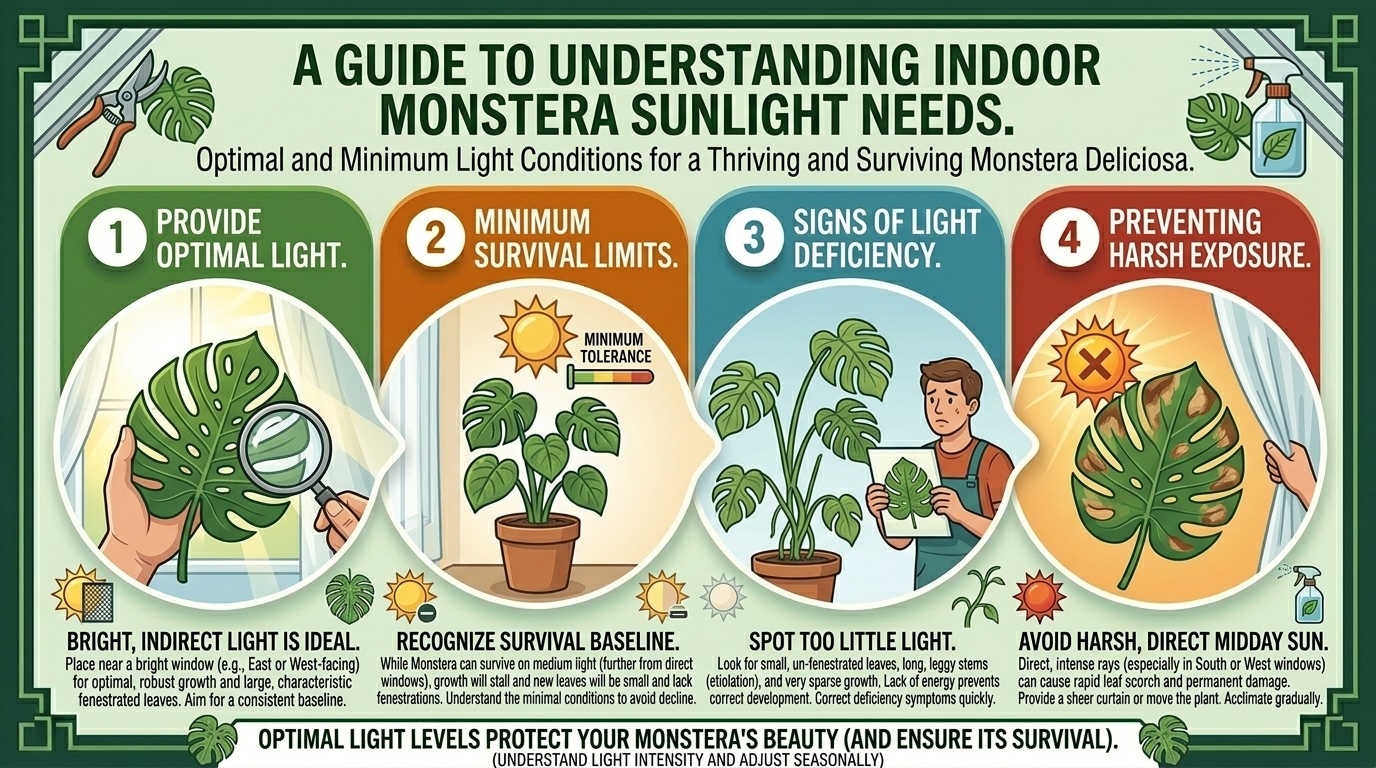
Indoor potted Monstera deliciosa plants need 5 to 8 hours of medium to bright indirect sunlight daily to thrive indoors. While a Monstera can survive on as little as 3 to 4 hours of low indirect light, prolonged low-light conditions cause slow growth, small leaves, and a complete loss of its signature leaf splits (fenestrations).
Whether you are growing Monsteras in sunny apartments across Texas and California, navigating low winter light in New York and Washington, or managing foggy window exposures in San Francisco, understanding light levels is essential for long-term plant health.
At KC Plants, we help plant enthusiasts master indoor microclimates to grow lush, healthy tropical foliage year-round.
1. Light Quality vs. Quantity for Monstera Deliciosa
Understanding the distinction between direct sun, bright indirect light, and low light determines how effectively your potted Monstera photosynthesizes indoors.
Bright Indirect Light (The Ideal Zone)
In their native tropical rainforests, Monsteras climb up jungle trees beneath a high canopy. They receive filtered sunlight rather than continuous harsh rays. Indoors, bright indirect light measures roughly 200 to 500 foot-candles (or 2,000 to 5,000 lux).
Direct Sunlight (Proceed with Caution)
Monstera plants can handle 1 to 2 hours of gentle morning direct sunlight (such as from an east-facing window). However, harsh afternoon sun (west or south exposures in Texas or California) can scorch delicate leaves, causing bleached patches and brown crisp edges.
| Light Level | Daily Duration | Foot-Candles (fc) | Impact on Monstera Health |
| Low Light | 3 – 4 hours | 50 – 100 fc | Bare survival; leggy stems; no leaf fenestrations. |
| Medium Light | 4 – 6 hours | 100 – 250 fc | Slow, steady growth; medium leaf size; partial splits. |
| Bright Indirect | 6 – 8+ hours | 250 – 500+ fc | Optimal growth; large foliage; deep fenestrations. |
| Direct Afternoon Sun | 3+ hours direct | 1,000+ fc | High risk of leaf sunburn and crisp brown foliage. |
2. Window Exposures and Seasonal Light Adjustments
Positioning your indoor potted Monstera relative to available window directions ensures consistent light throughout changing seasons.
1.East-Facing Windows:Best overall exposure for consistent growth.
East windows provide gentle morning sun paired with bright indirect light for the rest of the day. Place your potted Monstera directly in front of an east window for optimal results.
2.South and West-Facing Windows:High light intensity requiring filtration.
South and west exposures yield intense light and high heat. Set your Monstera 3 to 5 feet back from the glass, or diffuse the light using sheer curtain panels to prevent leaf burn.
3.North-Facing Windows:Low light exposure requiring supplemental light.
North windows provide soft, low indirect light. During winter months in northern climates like Washington or New York, add a full-spectrum LED grow light running 10 to 12 hours daily.
4.Rotate the Pot Regularly:Maintain balanced foliage growth.
Monstera leaves naturally lean toward the nearest light source (phototropism). Quarter-turn the pot every time you water to ensure balanced stem distribution and prevent lopsided growth.
3. Signs Your Monstera Is Getting Too Much or Too Little Light
Monstera foliage provides clear physical cues when light conditions are out of balance.
Signs of Too Little Light
- Stems become long, thin, and stretched out (“leggy”) as they reach for light.
- New leaves emerge small, solid, and lack fenestrations (holes or splits).
- Soil stays wet for weeks because the plant’s metabolic rate slows down.
Signs of Too Much Sunlight
- Foliage develops pale yellow, straw-colored, or crispy black-brown patches.
- Leaves curl downward or drop in an effort to reduce exposed surface area.
- Soil dries out completely within 2 to 3 days of thorough watering.
10 Frequently Asked Questions (FAQ)
1. Can a Monstera survive in a windowless room?
No. Monstera plants cannot survive indefinitely without natural or artificial light. In a room without windows, provide a full-spectrum grow light positioned 18 to 24 inches above the plant for 12 hours per day.
2. Why are my Monstera’s new leaves missing holes or splits?
Fenestrations develop only when the plant receives adequate energy from bright light. If new leaves lack splits, move the plant closer to a bright light source.
3. Will artificial LED grow lights work as a substitute for natural sunlight?
Yes. Full-spectrum LED grow lights emit the necessary wavelengths (red and blue spectrums) for photosynthesis. Running a grow light for 10 to 12 hours equals roughly 6 to 8 hours of natural indirect sun.
4. Can I put my indoor Monstera outside during summer?
Yes, provided outdoor temperatures remain above 60°F. Place the plant in a shaded porch or patio area protected from direct afternoon sun to avoid leaf scorch.
5. Does a variegated Monstera (like ‘Albo’) need more light than a green Monstera?
Yes. Variegated Monstera varieties have less chlorophyll in their white or cream leaf sections. They require brighter indirect light than solid green Monsteras to support photosynthesizing tissue.
6. How far away from a window should a potted Monstera be placed?
Place your Monstera within 1 to 3 feet of east or unobstructed north windows, or 3 to 6 feet back from high-intensity south or west windows.
7. Why are my Monstera leaves turning yellow?
Yellowing leaves often stem from overwatering, poor drainage, or severe light deficits. Assess soil moisture levels and ensure the plant is receiving at least 5 hours of indirect light daily.
8. Does seasonal light change in places like Seattle or New York affect Monsteras?
Yes. In northern regions with shortened winter daylight, move your Monstera closer to south-facing windows or add supplemental grow lighting between November and March.
9. Can direct sunlight through a window glass burn Monstera leaves?
Yes. Window glass can magnify sun intensity and heat. Afternoon direct sunlight shining through glass frequently burns Monstera foliage within a few hours.
10. How do I know if my indoor plant light is bright enough without a meter?
A simple test is the shadow method: hold your hand 1 foot above the plant’s foliage. If your hand casts a soft, slightly blurred shadow on the leaves, the light level is ideal (bright indirect).
Conclusion
Providing your indoor potted Monstera plant with 5 to 8 hours of bright indirect sunlight daily is the key to encouraging fast growth, robust stems, and deep leaf fenestrations. By matching window exposures to your local climate—whether in Texas, California, New York, Washington, or San Francisco—and adjusting position seasonally, your Monstera will remain a vibrant centerpieces in your home.