Welcome back to kcplants.com! If you are a busy professional, frequent traveler, or frequent vacationer juggling life across Texas, New York, California, Washington, or San Francisco, you likely love the tranquility of an indoor houseplant jungle—until a work trip or holiday getaway leaves you stressing over who will keep your plants alive.
Let’s face it: life gets busy. Between hectic travel schedules, long commutes, and unexpected getaways, high-maintenance tropical plants that demand strict watering schedules, customized humidity trays, and constant coddling simply aren’t practical.
Fortunately, nature has designed some incredible botanical survivors. Certain resilient houseplants store water internally, boast exceptionally slow metabolic rates, or adapt seamlessly to erratic human schedules.
This comprehensive guide breaks down the absolute best resilient indoor houseplants that easily survive occasional travel, irregular watering, and benign neglect, helping you maintain a thriving indoor oasis no matter how often you pack your bags.
1. The Anatomy of a Low-Maintenance Survivor
What makes a houseplant truly “travel-proof”? Resilient indoor plants typically share a few specific biological traits:
- Water Storage Mechanisms: They feature thick, succulent leaves, swollen bulbous stems (caudexes), or potato-like underground rhizomes that store moisture like a camel, allowing them to ride out weeks of drought.
- Crassulacean Acid Metabolism (CAM): Many drought-hardy plants open their pores to breathe only at night to minimize moisture loss during the day.
- Low Light Adaptability: They tolerate lower ambient lighting without instantly dropping leaves or dying back, making them resilient even when placed away from bright windows while you are away.
2. Top 6 Indestructible Houseplants for Busy Travelers
If you want green foliage that requires minimum oversight, these six bulletproof species are top tier:
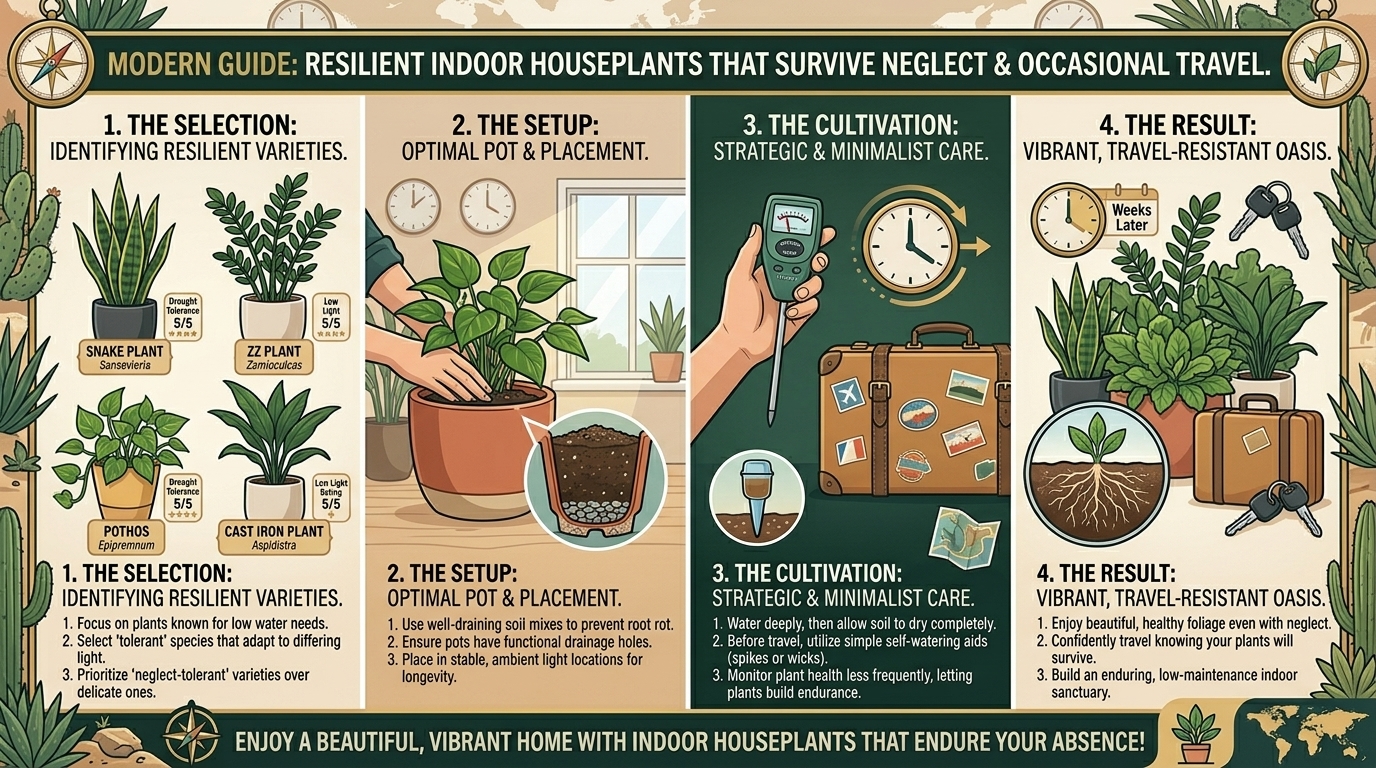
1. The ZZ Plant (Zamioculcas zamiifolia)
- Why it survives travel: The ZZ plant is arguably the reigning champion of neglect. It features thick, glossy, emerald-green leaves attached to stems that rise from massive underground potato-like tubers. These tubers store immense amounts of water and nutrients.
- Neglect Tolerance: You can comfortably leave a ZZ plant unattended for 4 to 6 weeks without a drop of water. It thrives in low-to-bright indirect light and shrugs off dry indoor air.
2. The Snake Plant (Sansevieria / Dracaena species)
- Why it survives travel: Also known as Mother-in-Law’s Tongue, the snake plant stores water in its rigid, upright, architectural sword-shaped leaves. Its slow growth rate means its metabolic demands are minimal.
- Neglect Tolerance: Snake plants can easily survive 3 to 4 weeks away from home. In fact, the single biggest danger to a snake plant is overwatering, meaning your absence is often a blessing in disguise for its health!
3. Pothos (Epipremnum aureum)
- Why it survives travel: Often called Devil’s Ivy, pothos is a vigorous, trailing vine that forgives erratic watering better than almost any other tropical plant. When it gets thirsty, it dramatically droops its leaves to signal for help, then snaps right back upright within hours of a deep drink.
- Neglect Tolerance: Pothos handles 2 to 3 weeks of vacation absence easily. If you return to slightly limp vines, a thorough soaking will restore them instantly.
4. Cast Iron Plant (Aspidistra elatior)
- Why it survives travel: True to its name, the cast iron plant earned its reputation during the Victorian era because it refuses to die. It tolerates deep shade, extreme temperature shifts, erratic watering, and dusty air.
- Neglect Tolerance: It can go 3 to 4 weeks without water and handles dim hotel-like rooms or low-light office corners with total grace.
5. Ponytail Palm (Beaucarnea recurvata)
- Why it survives travel: Despite its palm-like name, this is actually a succulent relative of the agave family. It features a distinct, swollen bulb base at the bottom of its trunk that functions as a massive water reservoir.
- Neglect Tolerance: A mature ponytail palm can easily store water for 6 to 8 weeks, making it the ultimate jet-setter companion for frequent flyers.
6. Jade Plant (Crassula ovata)
- Why it survives travel: This woody succulent features thick, fleshy leaves and sturdy stems that hold onto moisture for long periods.
- Neglect Tolerance: Jade plants thrive on benign neglect. They prefer their soil to dry out completely between waterings and can easily tolerate a month of total independence while you travel.
3. Regional Travel & Indoor Challenges Across the US
Depending on where you live, environmental factors can impact how well your plants handle your absence:
New York & Washington (Winter Heating vs. Summer AC)
- The Challenge: When you travel during winter in the Northeast or Pacific Northwest, running indoor heating systems drastically accelerates soil evaporation, while turning heat off while away can drop room temperatures too low.
- The Solution: Group your resilient plants away from direct heater vents before you leave, and cluster them together to create a micro-humidity zone.
San Francisco & California (Coastal Microclimates)
- The Challenge: Coastal California homes experience fluctuating indoor humidity due to marine layers. If you travel during foggy weeks, soil dries out much slower.
- The Solution: For drought-hardy plants like ZZ plants or snake plants, always verify the soil is completely dry before you leave, as slow evaporation combined with absence can invite root rot if overwatered beforehand.
Texas (Intense Heat & Sealed Homes)
- The Challenge: Texas homes remain tightly sealed against extreme outdoor heat, meaning indoor AC units run continuously, pulling moisture rapidly out of potting soil.
- The Solution: For longer trips during peak summer, move plants slightly away from sun-baked windows so they don’t scorch or dry out completely while you are out of town.
4. Pre-Travel Checklist: How to Prep Plants Before a Trip
Even the most resilient houseplants appreciate a little preparation before you head out the door for an extended journey:
- Water Thoroughly Before Leaving: Give your plants a deep, thorough soaking 24 hours before your departure so their internal water stores are fully charged. Ensure excess water drains out completely.
- Move Out of Direct Blistering Sun: While sun-loving plants enjoy bright spots, intense midday window beams can rapidly overheat soil when you aren’t home to monitor watering needs. Nudge plants back a few feet from hot glass.
- Group Plants Together: Clustering your indoor jungle increases local humidity and slows down moisture evaporation across all pots.
- Consider Self-Watering Spikes: For trips lasting longer than 3 weeks, insert terracotta self-watering stakes connected to a inverted wine bottle filled with water into the soil for a slow, steady drip feed.
5. Frequently Asked Questions (FAQ)
1. What is the absolute best houseplant for someone who travels constantly?
The ZZ Plant and the Snake Plant are tied for first place. Both feature internal water storage organs, resist pests, tolerate low light, and easily survive a month or more of complete neglect.
2. Should I water my plants right before I leave on a trip?
Yes, it is best to give your plants a thorough, deep watering the day before you leave so they start your trip fully hydrated. Just ensure you empty any standing water from saucers to prevent root rot.
3. How long can a ZZ plant survive without water?
A healthy mature ZZ plant can easily survive 4 to 6 weeks (and sometimes longer) without water during cooler months, drawing entirely on the moisture stored in its underground rhizomes and thick stems.
4. Can I use self-watering globes for indoor houseplants while away?
Yes! Glass or plastic watering globes work well for moderate drinkers like Pothos or Philodendrons on trips lasting 1 to 3 weeks, slowly releasing water as the soil dries out.
5. Why do my plants look worse after I return from a trip than before I left?
If a plant looks stressed upon your return, it is usually because it was placed too close to a hot window where soil dried out prematurely, or conversely, because it was left sitting in a saucer of stagnant water that caused root rot.
6. Do resilient plants need natural window light while I am away on vacation?
Most resilient low-maintenance plants (like Snake Plants and Cast Iron Plants) tolerate moderate indoor ambient light or even fluorescent office lighting quite well for a few weeks while you travel.
7. Will my succulents survive a two-week vacation with no water?
Absolutely. Succulents like Jade Plants, Aloe Vera, and Haworthias are built for drought and easily handle 2 to 4 weeks of complete neglect without blinking.
8. How do I prevent pests from attacking my plants while I’m away?
Pests thrive on stressed plants. Giving your resilient plants a quick preventative spray of insecticidal soap or checking them for bugs before you pack your bags ensures no minor infestation balloons while you are away.
9. Should I fertilize my plants right before leaving for a trip?
Never fertilize a plant right before traveling. Fertilizer stimulates active growth and water consumption. Without you there to manage moisture levels, fertilizer can cause root stress and burn if the soil dries out.
10. Are trailing plants like Pothos good for frequent travelers?
Yes! Pothos is wonderfully forgiving. If you travel frequently, pothos will clearly communicate its thirst by drooping its leaves, making it easy to care for as long as you give it a drink when you return.
Conclusion
Traveling and maintaining a vibrant indoor plant collection do not have to be mutually exclusive. By selecting bulletproof, resilient species like the ZZ plant, snake plant, pothos, and cast iron plant, you can enjoy all the aesthetic and mental health benefits of an indoor jungle without the constant anxiety of watering schedules.