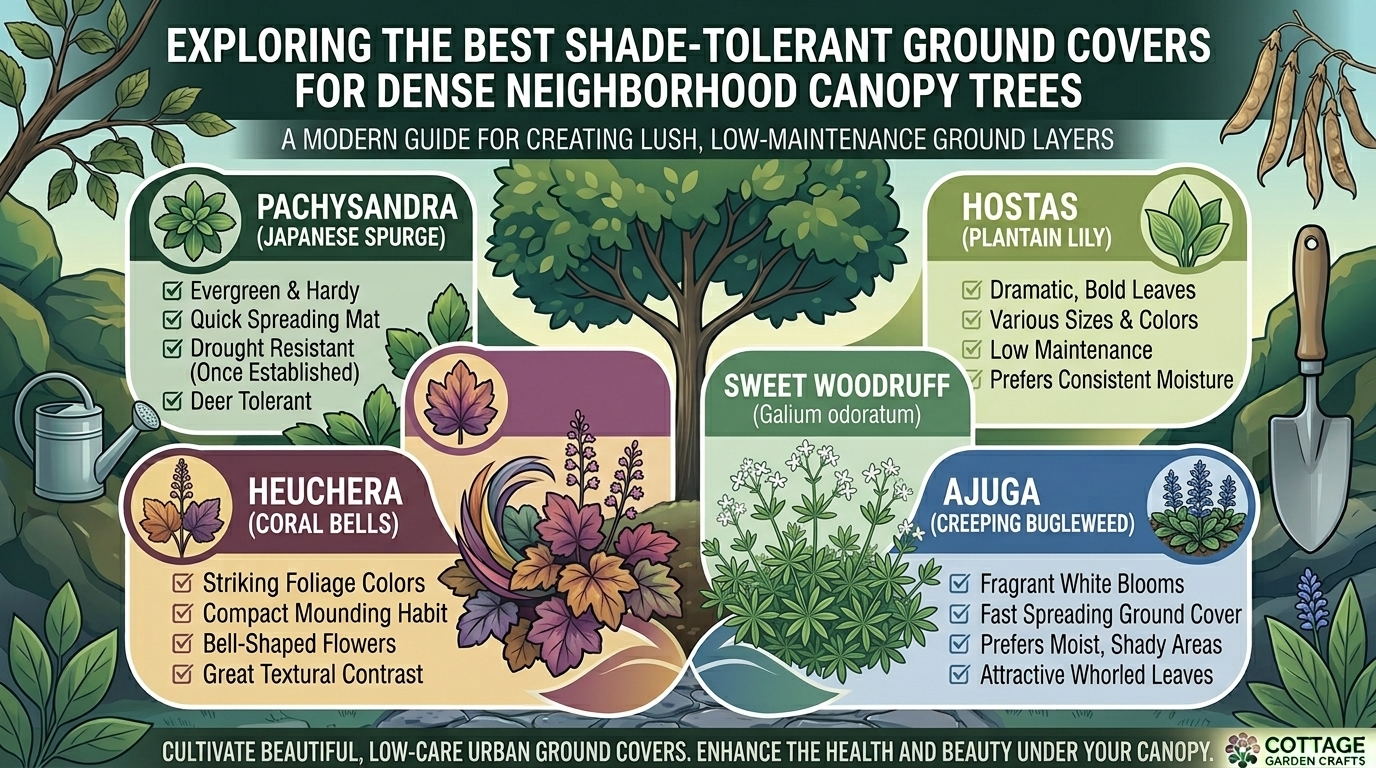
What Are the Best Shade-Tolerant Ground Covers to Plant Under Dense Neighborhood Canopy Trees
Stepping into the shaded sanctuary beneath a mature canopy of oak, maple, beech, or elm trees during the height of summer offers instant, cooling relief. These majestic neighborhood trees anchor our properties, provide soaring vertical scale, and shelter local wildlife.
However, ask any backyard gardener about the area directly beneath a large mature tree, and you will likely hear a heavy sigh.
That patch of earth is notorious for being a horticultural dead zone. It is dark, dry, locked in a fierce underground war for water and nutrients, and completely choked by a dense network of thick surface roots. Traditional turfgrass refuses to grow there, leaving you with bare, muddy soil that washes away with every rainstorm, or an unsightly bed of windblown autumn leaves and exposed roots.
Before you surrender that precious real estate to bare dirt or messy wood chips, there is a brilliant botanical solution: shade-tolerant ground covers.
By selecting resilient, tough-as-nails perennial plants specifically adapted to dry, low-light understory environments, you can transform those barren patches into lush, emerald green carpets of foliage and delicate blossoms.
Whether you are designing a shaded urban courtyard in San Francisco, managing woodland borders in Washington State, navigating dense suburban tree canopies in New York, or battling intense summer root competition across California and Texas, this comprehensive guide explores the absolute best shade-tolerant ground covers for your website, kcplants.com.
1. The Understory Challenge: Why Growing Under Trees Is So Difficult
To succeed with ground covers beneath dense canopy trees, you must first understand the brutal ecological pressures plants face in this zone.
[ Understory Environmental Obstacles ]
       │
       ├──> 1. Deep Shade (Limited Photosynthetic Light)
       │
       ├──> 2. Severe Moisture Competition (Tree Roots Steal Water)
       │
       └──> 3. Nutrient Deprivation & Root Barriers (Hard, Compacted Soil)
1. Light Deprivation
Canopy leaves absorb the vast majority of photosynthetically active radiation (PAR). Ground-level plants receive only a tiny fraction of direct sunlight, often relying entirely on dappled light or short windows of early spring sunshine before the canopy trees leaf out.
2. The Moisture and Nutrient Vampire Effect
Mature neighborhood trees act like giant biological sponges. Their massive lateral root systems drink hundreds of gallons of water daily and hoard available soil nutrients, leaving newly planted ground covers high and dry.
2. The Heavyweights: Best Ground Covers for Deep Tree Shade
Here are the masterclass shade-tolerant ground covers that possess the toughness, aggressive root-spreading nature, and beauty required to conquer difficult tree pits.
1. Barrenwort (Epimedium spp.)
Also known affectionately as Bishop’s Hat, Barrenwort is an absolute champion of dry shade.
- Why It Works: Epimediums feature wiry stems and heart-shaped leaves that emerge in bronze-tinted spring tones, mature to rich green through summer, and often turn stunning copper-red in winter. They possess tough, woody rhizomes that tolerate root competition remarkably well once established.
- Best For: Dry shade beneath mature oak and maple trees.
2. Creeping Liriope / Monkey Grass (Liriope spicata)
- Why It Works: Liriope spicata spreads rapidly via underground stolons, forming a dense, grassy, evergreen carpet that stands 8 to 12 inches tall. It tolerates deep shade, poor soil, drought, and heavy root competition without breaking a sweat. (Note: Choose Liriope spicata, the spreading type, rather than Liriope muscari, which grows in neat individual clumps).
- Best For: Urban tree pits and high-traffic neighborhood borders.
3. Sweet Woodruff (Galium odoratum)
- Why It Works: Featuring whorled, star-like bright green leaves and delicate clouds of tiny white star-shaped flowers in spring, sweet woodruff creates a fragrant, woodland carpet. It thrives in moist, organic shade and smells faintly of freshly cut hay when bruised.
- Best For: Woodland gardens and damp northern exposures.
4. Japanese Pachysandra (Pachysandra terminalis)
- Why It Works: A classic architectural ground cover that has graced formal and informal gardens for decades. Its glossy, leathery green leaves form a solid, evergreen carpet that blocks weed seeds entirely and tolerates deep, heavy shade with grace.
5. Hardy Geraniums / Cranesbill (e.g., Geranium macrorrhizum)
- Why It Works: Unlike delicate annual geraniums, perennial cranesbills (such as Bigroot Geranium) feature aromatic foliage that deters pests and rabbits, paired with aggressive underground root stalks that weave effortlessly through tree roots. They burst into blankets of pink or purple flowers in late spring.
3. Step-by-Step Installation Protocol for Difficult Tree Pits
You cannot simply jam ground cover plugs into rock-hard soil directly against a tree trunk and expect success. Follow this professional installation protocol:
[ Tree Pit Planting Workflow ]
       │
       ├──> Step 1: Clear Debris and Assess Root Zones (No Tilling!)
       │
       ├──> Step 2: Plant Small Plugs (Avoid Large Root Balls)
       │
       ├──> Step 3: Apply Organic Compost and Fine Mulch
       │
       └──> Step 4: Establish Deep Supplemental Irrigation
Step 1: Do Not Rototill!
Never bring a mechanical rototiller under a mature tree canopy. Tilling shreds and destroys the tree’s vital structural feeder roots, shocking the canopy and inviting disease. Instead, use a hand trowel to carve out small planting pockets between tree roots.
Step 2: Plant Small Plugs
Purchase your ground covers in small 4-inch pots or flat plugs rather than massive 1-gallon containers. Smaller root systems are vastly easier to wedge between existing tree roots, and they establish and adapt much faster than root-bound large specimens.
Step 3: Keep Mulch Thin Near the Trunk
As established in arboricultural standards, never pile mulch against the tree trunk (avoid volcano mulching). Maintain a 3-to-6-inch clear zone around the tree flare, and apply a light 2-inch layer of finely shredded bark over your newly planted ground cover plugs to retain moisture.
4. Regional Adaptations for Shade Ground Covers Across the U.S.
Regional climates dictate which ground covers will thrive best under your neighborhood canopy trees:
San Francisco & Coastal California
- Climate Challenge: Mediterranean dry summers mean urban street trees compete fiercely for limited soil moisture, while coastal fog provides cool ambient humidity.
- Top Picks: Native redwood sorrel (Oxalis oregana), wild ginger (Asarum caudatum), and evergreen sword ferns create lush, drought-tolerant carpets beneath coastal oaks and eucalyptus trees.
Texas
- Climate Challenge: Blistering summer heat combined with heavy clay soils or alkaline limestone make survival difficult for delicate woodland plants.
- Top Picks: Asian jasmine (widely adapted, though requires boundary management), pigeonberry (Rivina humilis), and frogfruit create tough, heat-tolerant ground cover blankets under Texas live oaks.
New York & Northeast
- Climate Challenge: Freeze-thaw winter cycles and dense deciduous shade from towering maples and oaks require hardy perennials that can handle heavy leaf drop.
- Top Picks: Wild ginger, foamflower (Tiarella cordifolia), barrenwort, and creeping myrtle (Vinca minor) thrive across northeastern suburban landscapes.
Washington State & Pacific Northwest
- Climate Challenge: Cool, damp woodland conditions and acidic soils provide an ideal natural habitat for rich understory carpets.
- Top Picks: Bunchberry (Cornus unalaskensis), evergreen huckleberry, sweet woodruff, and wild ginger blanket the ground beneath Pacific Northwest conifers and bigleaf maples.
5. Frequently Asked Questions (FAQ)
1. Will planting ground cover hurt my large neighborhood canopy trees?
No, as long as you plant carefully using hand tools and avoid rototilling or severing major tree roots. In fact, establishing a living ground cover protects the soil from compaction and eliminates the need for string trimmers or lawnmowers that can nick and damage tree bark.
2. How do I plant ground covers when the soil is packed with tree roots?
Use a sharp hand trowel or soil knife (hori-hori) to carve out small pockets of soil between roots. If you encounter a thick, living lateral root, do not cut it; simply shift your planting hole a few inches to the left or right.
3. Can I use turfgrass as a ground cover under dense shade trees?
Standard lawn grass (Kentucky bluegrass, fescue, or Bermuda) requires at least 4 to 6 hours of direct sunlight and uncontaminated root zones to thrive. Attempting to grow grass under a dense tree canopy almost always ends in failure, resulting in patchy, muddy dirt.
4. Are there native ground covers I should use instead of invasive species?
Yes! While plants like English ivy (Hedera helix) and periwinkle (Vinca minor) are traditional shade ground covers, they are considered invasive weeds in many regions because they climb trees and smother native woodlands. Whenever possible, choose regional native alternatives like wild ginger, foamflower, or barrenwort.
5. How often do newly planted shade ground covers need to be watered?
During their first growing season, ground covers planted under trees need frequent, deep watering. Because tree roots suck up moisture instantly, young ground cover plugs require supplemental irrigation 1 to 2 times a week until their root systems anchor deeply.
6. Do shade ground covers help suppress weed growth under trees?
Yes! Once ground covers spread and form a dense, living green canopy over the soil, they block sunlight from reaching weed seeds, acting as a natural, permanent weed suppression barrier.
7. What is the fastest-spreading shade ground cover?
If you are looking for rapid coverage, spreading varieties like Liriope spicata (creeping liriope), sweet woodruff, and bishop’s hat spread aggressively via runners to carpet bare earth within two growing seasons.
8. Will ground covers attract pests to my neighborhood trees?
Most resilient ground covers feature aromatic oils, tough foliage, or dense growth habits that actually deter pests and rodents (like voles that tunnel in heavy mulch). They create a clean, healthy ecological buffer zone.
9. Can ground covers survive being buried under heavy autumn leaf drop?
Many shade ground covers (like barrenwort and wild ginger) are adapted to forest floors where heavy leaf litter falls every autumn. However, if leaves form a suffocating, wet mat several inches thick, gently rake away excess leaves in late autumn to prevent rotting your ground cover.
10. How do I prepare hard, dry clay soil under a tree before planting?
Do not add massive amendments directly into small planting holes, as this creates a “bathtub effect” that traps water. Instead, loosen the top inch of soil gently, spread a 1-inch layer of organic compost across the entire bed surface, plant your plugs, and top with fine mulch.
Conclusion
Transforming the barren, challenging earth beneath your neighborhood canopy trees from a dusty or muddy wasteland into a lush, vibrant green oasis is one of the most rewarding landscaping transformations you can undertake. By selecting tough, shade-tolerant ground covers like barrenwort, liriope, wild ginger, and sweet woodruff, you solve erosion, suppress weeds, and elevate your property’s aesthetic appeal.