Why Ceramic Cachepots Without Drainage Holes Require Extreme Caution When Watering Indoor Plants
Welcome back to kcplants.com! If you are a design-conscious plant parent decorating an indoor urban oasis across Texas, New York, California, Washington, or San Francisco, you have undoubtedly fallen in love with the sleek, modern aesthetic of ceramic cachepots.
Unlike standard plastic nursery pots with drainage holes at the bottom, ceramic cachepots—also known as outer decorative pots—are sealed, solid vessels designed to hold water safely inside their walls. They look stunning on windowsills, bookshelves, and coffee tables, instantly elevating your interior decor.
However, ceramic cachepots without drainage holes are the #1 silent killer of indoor houseplants.
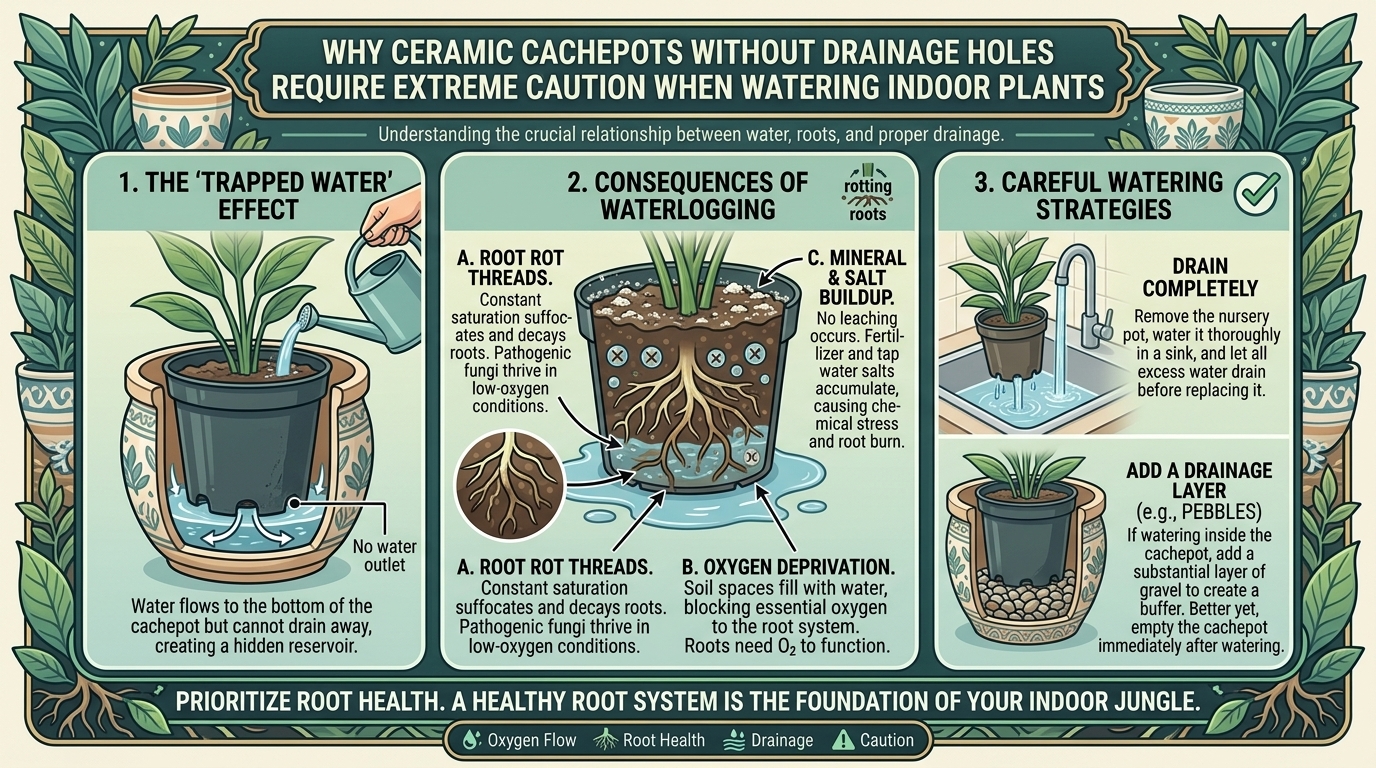
When used improperly, these un-drilled containers trap excess irrigation water, creating a hidden, suffocating swamp at the bottom of your pot. Within weeks, delicate root systems drown, anaerobic bacteria proliferate, and your prized houseplants succumb to fatal root rot.
This comprehensive, highly informative guide explores the science of root suffocation, the hidden dangers of un-drilled ceramic containers, and expert techniques to safely use cachepots without destroying your indoor jungle across every US climate zone.
1. The Anatomy of a Sealed Container: Understanding the Trap
To understand why ceramic cachepots are so hazardous, we must examine what happens beneath the soil surface every time you water a potted plant.
The Physics of Gravity and Capillary Action
When you water a potted plant, gravity pulls excess moisture downward through the soil profile.
- In a container with drainage holes, that excess water escapes freely out of the bottom, taking dissolved mineral salts and spent gases with it, while drawing fresh oxygen into the soil matrix.
- In a sealed ceramic cachepot without drainage holes, that escape route is completely blocked. The water pools at the bottom of the outer pot. Because the inner nursery pot sits directly in this puddle, capillary action acts like a wick, pulling stagnant water right back up into the root zone.
Root Asphyxiation (Oxygen Starvation)
Roots do not just drink water; they breathe oxygen. Soil air pockets are essential for cellular respiration. When a pot sits waterlogged in a sealed cachepot, water displaces 100% of the air pockets. Deprived of oxygen, root cells begin to suffocate, die, and decay, giving rise to pathogenic fungi like Pythium and Phytophthora.
2. Regional Indoor Factors That Worsen Cachepot Risks
Your local indoor climate and regional heating/cooling cycles heavily influence how quickly a sealed cachepot turns into a disaster zone:
New York & Washington (Winter Heating and Slow Evaporation)
- The Challenge: During winter, closed windows and forced-air heating create dry air on the surface, but inside a sealed ceramic cachepot, moisture evaporates extremely slowly because ambient air currents cannot reach the lower soil strata.
- The Solution: Never assume soil is dry just because the top inch is crusty. Always lift the inner pot out of the cachepot to check lower moisture levels before watering.
San Francisco & California (Coastal Microclimates and Humidity)
- The Challenge: Coastal fog and high ambient humidity mean indoor soil stays damp much longer. If excess water collects in a sealed cachepot in a San Francisco apartment, it can take weeks to evaporate.
- The Solution: Adopt strict drainage-emptying habits or use elevated pebble buffers (as covered in our previous guides at kcplants.com).
Texas (Continuous Air Conditioning and AC Cycles)
- The Challenge: Texas summers force continuous indoor AC usage, which quickly dries out topsoil while leaving hidden, waterlogged puddles deep at the bottom of sealed cachepots.
- The Solution: Never water a plant directly inside a cachepot. Always remove the inner nursery pot to water it over a sink.
3. The 4 Golden Rules for Safely Using Ceramic Cachepots
You do not have to throw away your gorgeous ceramic cachepots! You can use them safely if you follow these four non-negotiable horticultural rules:
Rule 1: Always Use an Inner Nursery Pot
- Never plant directly into an un-drilled ceramic cachepot. Always keep your plant housed inside a standard plastic nursery pot that features active drainage holes at the base, and slip that plastic pot inside the decorative ceramic cachepot.
Rule 2: The “Lift and Check” Habit
- Never water a plant while it sits tucked deep inside its ceramic cachepot.
- Lift the inner plastic pot out of the cachepot, take it to a sink or bathtub, water it thoroughly until water flows freely out of the drainage holes, let it drain completely (15 to 30 minutes), and then place it back into the decorative cachepot.
Rule 3: Never Let Water Sit in the Bottom
- After watering and returning your plant to its cachepot, wait 30 minutes and check the bottom of the outer ceramic pot. If you see standing water pooling at the base, dump it out immediately. Leaving even a half-inch of standing water defeats the entire purpose of an inner nursery pot.
Rule 4: Create an Air Gap (Use Pebbles or Risers)
- If your plastic nursery pot fits flush against the flat bottom of your ceramic cachepot, place a 1-to-2-inch layer of expanded clay pebbles or pot risers at the base. This elevates your nursery pot above any accidental runoff, creating an essential airspace buffer.
4. How to Spot Root Rot Caused by Sealed Cachepots
Catching root rot early can save your plant. Look out for these warning signs:
- Chronically Damp Soil: The soil stays wet for 3 to 4 weeks after watering, never seeming to dry out.
- Yellowing Lower Leaves: Older leaves turn pale yellow, soft, and drop off unexpectedly.
- Wilting Despite Wet Soil: The plant looks thirsty and droops, even though the soil is soaking wet (a classic sign that rotted roots can no longer transport moisture upward).
- Foul Smell: When you lift the nursery pot out of the cachepot, you notice a sour, earthy, or swampy rotting odor emanating from the drainage holes.
5. Frequently Asked Questions (FAQ)
1. Can I drill my own drainage hole in a ceramic cachepot?
Yes! If you have a diamond-tipped masonry drill bit and a power drill, you can carefully drill a drainage hole through the bottom of most ceramic or terracotta cachepots, turning an un-drilled pot into a safe, functional planter.
2. Why do plant shops sell pots without drainage holes if they cause root rot?
Decorative pots without drainage holes are legally and commercially classified as “cachepots” (meaning “hiding pots”). They are meant to act as decorative sleeves for inner nursery pots, not as direct planting vessels, though many consumers mistake them for regular pots.
3. What should I do if I already planted directly into an un-drilled ceramic pot?
You need to unpot the plant immediately! Gently wash away the soggy, compacted soil from the roots, inspect them for brown, mushy, rotting sections and trim them off with sterile shears, and repot the plant into a proper container with drainage holes using fresh, dry potting mix.
4. Can I use activated charcoal at the bottom of a cachepot to prevent root rot?
Adding a layer of charcoal at the bottom of an un-drilled pot helps absorb minor odors and impurities, but it does not prevent root rot or take the place of drainage holes. Excess water will still fill the container and drown the roots.
5. How do I remove stubborn mineral crusts from the inside of a ceramic cachepot?
If hard water minerals or fertilizer salts have crusted the inside of your ceramic cachepot, fill it with a 50/50 mixture of warm water and white vinegar, let it soak for an hour, and scrub it clean with a brush.
6. Are fiberglass or metal cachepots safer than ceramic ones without drainage holes?
No. Material makes no difference—whether ceramic, metal, fiberglass, or glass, any outer container lacking drainage holes will trap water and cause root rot if inner pots sit directly in standing runoff.
7. How long can a plant sit in a waterlogged cachepot before developing root rot?
Depending on the plant species and ambient temperature, sensitive tropicals (like ferns or calatheas) can develop the beginnings of root rot in as little as 48 to 72 hours of sitting in a stagnant cachepot puddle.
8. What is the best way to water heavy plants in large ceramic cachepots?
For massive plants in heavy ceramic cachepots that are difficult to lift to a sink, use a turkey baster or a narrow siphon pump to suction out any standing runoff water trapped at the bottom of the cachepot after watering.
9. Do succulents suffer faster in un-drilled cachepots than tropical plants?
Yes! Succulents store water in their leaves and require completely dry soil between waterings. Placing a succulent in a sealed cachepot that retains moisture spells almost certain death within weeks.
10. Can self-watering pots be considered safe cachepots?
Self-watering pots use a built-in reservoir separated from the soil by a physical aeration screen and a wicking system. While safer than a basic un-drilled cachepot, they still require careful monitoring to prevent stagnation in the water reservoir.
Conclusion
Ceramic cachepots without drainage holes add breathtaking style and sophistication to indoor spaces, but they demand extreme caution and disciplined watering habits. By always utilizing inner nursery pots, lifting plants to water them over a sink, and never allowing standing water to pool at the base, you can enjoy your favorite decorative planters without sacrificing the health of your indoor jungle.