Why Companion Planting French Marigolds with Tomatoes Protects Roots from Parasitic Root-Knot Nematodes
By the Horticultural Team at kcplants.com
Every home gardener and urban grower knows the heartbreak of walking out to the garden mid-season, only to find their heavy-laden tomato plants mysteriously wilting under the afternoon sun. Tugging gently at the stem reveals a devastated underground system: swollen, distorted, and covered in grotesque knots.
You are facing root-knot nematodes (Meloidogyne spp.), one of the most stealthy and destructive soil-borne pathogens known to horticulture.
For generations, garden lore has suggested throwing a handful of marigold seeds around your vegetables to magically banish pests. Modern agricultural science reveals that this practice is much more than an old wives’ tale—provided you use the right species, the right timing, and understand the underground biochemical warfare at play.
At kcplants.com, we champion region-smart gardening strategies suited for diverse climates—from the searing heat of Texas and California to the cooler, shorter growing windows of New York, Washington, and urban microclimates like San Francisco. In this comprehensive guide, we unpack the precise science of why pairing French marigolds (Tagetes patula) with tomatoes creates a protective biological shield around vulnerable plant roots.
1. Meet the Enemy: The Root-Knot Nematode
To understand how French marigolds save your harvest, you must first understand the adversary living beneath the soil line.
Root-knot nematodes are microscopic, unsegmented roundworms that thrive in warm, sandy, and loamy soils. While thousands of nematode species exist—many of which are beneficial components of a healthy soil food web—phytoparasitic root-knot nematodes are specialized plant predators.
How They Attack Tomato Roots
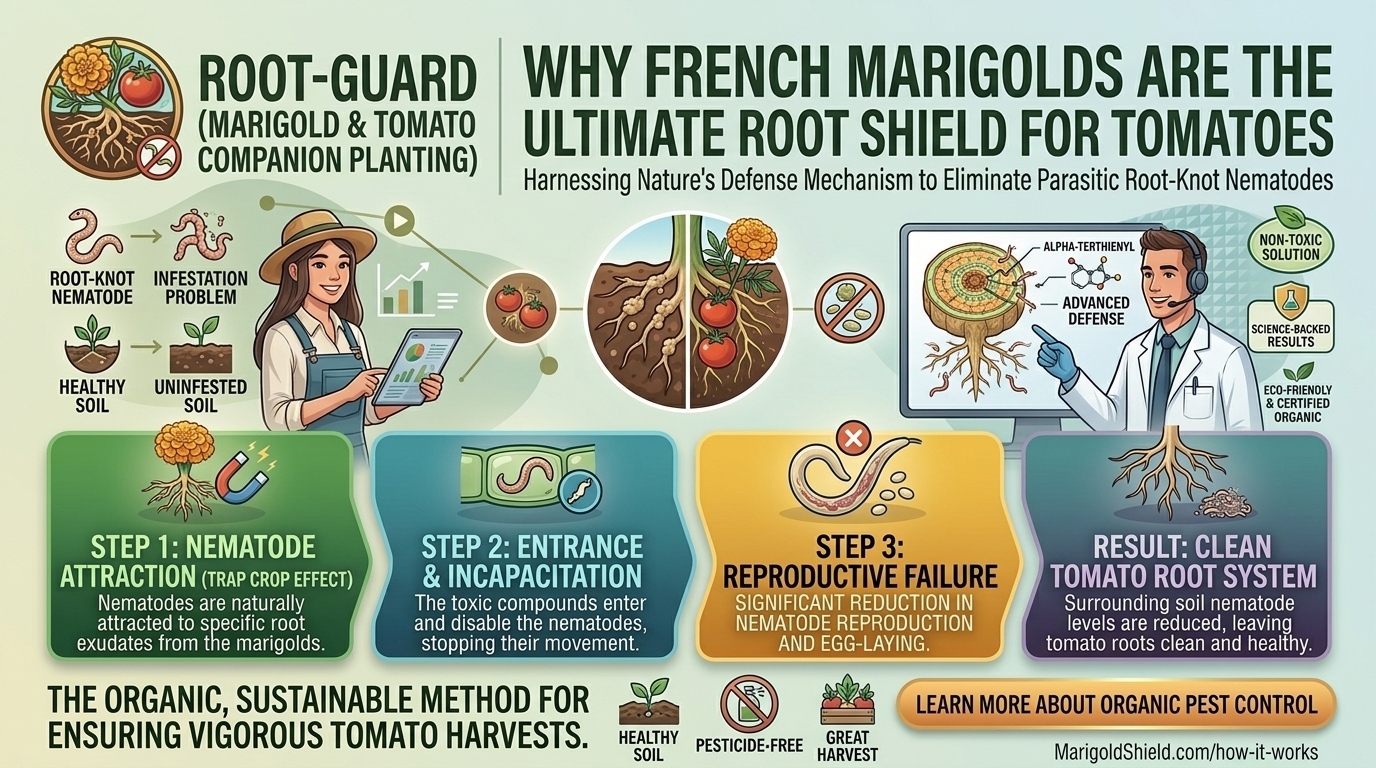
- The Quest: Second-stage juveniles (J2), the only mobile life stage in the soil, use chemoreceptors to track down carbon dioxide and root exudates leaking from growing tomato roots.
- The Penetration: The juvenile nematode punctures the root tip using a hollow, syringe-like mouthpart called a stylet, migrating inside the vascular cylinder.
- The Hijacking: Once inside, the nematode injects specialized secretions that force the plant’s root cells to enlarge dramatically without dividing. These become giant cells, which act as permanent feeding tubes for the parasite.
- The Symptoms: As the female nematode swells into a pear-shaped adult, the surrounding root tissue balloons outward, creating the characteristic “galls” or “knots”.
These distorted galls choke off the plant’s vascular system, blocking water and nutrient uptake. Above ground, your tomatoes suffer from chronic nutrient deficiency, stunted growth, afternoon wilting, and ultimately, a drastically reduced yield.
2. The Biochemical Weapon: Alpha-Terthienyl and Root Exudates
While many companion planting claims rely on anecdotal evidence, the relationship between French marigolds and nematodes is anchored firmly in rigorous laboratory and field science.
French marigolds (Tagetes patula) do not merely “scent” the soil to push pests away; they actively manufacture and exude a potent natural nematicide from their root systems: alpha-terthienyl.
[French Marigold Roots]
       │
       ├── Exudes ➔ Alpha-Terthienyl (Bioactive Nematicide)
       │                  │
       │                  ▼
       └─────── Disrups & Poisons ➔ Root-Knot Nematodes (Meloidogyne spp.)
The Mechanism of Action
- Phototoxicity: Alpha-terthienyl is a phototoxic compound. When nematodes absorb it or come into direct contact with the compound in the rhizosphere (the narrow zone of soil directly influenced by root secretions), their cellular membranes are systematically disrupted.
- The Dead-End Trap: When a root-knot nematode larva attempts to invade a French marigold root instead of a tomato root, it encounters a hostile biochemical environment. Unable to establish a functional feeding site or mature, the nematode dies or fails to reproduce.
- Population Suppression: Over an active growing season, interplanting or utilizing French marigolds acts as a biological vacuum, systematically driving down the viable nematode population density in the soil profile.
3. Why Species Matter: Do NOT Plant Just Any Marigold
A critical mistake made by thousands of gardeners every year is buying generic marigold flats from big-box garden centers without checking the botanical tag. Not all marigolds possess nematode-suppressing properties.
| Marigold Category | Botanical Name | Nematicidal Efficacy | Key Characteristics |
| French Marigolds | Tagetes patula | High / Proven | Compact, bushy habit; highest concentration of alpha-terthienyl roots. |
| Signet Marigolds | Tagetes tenuifolia | Moderate to High | Fine foliage, edible citrus-scented flowers; effective but variable by strain. |
| African Marigolds | Tagetes erecta | Low / Ineffective | Tall, massive blooms; bred for ornamental flower size rather than root chemistry. |
| Pot “Marigolds” | Calendula officinalis | None | Entirely different genus; lacks thiophenes completely, though beneficial for general pollinators. |
If your goal is root protection for tomatoes, you must specifically source French marigold cultivars—such as ‘Nema-Gone’, ‘French Dwarf’ variants, or ‘Petite Gold’.
4. The Golden Rule of Timing: Avoid the Mid-Season Trap
Science reveals a harsh truth about companion planting: timing dictates success or failure.
Many gardeners plant tomato starts and tiny marigold seedlings side-by-side on the exact same weekend in spring and expect immediate protection. Unfortunately, a newly planted marigold seedling has a tiny root mass and exudes negligible amounts of alpha-terthienyl. Hungry nematodes will bypass the small flower roots entirely, home in on the aggressive tomato root system, and establish an infection long before the marigolds can ramp up their chemical defenses.
How to Sequence Your Planting for Maximum Defense
- The Head Start (4 to 6 Weeks Prior): In regions with long growing seasons like Texas and California, sow your French marigold seeds directly into the garden beds or containers 4 to 6 weeks before your last frost date or prior to dropping in warm-season tomato transplants.
- The Living Mulch Phase: Allow the marigolds to establish dense root systems so that the surrounding soil becomes saturated with root exudates.
- Tomato Integration: When you finally transplant your tomatoes into the bed, weave them directly among the established, bushy marigold matrix.
Note for Cooler Regions (New York, Washington, San Francisco): Because spring arrives late and soil temperatures remain cold, start your French marigold seeds indoors under lights alongside your tomato seedlings 6 weeks before your final spring frost. Transplant them out concurrently as an integrated unit, or use marigolds as a dense post-harvest cover crop in late summer to clean the soil for the following year.
5. Regional Adaptations across the United States
Growing conditions across the United States vary wildly. Tailoring your companion planting strategy to your specific climate zone ensures maximum crop vitality:
Texas & Inland California
- The Challenge: Extreme summer heat waves, high soil temperatures, and long growing seasons where nematode populations multiply rapidly through multiple generations per year.
- The Strategy: Opt for heat-tolerant French marigold varieties like ‘Queen Sophia’ or ‘Bonanza’. Plant them densely on the sun-baked, western side of your tomato rows. This provides a microclimate shield that cools the root zone slightly while continuously pumping out root exudates to combat active nematodes.
New York & Washington State
- The Challenge: Shorter, cooler summers with heavy spring moisture and a compressed window for warm-season crop maturation.
- The Strategy: Start marigolds early indoors. Space your plants carefully (6 to 12 inches away from tomato stems) to avoid trapping excessive ambient humidity, which can invite fungal diseases like botrytis or powdery mildew in damp northern soils.
San Francisco & Coastal Microclimates
- The Challenge: Persistent marine layers, cool fog, and lower ambient soil temperatures that can slow down plant metabolism.
- The Strategy: Utilize raised beds or containers to warm the soil profile faster. Dwarf French marigolds (‘Lemon Gem’ or ‘Naughty Marietta’) perform exceptionally well in containers alongside determinate patio tomatoes, keeping the tight root space free of pest interference.
6. Beyond Nematodes: Secondary Benefits of French Marigolds
While root protection is the primary focus, pairing French marigolds with your tomatoes triggers a cascade of auxiliary benefits that elevate your entire garden ecosystem:
- Whitefly Deterrence via Airborne Limonene: Research from Newcastle University demonstrated that French marigolds continuously emit volatile organic compounds (VOCs) such as limonene and ocimene. These airborne compounds act as a “push” factor, masking the scent of nearby tomato plants and significantly slowing down glasshouse whitefly infestations.
- Recruiting Beneficial Insects: The bright, rich blooms of French marigolds act as a beacon for predatory insects, including hoverflies, minute pirate bugs, and lacewings, which prey upon destructive tomato pests like thrips and aphids.
- Aesthetic and Spatial Efficiency: Their compact, upright habit makes them ideal border plants, maximizing space utilization in small-scale raised beds and urban containers alike.
7. Common Companion Planting Pitfalls to Avoid
Even experienced gardeners can stumble when implementing companion planting strategies. Avoid these common missteps to ensure a thriving harvest:
- Overcrowding the Stems: Never plant marigolds closer than 6 inches to the main stem of your tomato plant. Crowding restricts airflow, traps moisture against the tomato stem, and invites fungal blights. Maintain a clean spacing of 8 to 12 inches between plants.
- Ignoring Soil Moisture: Marigolds tolerate mild drought once established, but water-stressed marigolds drop their VOC production and slow root exudation. Maintain consistent, moderate soil moisture using organic straw mulch.
- Expecting Miracle Cures for Sick Plants: If your tomatoes are already heavily infested with nematodes or wilt diseases, introducing marigolds will not cure them. Companion planting is a prophylactic (preventative) strategy, not an emergency treatment.
8. Step-by-Step Implementation Guide for Your Garden
Ready to put science into practice? Follow this blueprint to set up your tomato and French marigold bed this season:
- Test and Amend Your Soil: Clear out old debris and enrich your beds with high-quality compost to promote an active, balanced soil microbiome.
- Establish the Flower Border: Sow French marigold seeds (Tagetes patula) or transplant healthy starts in a defensive perimeter ring or staggered grid before or concurrently with your tomatoes.
- Transplant Your Tomatoes: Place your indeterminate or determinate tomato starts firmly in the center of the bed, ensuring a buffer distance of 6 to 12 inches from the surrounding marigolds.
- Apply Organic Mulch: Layer straw or untreated grass clippings around the base of both plants to retain moisture, suppress weeds, and keep soil-borne pathogens from splashing onto lower leaves.
- Monitor and Maintain: Water at the base of the plants early in the morning, and enjoy a vibrant, naturally protected summer harvest.
9. Frequently Asked Questions (FAQ)
1. Do all marigolds protect tomato roots from nematodes?
No. Only specific species—primarily French marigolds (Tagetes patula) and certain signet types (Tagetes tenuifolia)—exude high enough levels of the nematicidal compound alpha-thienyl. Common African marigolds (Tagetes erecta) and Calendula flowers do not provide this protection.
2. Can I plant marigolds after my tomatoes are already showing nematode damage?
No. Marigolds work as a preventative measure by saturating the soil with root exudates over time. If nematodes have already invaded your tomato roots, adding marigolds mid-season will not reverse the damage.
3. How close to my tomato plants should I put the French marigolds?
Keep your French marigolds between 6 to 12 inches away from the main stem of your tomato plants. Planting them any closer can cause root competition for water and nutrients, and restrict essential airflow around the tomato base.
4. Will French marigolds completely eliminate root-knot nematodes from my garden?
They will not eliminate them 100%, but scientific field trials demonstrate that dense, well-established French marigold plantings can significantly reduce nematode populations and root galling by up to 90% over a single season.
5. Do marigolds attract pests that might harm my tomatoes?
Marigolds can occasionally attract spider mites during prolonged hot, dry spells. To prevent them from spreading to your tomatoes, monitor soil moisture levels carefully, avoid drought stress, and hose down foliage during morning hours if necessary.
6. Can I grow French marigolds with tomatoes in containers and pots?
Yes! Choose a large container (at least 20 gallons for a standard tomato setup) or a spacious raised bed. Plant one dwarf French marigold variety (like ‘Lemon Gem’) around the perimeter while keeping it spaced roughly 6 to 8 inches from the central tomato stem.
7. How long before planting tomatoes should I start my French marigolds?
Ideally, give your French marigold seeds a 4 to 6-week head start in the soil (or indoors under lights) so they can develop active root systems capable of exuding protective chemicals before tomato roots expand.
8. Do marigolds repel pests above ground as well as below ground?
Yes. Above ground, French marigolds emit airborne volatile organic compounds like limonene, which masks the scent of your tomatoes and deters flying pests such as whiteflies and aphids.
9. What should I do with the marigolds at the end of the growing season?
At the end of autumn, you can chop up the entire French marigold plant and work it back into the soil as green manure. As the plant material breaks down, it releases residual bio-active compounds that continue to suppress over-wintering soil pathogens.
10. Are French marigold flowers safe for pets and wildlife?
Yes. True French marigolds (Tagetes patula) are non-toxic to cats, dogs, and humans. In fact, their edible petals are often used to garnish salads, making them a safe, multi-functional addition to a family food garden.
10. Conclusion
Companion planting French marigolds with your tomatoes bridges the gap between traditional gardening wisdom and modern biochemical science. By understanding that root protection relies on specific species (Tagetes patula), proper spacing, and proactive timing, you can harness nature’s own defense system to keep parasitic root-knot nematodes at bay.