Modern industrial agriculture relies heavily on synthetic chemical fertilizers, artificial nitrogen fixation, and chemical pest controls to sustain crop yields. However, home gardeners and sustainable growers know that nature operates on a far more elegant, self-sustaining blueprint: diversity.
When you plant single crops in isolated, uniform blocks (monoculture), you rapidly strip specific minerals out of the earth, unbalance the soil microbiome, and invite pest infestations. To maintain a rich, fertile, and naturally balanced soil nutrient profile across multiple crop rotation seasons, you need to combine companion planting with strategic crop rotation.
By pairing plants that naturally complement each other’s nutritional needs, fix atmospheric gases, and deter subterranean pests, you create an underground synergy that keeps your garden thriving year after year.
Whether you are managing baking clay in Texas, balancing urban container spaces in San Francisco, handling variable seasonal cycles in New York, or adapting to moisture-rich soils across Washington State and California, this comprehensive guide explores how companion planting preserves your soil’s natural nutrient balance.
1. The Core Mechanics: How Companion Planting Sustains Soil Fertility
Companion planting is the practice of growing two or more plants in close proximity for mutual benefit—whether for pest control, physical shading, structural support, or nutritional exchange.
The Nitrogen Fixation Partnership
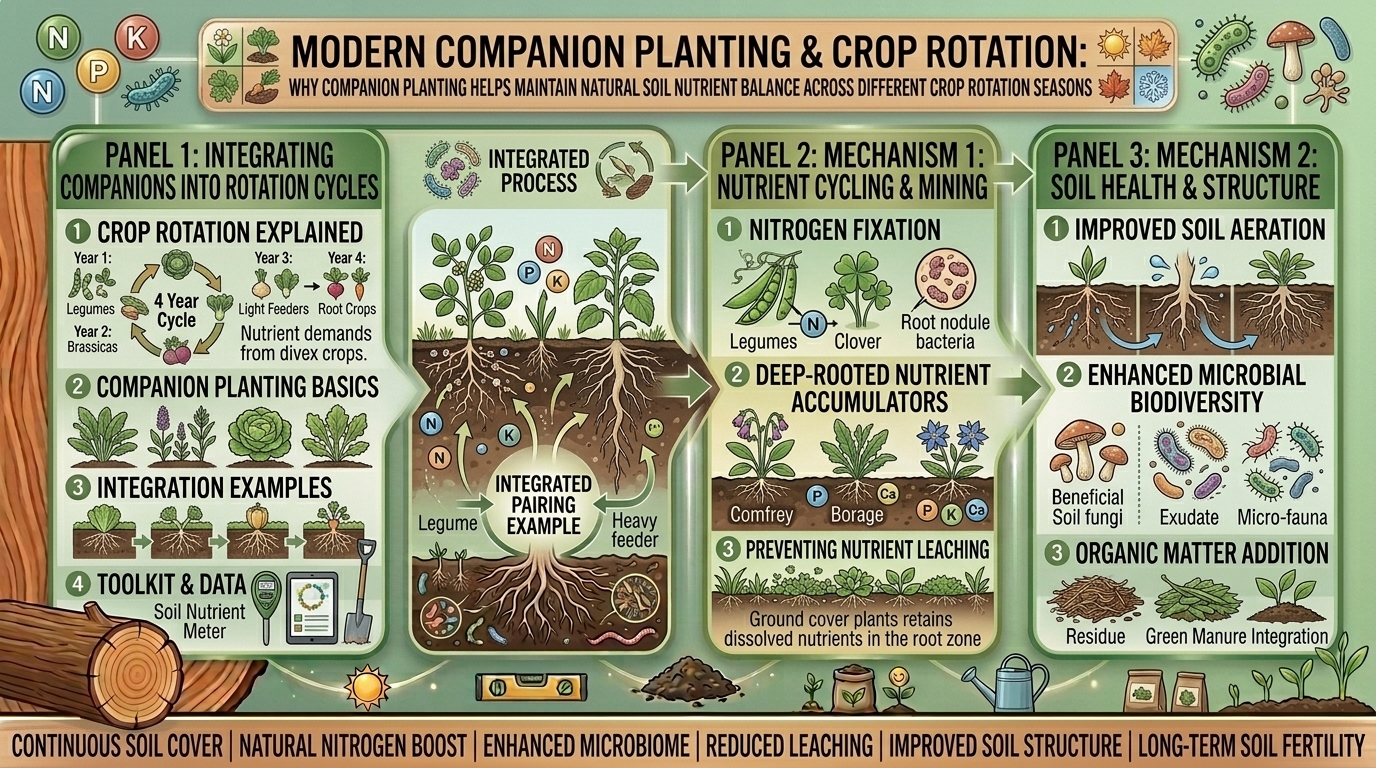
The most famous nutritional partnership in companion planting involves legumes (beans, peas, clover) and heavy nitrogen feeders (corn, brassicas, nightshades).
- The Rhizobia Alliance: Legumes form a symbiotic relationship with soil bacteria called Rhizobia living in their root nodules. These bacteria capture inert atmospheric nitrogen ($N_2$) and convert it into bio-available ammonium ($NH_4^+$).
- The Shared Bounty: While the legume uses what it needs, excess nitrogen leaks into the surrounding soil matrix, naturally feeding neighboring crops without the need for synthetic chemical bags.
Mineral Mining and Root Architecture
Different plants possess radically different root architectures and foraging depths:
- Taproot Miners: Plants like comfrey, dandelion, and daikon radish plunge deep taproots (often several feet down) into the subsoil, mining trace minerals like calcium, potassium, and magnesium that have leached away from the topsoil. When these leaves break down or are used as chop-and-drop mulch, those minerals become available to shallow-rooted crops.
- Fibrous Surface Feeders: Shallow roots weave a dense net in the top few inches of soil, stabilizing topsoil against erosion and absorbing readily available nutrients.
2. Companion Planting Meets Crop Rotation: The Ultimate Synergy
Crop rotation is the practice of shifting plant families to different beds each year to prevent soil depletion and break disease cycles. When you layer companion planting directly into your crop rotation schedule, your soil nutrient balance multiplies.
[ Year 1: Heavy Feeders (Tomatoes/Corn) + Nitrogen Fixers (Beans) ]
                              │
                              ▼
[ Year 2: Root Crops (Carrots/Beets) + Mineral Miners (Alliums) ]
                              │
                              ▼
[ Year 3: Leafy Greens (Lettuce/Cabbage) + Living Mulches (Clover) ]
The 3-Year Rotation Blueprint with Companions
- Phase 1: The Nitrogen Demand (Heavy Feeders & Fixers)
- Crops: Tomatoes, peppers, squash, or corn paired directly with pole beans or bush beans.
- Nutrient Dynamic: Heavy nitrogen consumption is balanced in real-time by the nitrogen-fixing root bacteria of the accompanying legumes.
- Phase 2: The Root & Mineral Phase (Bulbs & Tubers)
- Crops: Carrots, beets, and potatoes paired with alliums (onions, garlic, chives).
- Nutrient Dynamic: Alliums emit natural sulfur compounds through their roots, which deter soil-borne fungal pathogens while requiring moderate potassium rather than heavy nitrogen.
- Phase 3: The Rest & Recovery Phase (Leafy Greens & Living Mulches)
- Crops: Lettuce, spinach, and brassicas interplanted with low-growing crimson clover or sweet alyssum.
- Nutrient Dynamic: This phase allows the soil to rebuild its organic matter, while living mulch roots exude sugars that wake up dormant microbes for the next cycle.
3. Top Companion Plant Partnerships for Soil Health
Here are specific companion pairings engineered to protect and balance soil nutrient levels across growing seasons:
1. The Classic “Three Sisters” (Corn, Beans, and Squash)
- Corn: Acts as a living trellis and heavy nitrogen consumer.
- Beans: Climb the corn stalks while pumping vital nitrogen back into the shared root zone.
- Squash: Spreads massive, prickly leaves across the soil surface, acting as a living mulch that shades the earth, retains moisture, and suppresses nutrient-robbing weeds.
2. Tomatoes, Basil, and Marigolds
- Tomatoes: Heavy feeders that strip phosphorus and potassium.
- Basil: Enhances flavor and attracts beneficial pollinators while releasing aromatic compounds that confuse pests.
- Marigolds: Exude a natural nematicide (alpha-terthienyl) from their roots, sterilizing the soil against destructive root-knot nematodes and protecting the root zones of heavy feeders.
3. Brassicas (Cabbage/Broccoli) and Aromatic Herbs (Dill/Cilantro)
- Brassicas: Require robust soil fertility and heavy sulfur.
- Umbelliferae Herbs: Dill, parsley, and cilantro develop deep root systems that mine distinct trace minerals while drawing in predatory beneficial wasps that control destructive cabbage loopers.
4. Regional Adaptation: Balancing Soils Across U.S. Climates
Regional soils and climate pressures dictate how quickly nutrients cycle and deplete:
California & San Francisco
- Climate Challenge: Mediterranean dry summers and sandy coastal or hard clay soils prone to crusting and nutrient lock-up.
- Companion Strategy: Pair deep-rooting artemisia or dynamic accumulators like comfrey with drought-tolerant Mediterranean herbs. This keeps organic matter cycling and prevents topsoil baking during dry months.
Texas
- Climate Challenge: Intense heat burns through organic matter rapidly, while heavy alkaline clay locks up vital phosphorus and iron.
- Companion Strategy: Utilize warm-season cowpeas and okra as nitrogen-fixing and mineral-mining companions in crop rotation beds to break up dense clay structures naturally.
New York
- Climate Challenge: Humid summers and repetitive intensive vegetable cultivation that quickly strips nitrogen and potassium from suburban garden plots.
- Companion Strategy: Implement cover crop companions like winter rye and hairy vetch in autumn rotation beds to prevent nutrient leaching during heavy spring rains.
Washington State
- Climate Challenge: High seasonal rainfall leaches mobile nutrients deep into the subsoil, leaving garden beds acidic and depleted.
- Companion Strategy: Integrate deep-rooted perennial companions like comfrey and stinging nettle (in controlled zones) to mine leached minerals back to the surface layer.
5. Frequently Asked Questions (FAQ)
1. Does companion planting completely eliminate the need for fertilizers?
While companion planting drastically reduces your reliance on chemical fertilizers by cycling nutrients naturally, heavy-feeding annual crops (like slicing tomatoes or sweet corn) will still eventually draw down stored soil reserves, requiring occasional top-dressings of organic compost.
2. How does crop rotation prevent soil nutrient depletion?
Different plant families have unique nutritional appetites. Growing the same crop in the same spot year after year exhausts specific minerals, whereas rotating families ensures different nutrients are drawn and replenished cyclically.
3. Can companion plants compete with each other for nutrients?
Yes, if planted too densely. Overcrowding companion plants can trigger intense root competition for water and space. Always space companion plants according to their mature root spreads and canopy sizes.
4. What is a “dynamic accumulator” in companion planting?
A dynamic accumulator is a plant with deep taproots (like comfrey or dandelion) that pulls trace minerals up from the subsoil into its leaves. When harvested and laid on the soil as mulch, those minerals enrich the topsoil.
5. Do beans really fix enough nitrogen for neighboring plants?
Yes, but with a catch: most of the nitrogen is stored in the root nodules. To release that nitrogen into the soil for neighboring crops, you should cut the bean plant off at the soil surface at the end of its life cycle rather than pulling the roots out entirely.
6. Can I practice companion planting in raised beds and containers?
Absolutely! Intensive companion planting was practically designed for raised beds and large containers, where space is at a premium and maximizing every square inch of soil fertility is essential.
7. How do marigolds protect soil health?
Beyond deterring surface pests with their scent, marigold roots release biochemical compounds that kill harmful parasitic root-knot nematodes, protecting the root systems of sensitive crops like tomatoes and potatoes.
8. What plant families should never be planted together?
Plants within the same botanical family (e.g., tomatoes and potatoes, or cabbage and broccoli) often share the same diseases and nutritional vulnerabilities, making them poor companions that compete aggressively for identical soil minerals.
9. How many seasons should I wait before replanting the same crop family?
A standard agricultural best practice is a 3-to-4-year rotation cycle, meaning you should not plant members of the same family (like nightshades or brassicas) in the exact same garden bed more than once every four years.
10. Can flowers improve vegetable soil nutrient balance?
Yes! Flowering companion plants (like alyssum, zinnias, and phacelia) attract predatory insects that control pests, while their decaying roots and dropped organic matter feed diverse soil microbes, enhancing overall soil fertility.
Conclusion
Maintaining a natural soil nutrient balance across multiple crop rotation seasons does not require a chemistry degree or bags of synthetic fertilizer. By embracing the time-tested principles of companion planting—pairing nitrogen-fixers with heavy feeders, mineral-miners with shallow root crops, and protectors with vulnerable plants—you build a resilient, self-nourishing ecosystem.