Every gardener eventually reaches a critical juncture in the eternal battle against garden pests. When aphids blanket tender rose buds, Japanese beetles defoliate fruit trees, and stink bugs puncture heirloom tomatoes, the instinctive reaction is often to reach for synthetic chemical sprays. However, broad-spectrum insecticides present a devastating collateral cost: they indiscriminately annihilate beneficial pollinators like honeybees, predatory ladybugs, and parasitic wasps, while driving resistant pest populations to bounce back even stronger.
In the pursuit of a truly balanced, self-regulating ecosystem, organic gardeners are increasingly turning to nature’s most iconic ambush predator: the praying mantis.
Whether you are managing insect pressures in the scorching heat of Texas, navigating damp pest cycles in New York, protecting organic vegetable beds across California, contending with garden pests in Washington, or cultivating urban backyards in San Francisco, introducing praying mantises offers a magnificent, chemical-free biological control method.
This comprehensive masterclass explores the fascinating biology of praying mantises, their predatory mechanics, how to successfully introduce and shelter them in your backyard, and how they drastically reduce destructive insect populations.
The Apex Predator of the Garden: Understanding Praying Mantises
Praying mantises belong to the order Mantodea and are universally recognized for their distinctive posture—front legs folded together as if in quiet prayer. Beneath this serene exterior lies a relentless, highly evolved hunting machine engineered for one purpose: capturing and consuming other insects.
Unlike specialized predators that target only a single species (such as ladybugs that focus primarily on aphids), praying mantises are generalist ambush predators. They are not picky eaters. Their diet encompasses nearly any moving insect that crosses their path, making them a formidable frontline defense against diverse pest outbreaks.
Key Characteristics That Make Mantises Exceptional Hunters:
- The 180-Degree Swiveling Head: Mantises are the only insects capable of turning their triangular heads a full 180 degrees. This binocular vision allows them to track prey movement with surgical precision without shifting their bodies.
- Lightning-Fast Raptor Forelegs: Equipped with rows of sharp spines, a mantis’s front legs can snap outward and capture prey in less than 50 milliseconds—faster than the human eye can blink.
- Cryptic Camouflage: Whether species like the Carolina mantis (Stagmomantis carolina) mimicking green foliage or brown varieties blending into dry twigs, their natural disguise allows them to sit motionless for hours, luring unsuspecting pests within striking distance.
How Mantises Target and Reduce Harmful Garden Pests
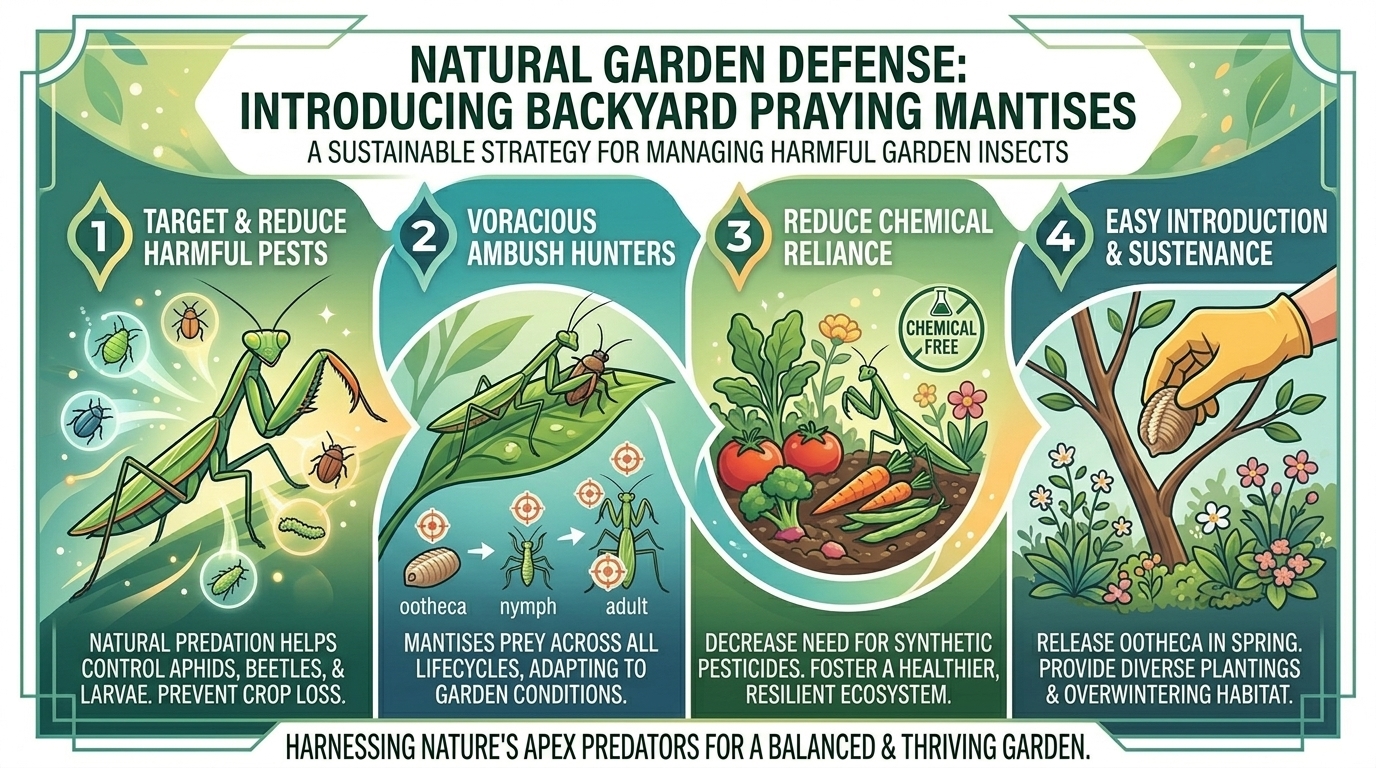
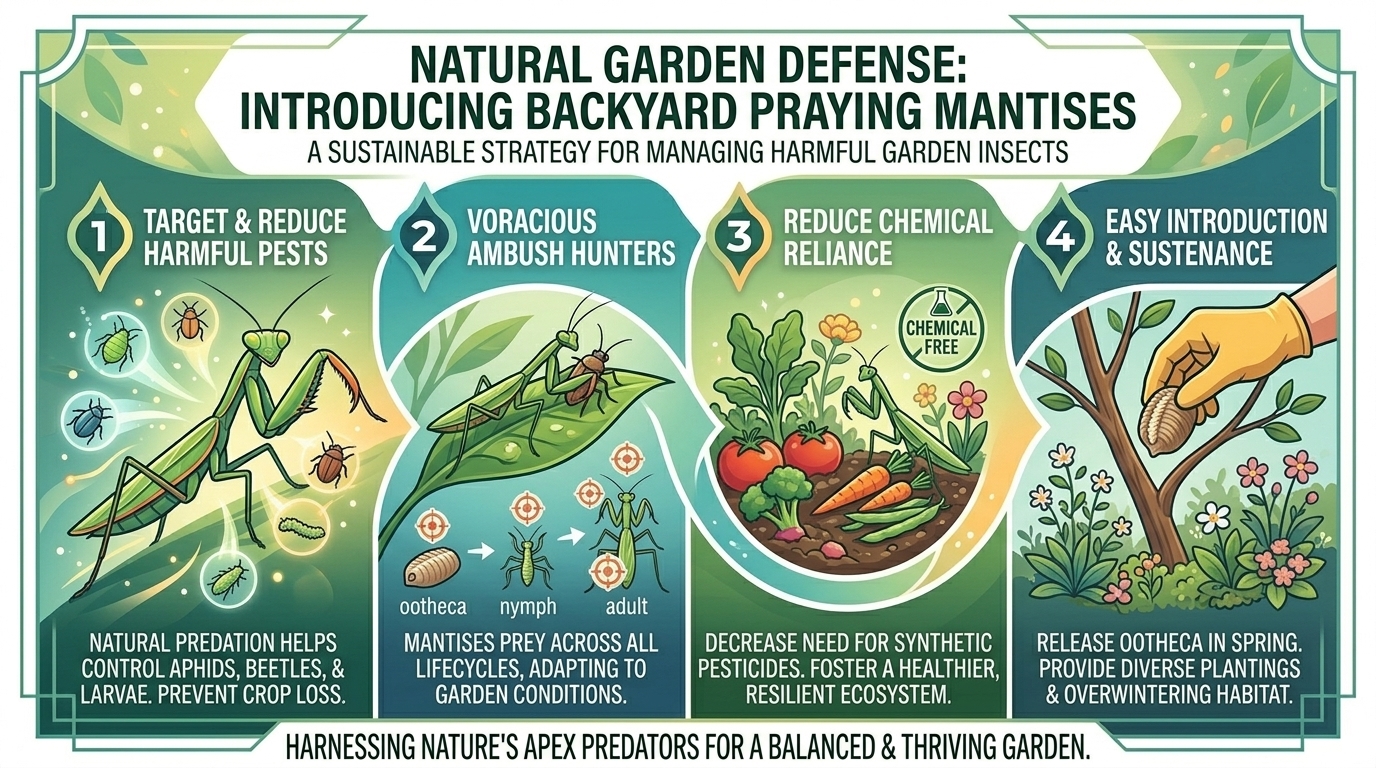
A single mantis consumes dozens of insects throughout its life cycle. When you introduce an ootheca (egg case) or several nymphs into your garden ecosystem, you establish a living biological control unit.
1. Eradicating Soft-Bodied Pests and Hard-Shell Invaders
While younger mantis nymphs focus on smaller pests like aphids, thrips, leafhoppers, and fungus gnats, mature adult mantises scale up their prey size dramatically. A full-grown mantis readily captures and devours:
- Stink Bugs: Notoriously difficult to control with standard organic sprays due to their hard shells.
- Caterpillars and Cutworms: Including hornworms and loopers that devastate nightshade crops.
- Japanese Beetles and Cucumber Beetles: Slow-moving chewers that fall easy victim to an ambush predator.
- Grasshoppers and Locusts: High-speed jumpers that are caught mid-flight or ambushed on stems.
2. Natural Population Regulation
Mantises do not eradicate pests entirely—nor would you want them to, as predators require a steady food source to remain in your yard. Instead, they act as a natural regulatory valve, keeping pest populations below the economic threshold where visible plant damage occurs.
Sourcing, Hatching, and Introducing Mantises to Your Yard
Successfully establishing praying mantises in your backyard requires understanding their life cycle and providing the right environmental conditions.
1. Procuring Mantis Oothecae (Egg Cases)
- What to Look For: In late winter or early spring, you can purchase mantis egg cases (oothecae) online or from reputable local nurseries. Ensure you source native species, such as the Carolina Mantis (Stagmomantis carolina), depending on your region, rather than the non-native Chinese mantis (Tenodera sinensis), which grows excessively large and occasionally preys on hummingbirds and beneficial pollinators.
- Anatomy of an Ootheca: A single frothy, tan, styrofoam-like egg case contains anywhere from 50 to 200 tiny eggs.
2. Strategic Placement and Hatching
- Mounting the Case: Never place an ootheca directly on the ground where moisture and crawling ground predators (like ants or mice) can destroy it. Instead, tie or wire the egg case securely to a sturdy branch, shrub, or trellis roughly 1.5 to 3 feet off the ground in a sunny, protected area.
- The Incubation Window: Depending on spring temperatures, nymphs typically hatch within 3 to 6 weeks (usually aligning with late spring when garden pests begin emerging). When they emerge, hundreds of miniature, thread-like nymphs will disperse rapidly in search of food.
Creating a Mantis-Friendly Backyard Habitat
Praying mantises will only stay in your yard if they find adequate food, water, and shelter. If your garden is completely sterile or heavily treated with synthetic pesticides, hungry mantises will migrate elsewhere.
| Habitat Requirement | Actionable Recommendation | Purpose |
| Pesticide-Free Zone | Strictly avoid synthetic insecticides, neonicotinoids, and broad-spectrum sprays | Prevents secondary poisoning and preserves mantis prey |
| Structural Cover | Plant dense shrubs, ornamental grasses, and tall perennial flowers | Provides safe ambush sites and protection from avian predators (birds) |
| Moisture Access | Maintain shallow water sources or rely on morning dew trapped on leaves | Keeps mantises hydrated during hot summer dry spells |
| Pollinator Corridors | Plant umbelliferous flowers (dill, fennel, yarrow) and native blooms | Attracts a diverse buffet of flying insect prey to your garden beds |
Regional Considerations for Raising Praying Mantises
Environmental factors dictate how mantises thrive across different geographic zones:
- Texas: Intense summer heat requires providing shaded canopy cover during peak afternoon hours. Mantises thrive across Texas gardens, helping suppress aggressive summer pest booms like grasshoppers and stink bugs.
- New York and the Northeast: Winter freezes protect native oothecae, which naturally diapause until spring. Mount your purchased egg cases after the last hard frost passes to ensure peak survival rates for newly hatched nymphs.
- California: Mild Mediterranean climates allow mantises to remain active well into late autumn. Ensure drip irrigation zones provide enough lush foliage to attract aphids and leafhoppers for growing nymphs.
- Washington and the Pacific Northwest: Cool, damp springs mean hatching may occur slightly later. Secure egg cases in south-facing garden corners where early morning sunlight accelerates incubation.
- San Francisco: Urban microclimates can experience chilly summer winds. Position mantis egg cases in sheltered courtyard gardens or sunny patio planters protected from heavy ocean gusts.
Troubleshooting Common Mantis Introduction Issues
- Issue: All the mantis nymphs hatched, but they vanished within 48 hours.
- Solution: Newly hatched nymphs are tiny and extremely vulnerable to starvation or predation by ants, spiders, and birds. Ensure you hatch them directly inside a dense patch of aphid-infested foliage so they have an immediate food source.
- Issue: I notice adult mantises eating honeybees and beneficial pollinators.
- Solution: While mantises are generalist predators, you can minimize beneficial pollinator loss by planting dense, high-volume pollinator flowers elsewhere in the yard, drawing bees away from primary mantis ambush zones.
- Issue: Mantises laid egg cases in the fall, but none hatched in the spring.
- Solution: The egg cases may have experienced extreme winter dampness or were accidentally brought indoors where warm heating tricked them into hatching prematurely. Always leave oothecae outdoors attached to garden branches through winter.
Frequently Asked Questions (FAQ)
1. Do praying mantises really help control garden pests?
Yes. As generalist ambush predators, praying mantises consume large quantities of destructive garden insects, including aphids, caterpillars, stink bugs, beetles, and leafhoppers, keeping pest populations naturally regulated.
2. Will praying mantises eat beneficial insects like ladybugs and bees?
Occasionally, yes. Because mantises are non-selective predators, they will consume beneficial insects if they wander into striking range. However, their net impact remains overwhelmingly positive for overall garden health.
3. How many praying mantises should I introduce to my backyard?
As a general rule, one ootheca (egg case) per 500 to 1,000 square feet of garden space is sufficient. Because hundreds of nymphs hatch from a single case, natural cannibalism and dispersal will naturally balance the population.
4. Are praying mantises harmful to humans or pets?
No. Praying mantises are completely harmless to humans and domestic pets. They do not possess venom, and while a large adult might give a tiny pinch with its raptorial legs if mishandled, it cannot break human skin.
5. What is the difference between native and non-native mantis species?
Native species (like the Carolina mantis) coexist harmoniously within local ecosystems. Non-native species (like the large Chinese mantis) grow up to 5 inches long and are powerful enough to occasionally capture hummingbirds and large pollinators. Whenever possible, source native species.
6. Where should I place a mantis egg case in my garden?
Mount the egg case securely to a sturdy branch, twig, or plant stem 1.5 to 3 feet off the ground in a sunny location near pest-prone crops (like tomatoes, peppers, or roses). Never place it directly on the soil.
7. What do baby praying mantises eat after hatching?
Newly hatched nymphs (nymphs) feed on microscopic pests like aphids, thrips, fruit flies, and gnats. As they molt and grow larger, they graduate to bigger prey like beetles, grasshoppers, and caterpillars.
8. How do praying mantises survive the winter?
Adult mantises die off with the first hard autumn frost after laying their frothy egg cases (oothecae). The eggs overwinter safely inside the hardened foam case, waiting for spring warmth to hatch the next generation.
9. Can I keep praying mantises indoors as pets?
Yes, mantises can be kept in screen enclosures indoors and fed flightless fruit flies or crickets, but their primary ecological value is realized when deployed as free-roaming guardians in an outdoor organic garden.
10. Where can I find more expert organic pest control tips and gardening guides?
For comprehensive horticultural advice, regional planting strategies, and expert plant care tips tailored to your backyard, visit kcplants.com.
Conclusion
Introducing praying mantises into your backyard is one of the most rewarding steps you can take toward establishing a thriving, self-sustaining organic ecosystem. By harnessing the predatory power of these remarkable insects, you replace toxic chemical sprays with natural biological control, safeguarding your vegetables, flowers, and beneficial pollinators alike. Whether you are managing pest pressures in urban San Francisco or sprawling suburban gardens in Texas, inviting praying mantises into your landscape ensures a balanced, flourishing garden all season long.