Why Maintaining Proper Mulch Depth Around Landscape Trees Protects Root Collars from Damage
Stepping back to admire your freshly landscaped yard, there is nothing quite as satisfying as seeing neat, dark, freshly laid rings of mulch encircling the base of your mature trees. It pulls a landscape design together, suppresses weeds, retains vital soil moisture, and gives your property a crisp, professional finish.
However, a dangerous landscaping epidemic is silently destroying millions of shade and ornamental trees across suburban developments, urban streetscapes, and residential backyards: volcano mulching.
Piling wood chips several feet deep directly against the trunk of a tree—resembling an active volcanic cone—is one of the most destructive maintenance errors a property owner can commit. Far from helping the tree, excessive mulch depth suffocates the vital transition zone where trunk meets root, triggering a slow, agonizing decline.
Whether you are managing moisture retention in Washington State, dealing with summer drought stress in Texas, maintaining urban trees in San Francisco, or managing seasonal landscapes across New York and California, this comprehensive guide explores the structural biology of tree root collars, why proper mulch depth is essential for tree survival, and how to mulch correctly for your website, kcplants.com.
1. Anatomy 101: Understanding the Root Collar and Flare
To understand why mulch depth matters, you must first understand the foundational anatomy of a tree.
[ Tree Base Structure ]
       │
       ├──> Trunk (Above Ground Aerial Support)
       │
       ├──> Root Flare / Root Collar (Critical Air-Exchange Zone)
       │
       └──> Structural Lateral Roots (Subterranean Anchorage)
The Root Flare (The Anchor)
The root flare (or root collar) is the wide, flared base where the vertical trunk transitions outward into massive structural lateral roots. This biological junction is structurally engineered to support the physical weight of the tree against heavy winds and storms.
The Biological Need for Oxygen
Unlike deep structural roots that anchor a tree underground, the tissues in and around the root collar are uniquely adapted to ambient air exposure.
- Gas Exchange: The bark and cambium layers at the root flare require a constant, unimpeded exchange of oxygen and carbon dioxide with the atmosphere.
- The Danger of Suffocation: When organic mulch is piled high against this zone, it seals off the bark from oxygen, trapping moisture directly against living tissues and inviting decay.
2. The Dangers of Volcano Mulching: What Happens When Mulch is Too Deep?
Piling mulch against a tree trunk is not just harmless over-mulching; it actively initiates a cascade of destructive biological failures.
1. Rot and Pathogen Invasion
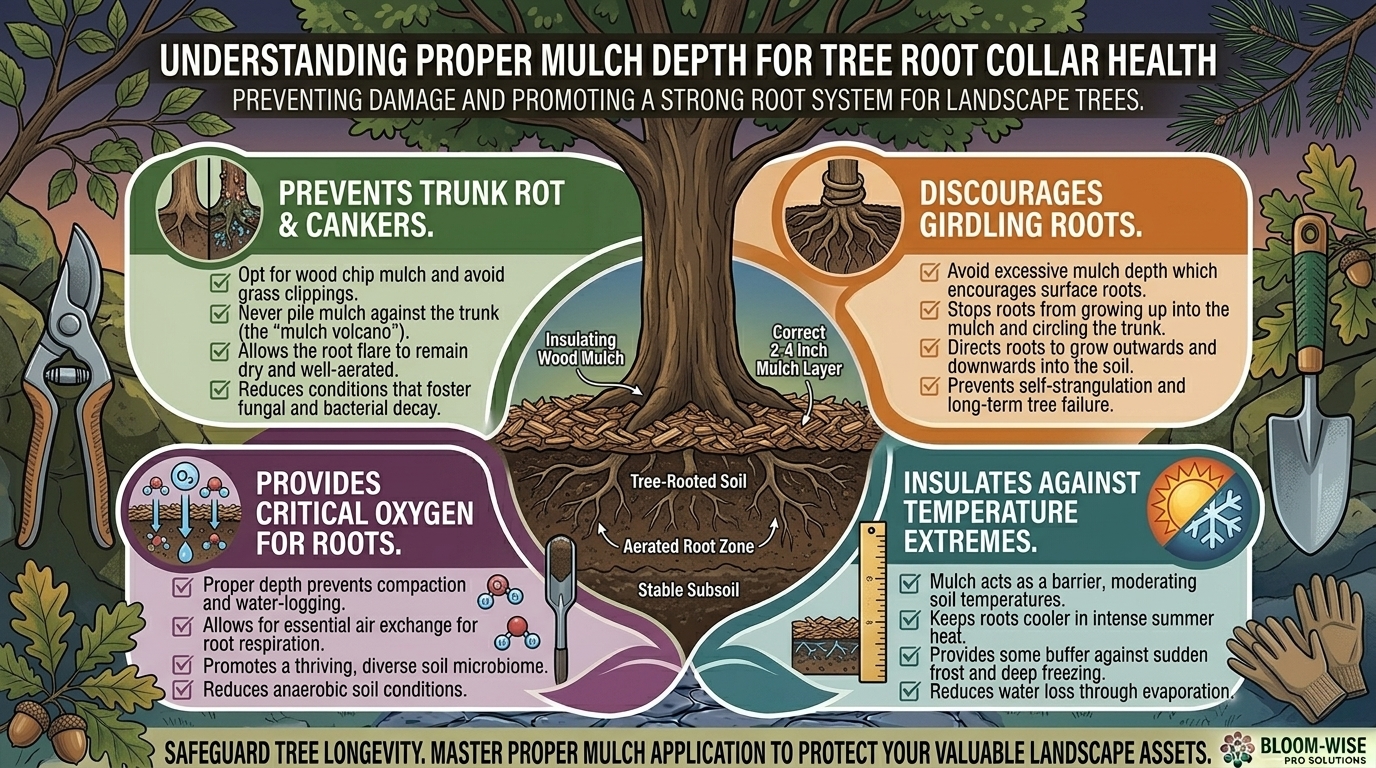
Moist wood chips piled against tree bark create a warm, humid incubation chamber. This constant moisture softens the outer bark, allowing soil-borne fungi, wood-decaying organisms, and bacterial pathogens to penetrate the cambium layer. This leads to collar rot, girdling the tree and cutting off the flow of nutrients and water between roots and canopy.
2. Adventitious Root Girdling
When mulch covers the lower trunk, the bark responds to the darkness and moisture by producing adventitious (surface) roots that grow directly into the loose mulch layer instead of downward into the soil.
- As these encircling roots grow larger, they wrap tightly around the main trunk like a strangling cord, eventually girdling the tree, choking off its vascular system, and causing crown dieback or sudden wind-throw failure.
3. Pest and Rodent Infestations
Deep, damp mulch volcanoes act as luxury resort housing for rodents (such as voles and mice) and destructive insects. Voles chew away the tender bark around the root collar during winter months, completely ring-barking and killing mature trees.
3. The Golden Rules of Proper Mulch Depth
Protecting your landscape trees requires adhering strictly to professional arborist standards regarding mulch depth and placement.
[ The 3-3-3 Mulch Rule ]
       │
       ├──> Depth: Maintain a 2 to 3-Inch Layer Maximum
       │
       ├──> Clearance: Leave 3 to 6 Inches of Clear Space Around the Trunk
       │
       └──> Spread: Extend Mulch Out to the Drip Line (Radius)
1. The 2-to-3-Inch Depth Rule
Apply organic mulch (such as shredded hardwood bark, aged wood chips, or pine straw) at a uniform depth of 2 to 3 inches. This thickness is deep enough to suppress weed germination and retain soil moisture, but thin enough to allow proper gas exchange and water penetration.
2. The “Donut,” Not the “Volcano”
Never let mulch touch the trunk. Maintain a 3-to-6-inch clearance ring of bare soil or exposed root flare between the edge of the mulch bed and the trunk of the tree. The finished bed should resemble a flat-topped donut or saucer, with the root flare fully visible to the open air.
3. Extend to the Drip Line
Instead of piling mulch high in a tiny 12-inch ring around the trunk, spread your 3-inch layer outward in a wide circle extending all the way to the tree’s drip line (the outer perimeter of the branch canopy) or beyond. This covers the active absorptive feeder roots where nutrients and water are actually taken up.
4. Regional Considerations for Mulch Management Across the U.S.
Regional environmental conditions influence how mulch interacts with soil moisture, temperature, and tree health:
Washington State & Pacific Northwest
- Climate Challenge: High annual rainfall and damp winters mean excessive mulch depth creates a permanent moisture trap around tree trunks, rapidly accelerating collar rot and fungal decay.
- Management Strategy: Keep mulch layers thin (strictly 2 inches) and pull mulch back aggressively from tree bases during wet autumn and winter months to let root collars breathe.
New York & Northeast
- Climate Challenge: Freeze-thaw cycles and winter snow cover cause deep mulch rings to retain heavy moisture, inviting voles to tunnel against frozen tree bark.
- Management Strategy: Rake mulch back from tree trunks every autumn to create a clear 6-inch stone or bare-earth buffer zone that deters rodent nesting and trunk chewing.
Texas
- Climate Challenge: Blistering summer heat and dry winds cause thin mulch layers to dry out rapidly, threatening root hydration.
- Management Strategy: Maintain a full 3-inch mulch layer extending out to the drip line to insulate soil temperatures and conserve precious irrigation moisture, while strictly keeping mulch clear of the root flare.
California & San Francisco
- Climate Challenge: Mediterranean dry seasons alternate with urban irrigation needs, making efficient moisture retention critical without waterlogging urban street trees.
- Management Strategy: Apply coarse, well-aerated wood chips in wide, shallow basins around street and yard trees to catch irrigation water while exposing the root collar to dry urban air.
5. Frequently Asked Questions (FAQ)
1. What is “volcano mulching,” and why is it bad?
Volcano mulching is the improper practice of piling mulch high up the sides of a tree trunk like a volcano. It is bad because it traps moisture against the bark, invites wood-rotting fungi, encourages girdling roots, and cuts off vital oxygen exchange to the root collar.
2. How far away from the tree trunk should mulch be kept?
You should maintain a clear ring of 3 to 6 inches of open space between the tree trunk and the beginning of the mulch bed, ensuring the natural root flare remains completely visible and exposed to the air.
3. What is the ideal mulch depth for landscape trees?
The ideal mulch depth is 2 to 3 inches. Anything less fails to suppress weeds effectively; anything more than 4 inches restricts oxygen flow to the soil and root systems.
4. Can deep mulch cause a tree to rot?
Yes. Piling mulch against the bark creates a humid, anaerobic micro-environment that softens wood tissue, encouraging fungal pathogens and collar rot to consume the lower trunk.
5. What are “girdling roots,” and how does mulch cause them?
Girdling roots are lateral roots that circle around the main trunk instead of growing outward. When mulch is piled against the trunk, it stimulates adventitious root growth in the loose organic matter, which can wrap around and strangle the tree’s vascular system.
6. Is rubber mulch safe to use around landscape trees?
Rubber mulch (made from shredded recycled tires) is generally discouraged around trees. It does not break down to enrich the soil, it leaches chemicals into the root zone during hot weather, and it creates an impermeable barrier that alters soil temperature extremes. Organic wood chips are always superior.
7. How do I fix a tree that has been volcano mulched for years?
Carefully pull back the excess mulch using a garden rake or trowel until you expose the buried root flare and structural root junctions. Inspect the bark for signs of rot or girdling roots. Leave the root flare permanently exposed to the air.
8. Does mulch thickness affect soil watering?
Yes. If mulch is applied thicker than 4 inches, it can become tightly matted, acting like an umbrella that sheds rainwater and prevents moisture from penetrating down into the root zone. A 2-to-3-inch loose layer allows water to pass through freely while reducing evaporation.
9. Should I remove old mulch before adding new mulch each year?
You do not need to remove all old mulch if it has decomposed into rich humus. However, you should rake it smooth, check that the root flare is still clear, and only add enough fresh material to top it back up to the 2-to-3-inch mark. Never pile new mulch directly on top of an already thick layer.
10. Do all tree species react the same way to deep mulch?
While almost all trees suffer from root collar suffocation, thin-barked trees (such as maples, beeches, and fruit trees) are especially vulnerable to rapid bark decay and collar rot when subjected to volcano mulching.
Conclusion
Maintaining proper mulch depth around your landscape trees is one of the most impactful, low-cost maintenance practices you can perform to ensure long-term tree health. By abandoning the destructive habit of volcano mulching, keeping mulch layers at a healthy 2 to 3 inches, and exposing the vital root flare to open air, you protect your trees from rot, girdling roots, and premature decline.